At some point in late May, a lot of AI budget spreadsheets quietly became obsolete.
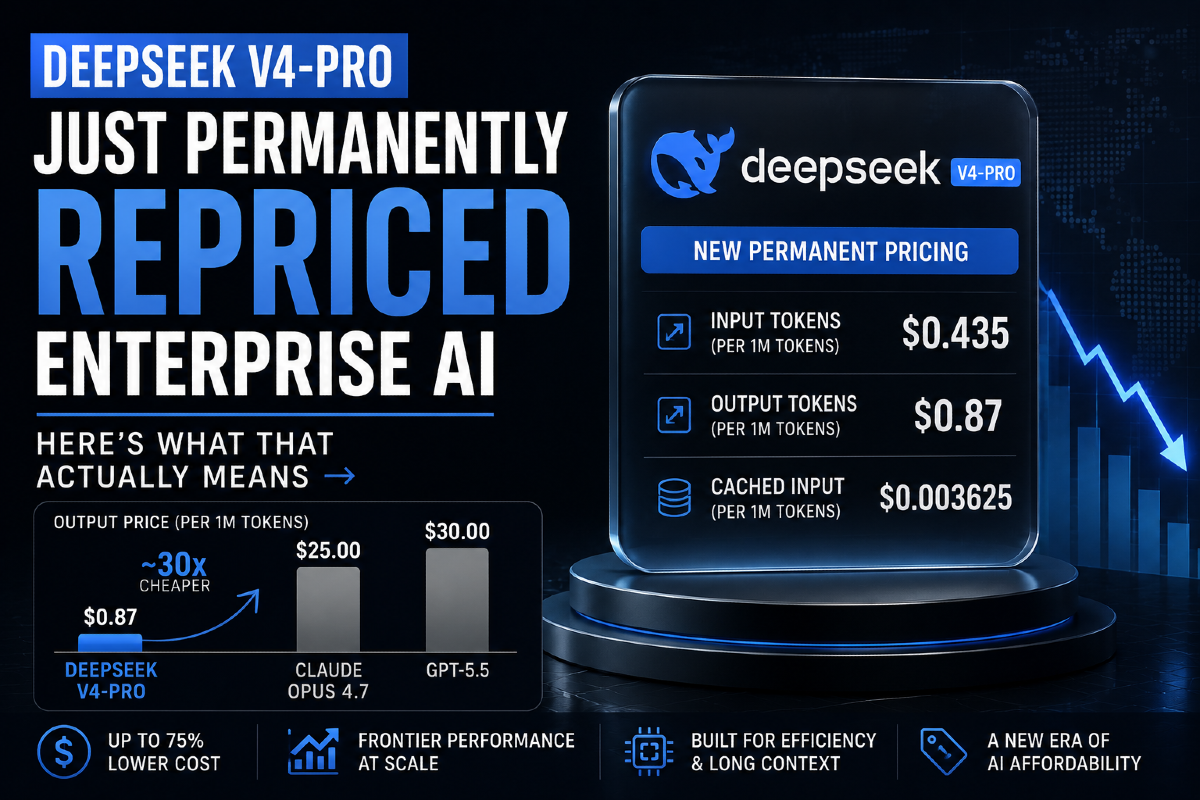
On May 22, 2026, DeepSeek announced that the 75% discount it had been running on its V4-Pro API — originally scheduled to expire on May 31 — was now permanent. What had been framed as a promotional period became the new standard pricing. V4-Pro output tokens now cost $0.87 per million. Input tokens cost $0.435 per million. Cached input hits $0.003625 per million, the lowest first-party frontier-model cache price on the market.
For casual observers, those numbers are easy to dismiss as just another AI pricing announcement in a year full of them. For anyone running AI workloads at scale, the implications are harder to ignore.
What Changed and Why It Matters
V4-Pro launched on April 24, 2026, with a list price of $1.74 per million input tokens and $3.48 per million output tokens. DeepSeek immediately offered a 75% promotional discount and extended it once before announcing on May 22 that the discounted rate would simply become the permanent one. The crossed-out original prices still appear on DeepSeek's pricing page — a visible reminder of how much the floor dropped.
The distinction between "a discount that expires" and "a discount that doesn't" matters more than it sounds. Promotional pricing is a marketing event. Permanent pricing is a market floor. Every lab that wants to compete for the same enterprise workloads now has to answer to these numbers.
A separate change, effective April 26, cut cache hit prices across DeepSeek's entire API suite to one-tenth of their original levels. That change is arguably the bigger deal for production agentic applications, where repeated or structurally similar requests are routine. Heavy retrieval workloads can now run well under $50 per month at meaningful scale.
V4-Pro was also engineered with cost efficiency as a design goal. According to Sanchit Vir Gogia, chief analyst and CEO at Greyhound Research, the model runs at roughly a quarter of the single-token compute and a tenth of the memory footprint of its predecessor at very long context. The price cut is permanent because the underlying efficiency gain is permanent — it's not a subsidy, it's an engineering outcome being passed through to customers.
The Actual Numbers Against Western Flagship Models
Here's where the pricing story gets concrete. At $0.87 per million output tokens, DeepSeek V4-Pro sits at a significant discount compared to the Western frontier.
| Model | Input ($/M tokens) | Output ($/M tokens) | Output vs V4-Pro |
|---|---|---|---|
| DeepSeek V4-Pro | $0.435 | $0.87 | — |
| Claude Opus 4.7 | $5.00 | $25.00 | ~29x more expensive |
| GPT-5.5 | $5.00 | $30.00 | ~34.5x more expensive |
| DeepSeek V4-Flash | $0.14 | $0.28 | 3x cheaper than V4-Pro |
To put that in budget terms: a workload consuming 1 billion tokens per month — 800 million input (cache miss) plus 200 million output — costs around $522 on V4-Pro. The same workload on Claude Opus 4.7 runs roughly $9,000. On GPT-5.5, it's closer to $10,000. That's not a marginal difference. It's the kind of gap that changes whether a product is viable at all.
Batch processing and prompt caching can compress costs further on all three platforms, but the starting gap is wide enough that V4-Pro maintains a substantial lead even after applying Anthropic's or OpenAI's available discounts.
Where V4-Pro Actually Stands on Benchmarks
The pricing argument only works if the model is genuinely competitive. So how does V4-Pro perform?
On SWE-bench Pro, the benchmark tracking real-world GitHub issue resolution, Claude Opus 4.7 leads at 64.3%, GPT-5.5 follows at 58.6%, and DeepSeek V4-Pro lands at 55.4%. A meaningful gap, but not a disqualifying one for most engineering workflows. On GPQA Diamond, a graduate-level reasoning benchmark, GPT-5.5 scores 93.6% versus V4-Pro's 90.1% — a 3.5-point spread. On BrowseComp, the agentic web research benchmark, V4-Pro actually beats Claude Opus 4.7 by 4 points.
The clearest weakness is Terminal-Bench 2.0, which tests complex command-line workflows requiring sustained planning and tool coordination. GPT-5.5 leads that benchmark at 82.7%, with V4-Pro at 67.9%. For teams running heavy command-line agentic work where every tool call matters, that 14.8-point gap is real.
The honest summary: V4-Pro is not the best model at anything except price. But it's within striking distance on most benchmarks that matter for typical production workloads. A NIST evaluation (CAISI, May 2026) found that V4-Pro "performs similarly to GPT-5, which was released about eight months ago" — which means it trails the absolute frontier by roughly one model generation. For the majority of production applications, that gap doesn't matter. For tasks demanding state-of-the-art reasoning, it does.
What This Does to Enterprise Budget Planning
The more interesting effect of DeepSeek's pricing isn't necessarily on companies that switch to it. It's on the companies that don't.
Enterprise procurement teams now have a reference price to bring into every contract negotiation with AI vendors. Even organizations that never deploy DeepSeek can use V4-Pro's pricing as a bargaining chip when renewing agreements with OpenAI, Anthropic, or Google. The permanent price cut establishes a floor that the entire market has to acknowledge.
More concretely, it changes what's financially viable to build. When frontier-level reasoning costs $0.87 per million output tokens rather than $25-$30, the question shifts from "can we afford to run this agent?" to "how do we architect it well?" Workloads that were economically borderline on Western flagship models — high-frequency document processing, long-running reasoning chains, large-scale batch analysis — become straightforwardly viable on V4-Pro.
The multi-model routing strategy that was previously a cost optimization tip becomes more or less mandatory. Industry analysts are now describing a pattern where premium Western models handle high-stakes or compliance-sensitive work, V4-Pro or V4-Flash handle high-volume tasks where cost dominates quality, and an orchestration layer routes traffic based on task complexity and risk level.
The Risks You Shouldn't Ignore
The pricing argument for V4-Pro is real. The risks are also real, and underselling them would be dishonest.
Data sovereignty. When you call api.deepseek.com, your prompts, documents, embeddings, and logs cross into Chinese jurisdiction. DeepSeek's privacy policy states that user data is stored on servers in China. Under China's 2017 National Intelligence Law, organizations there can be required to support state intelligence work and provide data on request, with no obligation to notify users. That's a structural difference from US providers where a data request generally requires a court order. For any workload involving PII, PHI, financial data, proprietary IP, or customer information, the hosted API is not the right tool without strict controls in place.
Regulatory uncertainty. US lawmakers escalated calls in April 2026 to add DeepSeek to the Commerce Department's Entity List. No listing has been finalized as of this writing, but enterprise teams should plan against that scenario rather than assuming the current state is permanent. An Entity List designation would block API access overnight for US persons and entities.
Security track record. In January 2025, Wiz Research found two DeepSeek ClickHouse databases left publicly exposed without authentication, leaking over a million log entries including plaintext chat history and API keys. Separate research found hidden code in DeepSeek's mobile apps transmitting user data to China Mobile. These aren't ancient history. They're part of the operational risk profile.
Ecosystem maturity. Neil Shah at Counterpoint Research puts it clearly: V4-Pro's limitations aren't in raw intelligence. They're in "broader ecosystem adoption, global support structures, clear IP provenance, and the deep hyperscaler integrations natively offered by AWS, Microsoft, and Google." If your stack is deeply integrated with Azure OpenAI, GCP Vertex, or Bedrock, the switching cost is real.
The good news is that DeepSeek's open weights under MIT license offer a genuine alternative path. You can download V4-Pro weights, run them on your own infrastructure, and keep your data entirely off DeepSeek's servers. That eliminates the data sovereignty concern at the cost of meaningful GPU infrastructure investment — you're looking at 16+ H100s for production-class throughput at full V4-Pro scale.
Practical Guidance for Teams Evaluating This Now
A few things worth considering before making any migration decisions:
Run your actual workloads. Benchmark scores are a starting point, not a verdict. The Terminal-Bench 2.0 gap matters a lot for complex command-line agentic work and much less for document summarization or classification. Run a controlled A/B on your real task mix before drawing conclusions.
Classify your data before your models. Any workload involving sensitive data should stay on providers with clear data residency and compliance guarantees. V4-Pro via the hosted API is appropriate for tasks involving non-sensitive data — internal tooling, public data processing, development and testing. It's not appropriate for anything touching regulated or proprietary information.
Update your model IDs before July 24, 2026. The legacy aliases deepseek-chat and deepseek-reasoner are being deprecated. Anything calling those endpoints needs to be updated to deepseek-v4-pro or deepseek-v4-flash before that date. No grace period, no silent fallback.
Plan a rollback path. If you're moving any production traffic to V4-Pro, have a tested fallback to another model that can be activated quickly. Geopolitical conditions can change faster than deployment cycles.
Don't over-assign to V4-Pro either. V4-Flash at $0.14 input / $0.28 output handles classification, routing, extraction, and simpler agent subtasks well at a fraction of V4-Pro's cost. A well-structured routing layer that sends 60-70% of traffic to V4-Flash and escalates to V4-Pro or Claude Sonnet for harder tasks can reduce costs substantially compared to a single-model approach on either provider.
The Bigger Picture
DeepSeek's pricing move didn't happen in isolation. OpenAI dropped o3 pricing 80% earlier in 2026. Kimi K2 repriced aggressively. The 2026 LLM market is in a clear margin compression phase, and V4-Pro's permanent cut is the most aggressive example because it targets the frontier capability band, not the budget tier.
The pricing war isn't slowing down. If anything, DeepSeek making this discount permanent signals that aggressive pricing is the strategy, not a short-term play. DeepSeek has said explicitly that prices will fall further as Huawei Ascend 950 supernodes come online in larger numbers in the second half of 2026.
For developers and engineering leaders, the practical implication is straightforward: frontier-level reasoning is no longer exclusively priced for frontier budgets. That changes what you can build, what you can afford to run, and how you negotiate with every AI vendor you work with. The rest of the market is going to respond — they just haven't yet.