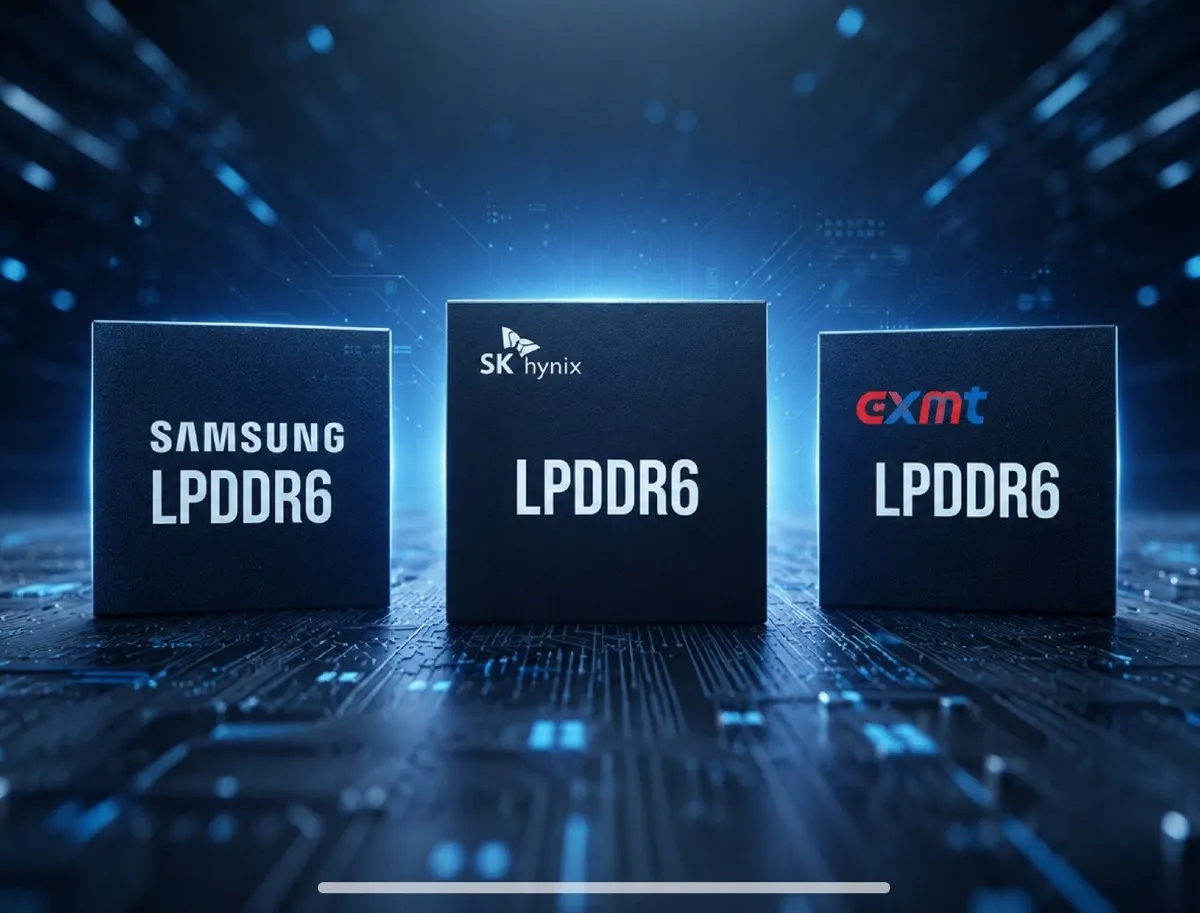
China's memory industry has been closing the gap on Samsung and SK hynix faster than most analysts expected. The latest signal: CXMT, now the world's fourth-largest DRAM manufacturer, has reportedly begun sampling its first LPDDR6 memory chips and is targeting mass production in the second half of 2026.
For a company that held a negligible share of the global DRAM market just a few years ago, an 8% market share and a next-generation product in sampling is a significant inflection point — and the customer list makes it impossible to dismiss.
What CXMT's LPDDR6 Actually Delivers
The new chips are reported to hit speeds of up to 12.8 Gbps — a meaningful step up from current LPDDR5X silicon. CXMT is also upgrading its chip packaging technology to support the new memory standard, which suggests the company isn't just producing a nominal product; it's investing in the manufacturing infrastructure to compete at scale.
LPDDR6 is the next frontier for mobile memory, and the timeline matters: Samsung and SK hynix are expected to supply LPDDR6 to the first wave of compatible smartphones in 2027. CXMT's own devices will likely follow later as production ramps and supply chains expand — but the fact that sampling has already started puts it closer to commercial readiness than many in the industry assumed.
The Customer List Is the Real Story
CXMT already supplies memory to Huawei, Xiaomi, OPPO, Alibaba Cloud, and Tencent Cloud — a roster that spans handsets, hyperscale cloud, and consumer electronics. That's not a niche supplier filling gaps; that's a company embedded in the core supply chains of China's biggest tech names.
The more consequential detail in the reports, though, is Apple. Sources claim Apple is testing CXMT's memory, though no confirmation has emerged that the chips have passed Apple's qualification process. Apple's memory supply chain has historically been dominated by Samsung and SK hynix, and its qualification bar is extraordinarily high. Testing is not adoption — but the fact that testing is reportedly happening at all signals that Apple is at minimum exploring its options.
Whether that reflects genuine supply chain diversification strategy, negotiation leverage against existing suppliers, or something more concrete remains unclear. Apple hasn't commented.
Context: How Quickly CXMT Got Here
CXMT's rise has been fast by semiconductor standards. The company now holds roughly 8% of the global DRAM market — a number that would have seemed implausible five years ago, when Chinese DRAM production was essentially nonexistent at scale. That share still trails Samsung and SK hynix by a wide margin, but the trajectory is what matters.
China's broader push toward semiconductor self-sufficiency has accelerated dramatically under export control pressure. The same dynamic that pushed DeepSeek to train frontier models on Huawei's Ascend processors — rather than Nvidia silicon — is pushing memory producers like CXMT to move faster. Necessity has become the accelerant.
For context on just how intertwined China's AI and chip strategies have become, it's worth noting that DeepSeek V4 is now running entirely on Huawei Ascend processors — a development that would have seemed far-fetched even eighteen months ago. The memory supply chain is following a parallel track.
What the LPDDR6 Timeline Means for the Market
The competitive picture for LPDDR6 is shaping up as follows: Samsung and SK hynix supply the first wave of devices in 2027, with CXMT entering later in the ramp. That's still a meaningful lag — but it's a lag measured in months or quarters, not years.
The implications extend beyond China's domestic market. If CXMT can qualify its LPDDR6 with customers like Apple — or even sustain its position with Huawei and Xiaomi through the transition — it will have established itself as a credible alternative supplier at the leading edge of mobile memory. That's a structural shift in an industry that has been effectively a two-player race for most of its history.
There's also a pricing dimension. Competition from a third credible DRAM supplier at the high end would put downward pressure on memory prices — a dynamic that smartphone OEMs and cloud hyperscalers would welcome, even if Samsung and SK hynix would not.
What to Watch
The immediate milestones worth tracking are straightforward: whether CXMT hits its H2 2026 mass production target, whether Apple's testing converts into qualification, and whether the company's packaging technology can keep pace with the speeds its chips are rated for. LPDDR6 at 12.8 Gbps sets a high bar for signal integrity and thermal management — areas where CXMT's production experience at this node is still limited.
China's memory industry is no longer catching up on yesterday's technology. With LPDDR6 sampling underway, it's starting to compete on the same generation as the market leaders — just slightly behind the wave, and closing.