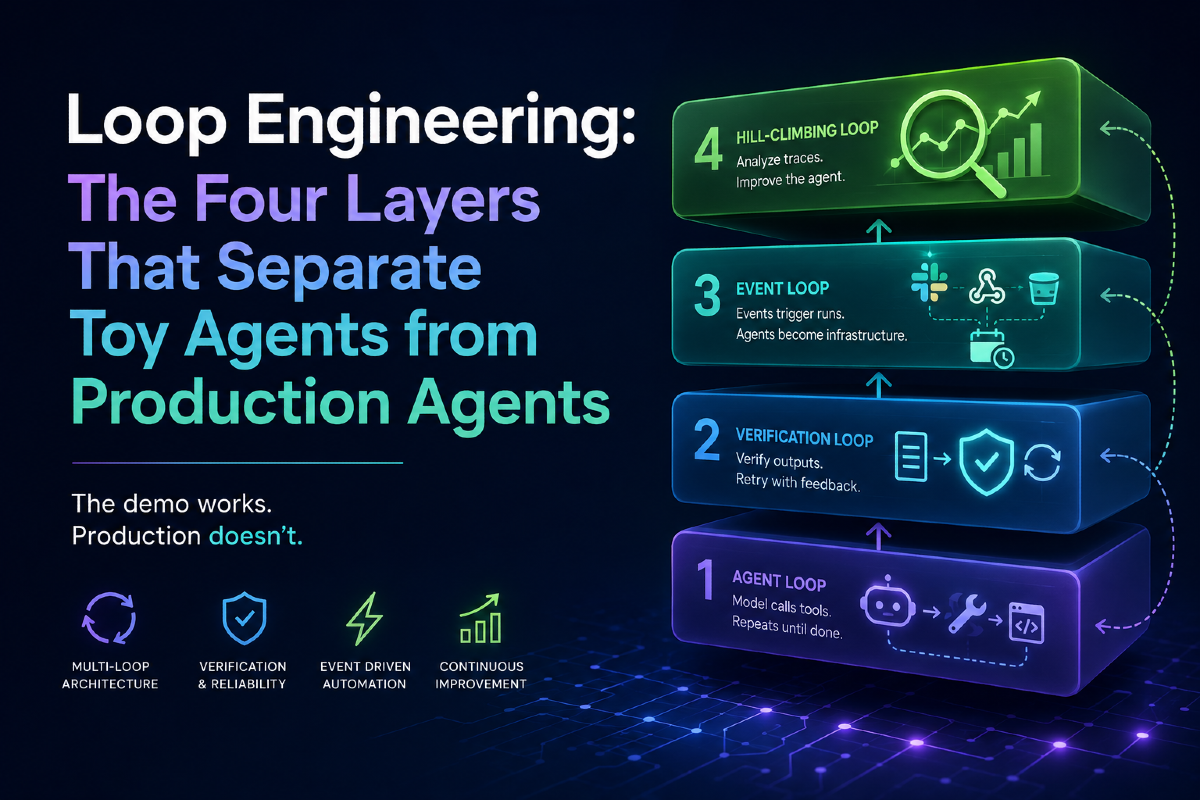
Prompt engineering was a genuine skill shift. It forced practitioners to think clearly about inputs, constraints, and desired outputs. Loop engineering extended that — AI models could now iterate on their own work, refining outputs through repeated passes. But neither framework scales to the kind of complex, multi-stage work that actually drives business value.
Graph engineering does. And the builders who understand it are already architecting systems that leave single-agent workflows behind.
Why Linear AI Hits a Ceiling
Most AI usage still follows a simple pattern: you provide input, the model reasons, it responds. For narrow tasks, this is fine. But real knowledge work rarely fits that shape.
A competitive intelligence report, for example, requires gathering data on multiple companies, validating sources, identifying contradictions, and synthesizing findings into a coherent argument. Routing all of that through a single conversation isn't just inefficient — it produces worse outputs. Context gets diluted. Competing priorities blur. The model can't hold the full complexity of the task without degrading on the details.
Graph engineering addresses this directly. Instead of one model doing everything, you design a workflow as a network of nodes. Each node has a single responsibility. The connections between nodes define how information flows. The result is a system that thinks like a coordinated team rather than an overloaded individual — a shift that recursive self-improvement agents like Tencent's Hyra are already exploiting at the research level.
The Real Gain Is Parallel Execution
Sequential AI workflows contain a structural inefficiency that's easy to miss: most of the waiting is unnecessary. If you're researching five competitors, there's no reason Task B needs Task A to finish first. A graph lets you launch all five in parallel. A synthesis node fires only once every branch returns a result.
Removing fake dependencies — steps that are sequential only because nobody questioned them — often improves a system more than adding another capable model. The bottleneck is rarely intelligence. It's architecture.
This matters especially as multi-agent coordination becomes a prerequisite for frontier-grade performance in complex domains like cybersecurity and scientific research, where tasks naturally decompose into parallel workstreams.
The Diamond Pattern
One architecture appears consistently in well-designed graph systems. It starts with a planning node that structures the task. It then fans out into parallel workers, each pursuing a different angle. A dedicated verification layer challenges the outputs before anything is accepted. Finally, a synthesis node merges the validated findings into a single result.
This is sometimes called the Diamond Architecture, and it encodes something humans have practiced for decades in professional settings: create disagreement before demanding agreement. A reviewer whose only job is to find flaws will find more of them than a creator asked to review their own work. Independent verification consistently outperforms self-review, and a well-structured graph makes that separation structurally inevitable rather than a matter of discipline.
More Agents Aren't Automatically Better
The most common mistake when building graph-based systems is treating agent count as a proxy for capability. If a workflow is inherently sequential — if each step genuinely depends on the output of the previous one — adding more agents increases coordination overhead without improving the output. One capable model in a sequential chain often outperforms ten agents in an unnecessary network.
The right question isn't "how many agents?" It's "where does the work naturally branch?" Graph engineering only delivers its advantages when the task structure actually supports parallel execution. Forcing a parallel architecture onto an inherently sequential problem creates complexity without benefit.
This is why understanding task decomposition matters as much as model selection. The agent swarm features built into models like Kimi K3 are powerful only when the underlying workflow justifies the branching — the architecture has to earn its complexity.
Human Judgment Belongs in the Graph Too
The goal of a well-designed agentic system isn't to remove humans — it's to route human judgment to the decisions where it actually changes outcomes. Approving a customer-facing email, authorizing a financial transaction, signing off on a published report: these are nodes in the graph where the cost of an autonomous mistake is high enough to justify the latency of human review. Everything else runs automatically.
Treating human approval as a last-resort safeguard is the wrong mental model. It's more useful to think of it as just another node — one with higher latency and better judgment on specific decision types. High-stakes domains like medicine make this especially clear: the question isn't whether humans belong in the loop, but where in the graph their involvement creates the most value.
The Skill That Actually Transfers
Prompt engineering was a communication skill — learning to specify intent clearly. Loop engineering was a reasoning skill — learning to structure iterative improvement. Graph engineering is a systems design skill, and it transfers further than either of its predecessors.
Designing a graph means asking: What does each node own? Why does this connection exist? What would break if this dependency were removed? Those questions apply whether you're building AI workflows or any other distributed system. The vocabulary changes. The underlying discipline doesn't.
As AI systems grow more capable and more autonomous, the bottleneck will increasingly be the human who decided how to structure the work — not the model that executed it. Graph engineering is how that decision gets made well.