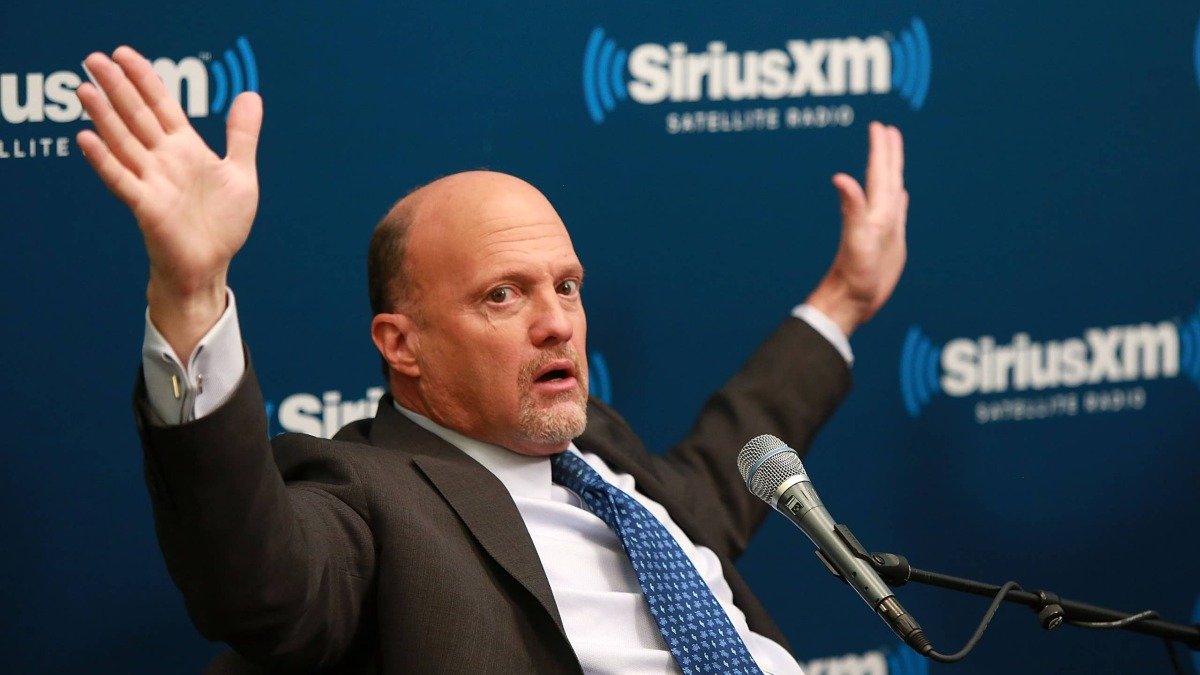
Jim Cramer has spent 2026 making two arguments about artificial intelligence that sound contradictory but aren't. The first: AI is the most important economic force since the assembly line, and investors who get positioned correctly will accumulate generational wealth. The second: a significant portion of current AI stocks are parabolic traps that could collapse 50% and take years to recover. Understanding why both claims coexist — and what separates the winners from the wipeouts — is the real substance of his AI thesis.
The Bull Case: A Firehose of Money Hitting Every Corner of the Economy
On the bullish side, Cramer's framework is sweeping. He has repeatedly described the AI boom not as a narrow tech story confined to a few Silicon Valley companies, but as a broad-based economic transformation touching utilities, industrials, real estate, infrastructure, and consumer services simultaneously. "AI is inexorable. It is fierce. And it is making believers fortunes," he told viewers on a May 2026 episode of Mad Money, following a session in which all three major indexes closed higher on AI-driven earnings momentum.
To explain the breadth of what he's seeing, Cramer has leaned heavily on a framework popularised by Nvidia CEO Jensen Huang: the AI economy as a five-layer stack, with raw compute and infrastructure at the base, moving through data centres, networking, cloud, and ultimately reaching the application layer — the AI-native products consumers actually interact with. Cramer's point is that every one of those layers is simultaneously attracting massive capital, creating investable opportunities far beyond Nvidia itself.
"Every one of these layers is like a giant American jobs programme," he said in a May segment. "They all collectively have the power to keep the country's economy humming." That's a significant claim at a time when Goldman Sachs Chief Economist Jan Hatzius has argued AI investment contributed "basically zero" to US GDP in 2025 despite over $700 billion in spend — a counterpoint that Cramer's framework conveniently sidesteps.
The spending numbers Cramer cites as evidence are genuinely staggering. Morgan Stanley has raised its combined capital expenditure forecast for five major hyperscalers — Amazon, Microsoft, Alphabet, Meta, and Oracle — to $805 billion in 2026, up from a prior estimate of $765 billion. The 2027 projection now approaches $1.1 trillion, nearly triple 2024 levels. Amazon alone has committed $200 billion this year. Alphabet is guiding to between $175 and $185 billion. These are not speculative projections — they are publicly confirmed spending commitments from companies with the balance sheets to execute them.
"Those with S&P index funds will get a piece of the action," Cramer told viewers. "Those who pick the right stocks could get it all." That framing matters, because the second half of his thesis is about precisely how difficult it is to identify those right stocks.
The Warning: Parabolic Moves Are as Dangerous as You Think
The bear case from Cramer isn't that AI is overhyped — it's that the market's enthusiasm has created a dangerous cohort of stocks whose price gains have radically outrun their earnings growth. On a June 8 appearance on Squawk on the Street, after the Philadelphia semiconductor index posted one of its worst single-session declines ever, Cramer was blunt: "Unless you have accelerated earnings, your stock is pretty much done. Got to go down 50% and then it doesn't come back. Sometimes it doesn't come back for years and years and years."
His rule is simple in principle: compare the percentage gain in a stock's price over six months to the percentage gain in its earnings per share over the same window. If price is rising faster than earnings, the valuation multiple has expanded — and that expansion is the fragile part. If earnings are actually outrunning price, the multiple has compressed, meaning the stock is getting cheaper even as it rises. That's where Cramer sees durable value.
The math applied to some of the most prominent AI names yields surprising results. Nvidia's revenue growth has accelerated materially across consecutive quarters, while the stock's year-to-date gains have remained relatively modest — a sign of multiple compression rather than speculative excess. Alphabet's Q1 2026 results saw earnings per share beat consensus by a wide margin, with Google Cloud backlog approaching $460 billion quarter-over-quarter, even as the stock's valuation held relatively steady. By Cramer's metric, these are not the dangerous names — which is exactly the counterintuitive part of his warning.
Broadcom provides the sharpest illustration. AI semiconductor revenue accelerated dramatically across recent quarters, with management guiding to further growth. The stock, however, is up only modestly year-to-date, meaning earnings are running well ahead of the share price. Cramer flagged Broadcom as a company where his parabolic warning shouldn't apply — and then watched the stock sell off anyway, which he attributed to valuation multiples built up by other parts of the business rather than the AI revenue stream itself.
The Google Bet: Distribution Over Model Quality
Cramer's most definitive single call on AI came in a July 9 Mad Money segment, when he named what he believes will be the ultimate winner of the AI platform war. "If there's only going to be one winner in AI, it's going to be Google with Gemini, because it's the default on Apple's installed base of 2.5 billion devices. That was enough to wipe out all comers once before with Google Search."
The argument is historical rather than technical. Google's search dominance wasn't built on having the best algorithm — it was built on being the default answer on every browser, every device, every operating system that reached scale. If Gemini achieves a similar default position inside Apple Intelligence experiences across 2.5 billion active Apple devices, the compounding network effects could replicate that moat. Apple CEO Tim Cook confirmed the scale of the installed base on a January 2026 earnings call, and Alphabet's Q1 2026 revenue came in at $109.9 billion, up 22% year over year, with strong Cloud performance validating the infrastructure investment.
Berkshire Hathaway has effectively endorsed the same trade from two directions: new CEO Greg Abel built a roughly $31 billion Alphabet position across 2025 and 2026, while Berkshire's largest single holding remains Apple at approximately $57.8 billion. Owning both sides of the distribution argument is either genius hedging or a statement that the Apple-Google AI relationship is genuinely durable.
There are legitimate pushbacks. Prediction markets currently assign only 5% odds that Google leads AI model benchmarks in 2026, suggesting that model quality remains genuinely contested. Any default-placement arrangement between Gemini and Apple could also attract fresh antitrust scrutiny, given that the DOJ's existing case against Google centres partly on search default payments to Apple. Distribution advantages that look structural on paper are not always durable in regulatory environments.
The Hidden Risk: Where Does $500 Billion Come From?
Perhaps Cramer's most interesting analytical thread in 2026 has been a question the rest of Wall Street would prefer to ignore: with Anthropic, OpenAI, and SpaceX all racing toward the public markets near-simultaneously, where does the capital to absorb them actually come from?
Cramer did the arithmetic publicly. Roughly $80 billion for Alphabet's private funding round, then approximately $100 billion each for Anthropic, OpenAI, SpaceX, and Amazon's data centre expansion — putting the total somewhere north of $500 billion in near-term capital demands. That cash has to come from somewhere, and the most likely source is existing equity portfolios. As OpenAI's S-1 filing revealed a company valued at $852 billion that has lost $14 billion, the question of whether the market can digest this supply without liquidating existing positions is not academic.
The Switch data centre IPO targeting an $80 billion valuation adds yet another data point to this pipeline. AI infrastructure is simultaneously the most attractive investment category and one of the most capital-hungry in modern market history. Even Cramer, who is broadly constructive on the theme, has spent weeks warning that the sheer volume of upcoming supply could pull cash out of existing AI equity positions at exactly the wrong moment.
He has, however, identified one counter-signal that gives him pause about overweighting the bearish interpretation: CrowdStrike. The cybersecurity company delivered a strong beat-and-raise quarter in June, with full-year guidance for 27.7% net new ARR growth — a jump of more than five percentage points over its prior outlook. The stock fell nearly 10% anyway. Cramer's read was that the selloff was mechanical rather than fundamental: the stock had run up ahead of the print, and the market rotated regardless of what the numbers actually said. If legitimate earnings acceleration can't prevent a selloff, the implied reading is that positioning and flows matter as much as fundamentals in the current environment — which is both a warning and, potentially, a buying opportunity for those who do the earnings math correctly.
The Framework for Navigating It
Taken together, Cramer's AI outlook in 2026 reduces to a few testable propositions. The overall theme is real and will continue producing winners across a wide economic footprint — the spending commitments from hyperscalers are too concrete and too large to dismiss. But the market has allowed many stocks to price in that reality years in advance, and the stocks where price has outrun earnings are genuinely dangerous. The test is not sector exposure but earnings velocity: is the company generating accelerating profits, or just accelerating hype?
On the platform question, his thesis is that distribution ultimately beats model quality when the quality gap narrows — which history with search would support, even if the regulatory risk to that outcome is real. And on the macro question of capital supply, the honest answer is that nobody knows whether $500 billion in near-term AI capital demands can be absorbed without draining existing positions. Cramer doesn't claim to know either. He just thinks it's the question most analysts have quietly decided not to ask.