The dumbphone was supposed to be the antidote to the attention economy — a retreat to T9 keyboards, FM radio, and the blessed absence of infinite scroll. Nokia's latest four handsets, released by HMD this week, tick every one of those boxes. They also come with a large, dedicated AI assistant button pressed right into the centre of the D-pad. The internet has opinions.
What HMD Actually Launched
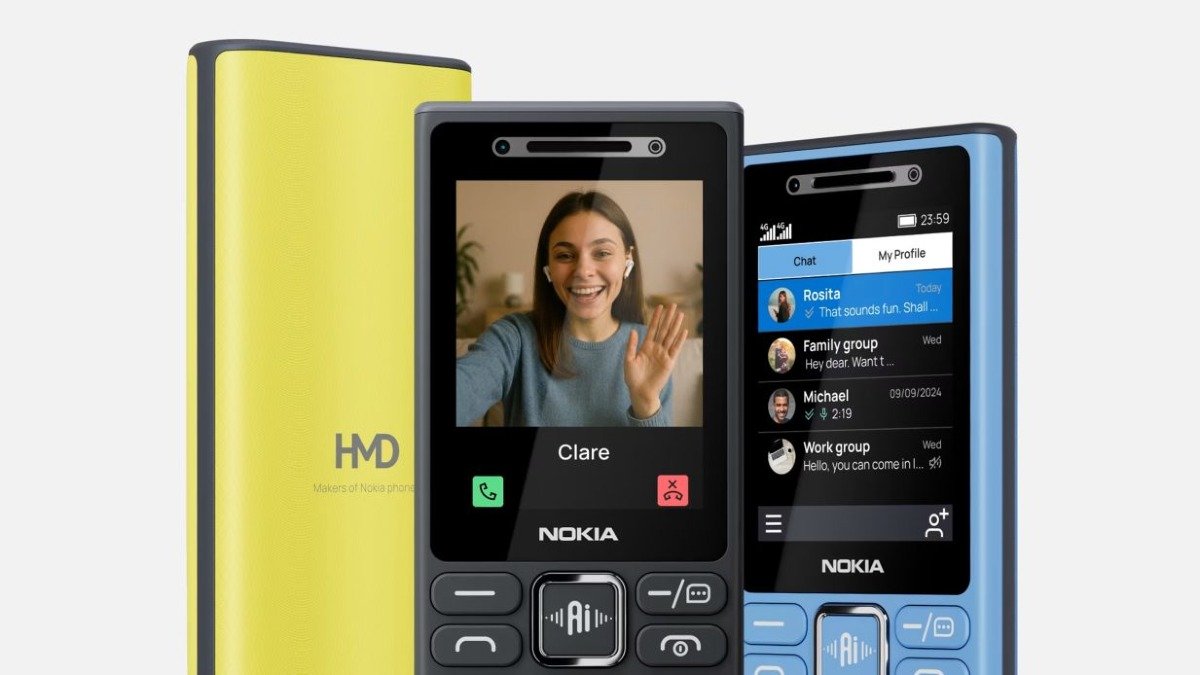
The new lineup consists of four models: the Nokia 200 4G, Nokia 210 4G, Nokia 215 4G 2nd Edition, and Nokia 235 4G 2nd Edition. All four are 4G feature phones — meaning they support basic connectivity but do not run traditional smartphone apps.
On paper, the specs read like a love letter to 2005. Each device ships with:
- A T9 numerical keyboard
- A 3.5mm headphone jack
- MicroSD card expansion
- FM radio (on three of the four models)
- A front-facing camera for video calls via an app called Xpress Chat
Xpress Chat supports group chats, voice messages, photos, and emojis — a meaningful set of modern communication tools without the rabbit hole of a full Android install.
The AI Button: What It Does
Sitting at the centre of the D-pad is a button that summons a chatbot assistant powered by Shenzhen-based company Sikey AI. The pitch from HMD is straightforward: voice control for everyday tasks. Rather than navigating multiple key presses to set an alarm or dial a contact, users can speak the instruction and let the AI handle it.
Beyond navigation, the assistant can answer simple factual questions — basic recipe steps, foreign-language phrases, that sort of thing. Think of it less as GPT-4 and more as a capable voice shortcut layer bolted onto a very simple operating system.
The catch? The AI functionality is free for the first 180 days only. After that, it costs approximately £3 per year in the EU and £2.25 per year elsewhere — and the subscription must be activated through a separate smartphone. For a device marketed partly at people who don't own a smartphone, that last requirement is a notable friction point.
Who Is This Actually For?
HMD has not yet confirmed which markets the phones will launch in. But previous statements from the company have pointed at two primary demographics: elderly users who want essential digital services without smartphone complexity, and people in regions where connectivity is limited or expensive, where a capable 4G feature phone is a meaningful upgrade rather than a step down.
For those audiences, the AI button arguably makes sense. Voice control reduces the barrier to entry for users less comfortable with keypads. The ability to ask a phone a question in natural language — rather than searching a browser via T9 — is genuinely useful when the alternative is no search capability at all.
But that framing sits uneasily alongside the other audience these phones have always attracted: digital detox seekers who want to shed their smartphones intentionally.
The Backlash: "Completely Defeating the Purpose"
Tech journalists and Reddit communities did not hold back. The core criticism is simple: a chatbot assistant is, by definition, a vector for the same dopamine-loop behaviours that dumbphone buyers are trying to escape. You might not have Instagram, but you still have an AI you can ping with questions at any moment — and that frictionless access to answers is precisely what some people are trying to step away from.
One reviewer argued the AI button risks "completely defeating the purpose" of owning a dumbphone in the first place. The sentiment reflects a broader fatigue with what critics call AI-washing — the tendency to add AI features to products regardless of whether the use case justifies them. The AI-everywhere instinct has already drawn fire in other sectors, and the dumbphone community seems particularly allergic to it.
Whether that criticism is fair depends almost entirely on who is buying the phone. For a pensioner in rural India who wants to make video calls and ask a device how to adjust a recipe, the button is a feature. For a tech professional in London trying to force themselves offline, it is an intrusion.
Nokia's Longer Arc
HMD has been quietly rebuilding the Nokia dumbphone line for several years, targeting a market that the major manufacturers largely abandoned. Previous releases — including the Nokia 2660 Flip — found an audience among both older users and digital minimalists. The new 4G lineup is a direct continuation of that strategy, with modern connectivity requirements (4G is essential as 2G and 3G networks are switched off globally) wrapped in familiar hardware.
The addition of AI does not fundamentally change the phone's character. There is still no app store, no social media, no browser-based rabbit holes of any real depth. What it does change is the philosophical purity of the proposition — and for some buyers, that purity is the entire point.
The Bigger Question
The Nokia AI button is a microcosm of a genuine tension in consumer tech right now. AI assistants are becoming default inclusions the way cameras once did — expected, table-stakes, assumed. Even major smartphone OS updates are now defined by AI integration, with Apple's iOS 27 and its reworked Siri front and centre.
The question the Nokia launch forces is whether there is a category of device where AI genuinely should not go — not for technical reasons, but for reasons of purpose. A dumbphone that is for digital detox probably should not have an always-ready chatbot. A dumbphone that is for digital inclusion in under-connected communities probably should.
HMD appears to be building for the latter while marketing to the former. Until the company confirms pricing and availability by market, it is hard to say whether that tension will matter commercially. What is already clear is that the conversation around where AI belongs — and where it actively undermines the thing it is attached to — is not going away.