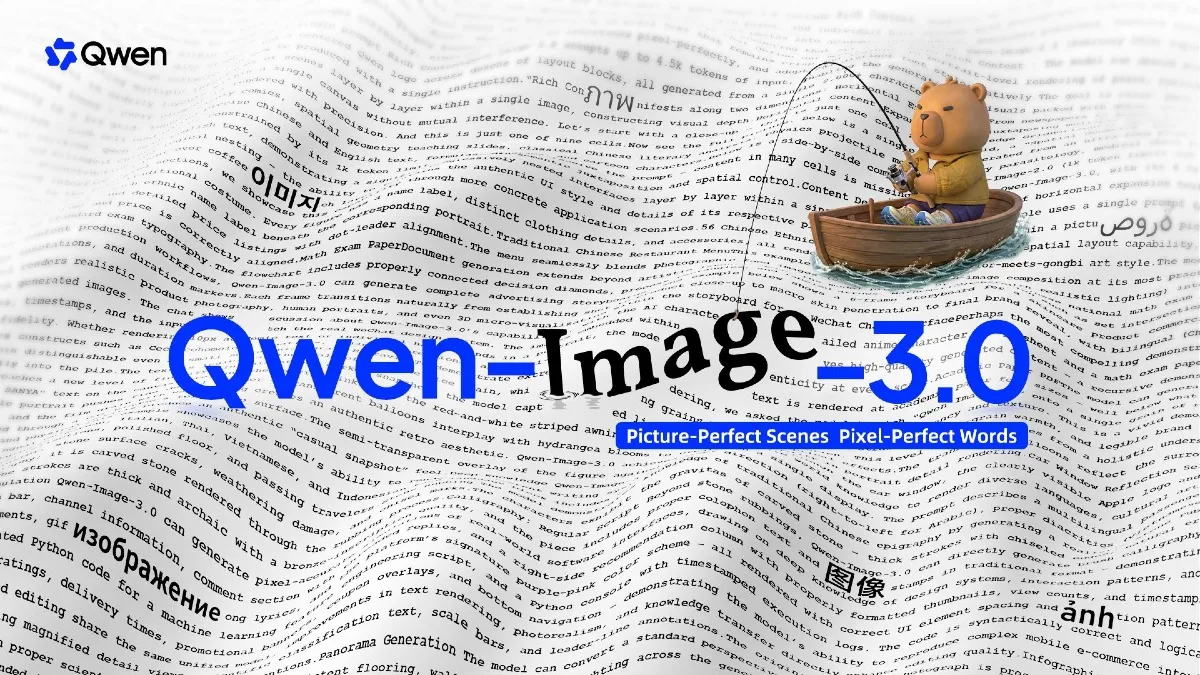
Alibaba's Qwen team has released Qwen-Image-3.0, the third generation of its foundational image generation model — and the shift in ambition from the previous version is significant. Where Qwen-Image-2.0 focused on precision, variety, and aesthetic quality, the new model is built around a single word the team calls "Real": the ability to generate images that aren't just visually convincing but functionally accurate enough to use in professional and academic contexts.
That's a harder problem than it sounds. Most image generation models collapse under the weight of complex instructions — layout breaks, text becomes illegible, or nested UI elements blur into abstraction. Qwen-Image-3.0 is an attempt to solve all three simultaneously.
4,500 Tokens In, One Image Out
The clearest demonstration of what's changed is the model's input ceiling. Qwen-Image-3.0 accepts instructions up to 4,500 tokens long — roughly the length of a detailed technical brief — and renders the resulting image in a single pass rather than by stitching together components.
The Qwen team illustrates this with a 3×3 grid that required a 3,700-token prompt to fully specify. Each cell contains a different complex infographic: a tunnel safety comic, a spatial geometry lesson, a physics projectile motion diagram, a cell DNA structure comparison, and several others — each with accurate Chinese and English text, mathematical formulas, charts, and illustrations. The model generated the entire grid at once, without each cell interfering with the others.
This matters beyond the benchmark. Complex information design — exam papers, storyboards, technical slide decks, newspaper layouts — has historically required either dedicated software or careful post-generation assembly. The 4,500-token ceiling moves Qwen-Image-3.0 into territory where a single prompt can replace that workflow.
10px Text That Stays Legible
Alongside layout complexity, the model targets a different kind of precision: rendering small text accurately. The Qwen team claims Qwen-Image-3.0 can correctly generate text as small as 10 pixels, including LaTeX formulas with superscripts, subscripts, Greek letters, and multi-line alignment.
The example used to support this is a full page of an algebraic geometry paper — dense formula derivations with fraction bars, curly braces, and theorem numbering — rendered at a size where every symbol remains readable. A separate whale shark infographic demonstrates the same capability applied to labeled diagrams and dense annotation text.
For publishers and educators, legible small-text generation is the difference between a model that produces decorative images and one that produces usable documents. The newspaper example in Alibaba's blog — a full-page layout with dense columns and authentic paper texture — suggests the model is targeting the latter.
Nested Interfaces and World Knowledge
The third capability pillar Alibaba calls "Deep Knowledge" covers two distinct things: native rendering of 12 languages and realistic simulation of real-world UI environments.
On the language side, the model accurately generates Japanese, Korean, Spanish, and Chinese in the same pass — each preserving correct character rendering and typographic conventions. On the interface side, the team demonstrates what they describe as "picture-in-picture" depth: a single prompt generates a VSCode editor containing a Qwen Chat window containing a WeChat interface containing a pour-over coffee poster, with each layer preserving the authentic visual style of its respective UI.
This isn't purely cosmetic. Developers building documentation, onboarding flows, or product mockups spend real time constructing multi-layer UI screenshots. A model that can generate accurate nested interfaces from a description cuts that process significantly.
Beyond simulated interfaces, the model can pull from external sources to generate content grounded in real-world data — the team shows a Hangzhou weather forecast image generated by fetching live weather data, and an entomological research figure created by adding taxonomic annotations and scale bars to a photograph of an insect.
Where This Sits in the Qwen Roadmap
Qwen-Image-3.0 doesn't exist in isolation. Alibaba has been building out the Qwen ecosystem aggressively: Qwen3.8, its 2.4-trillion-parameter text model, is already live in preview with open weights on the way, and Qwen3.8 Max was positioned against Anthropic's Fable 5 in benchmark claims last week. The image generation arm has followed a parallel track: Qwen-Image-1.0 was narrow, Qwen-Image-2.0 broadened the capability surface, and 3.0 attempts to make the output genuinely deployable.
The practical application list Alibaba highlights — newspaper PDFs, short-drama storyboards, complex UI interfaces, academic figures — is notably different from the typical image generation showcase of artistic styles and photorealistic portraits. Whether the model performs as advertised across all of these use cases in real-world deployment will depend on how the token ceiling and text accuracy hold up under less curated inputs. But the direction is clear: image generation as infrastructure, not decoration.
Qwen-Image-3.0 is available via Qwen Studio and the API platform. Open weights have not been announced for this release.