India's AI ecosystem is about to have its clearest public moment yet. On July 30, Sarvam — the company building India's sovereign, full-stack AI platform — is hosting Sarvam Epoch, a frontier AI conference in Bengaluru that will feature live model demos, new product announcements, and a room full of the people actually deciding where Indian enterprise AI goes next. Attendees confirmed so far include decision-makers from NVIDIA, AWS, HCLTech, Zepto, Swiggy, and Razorpay.
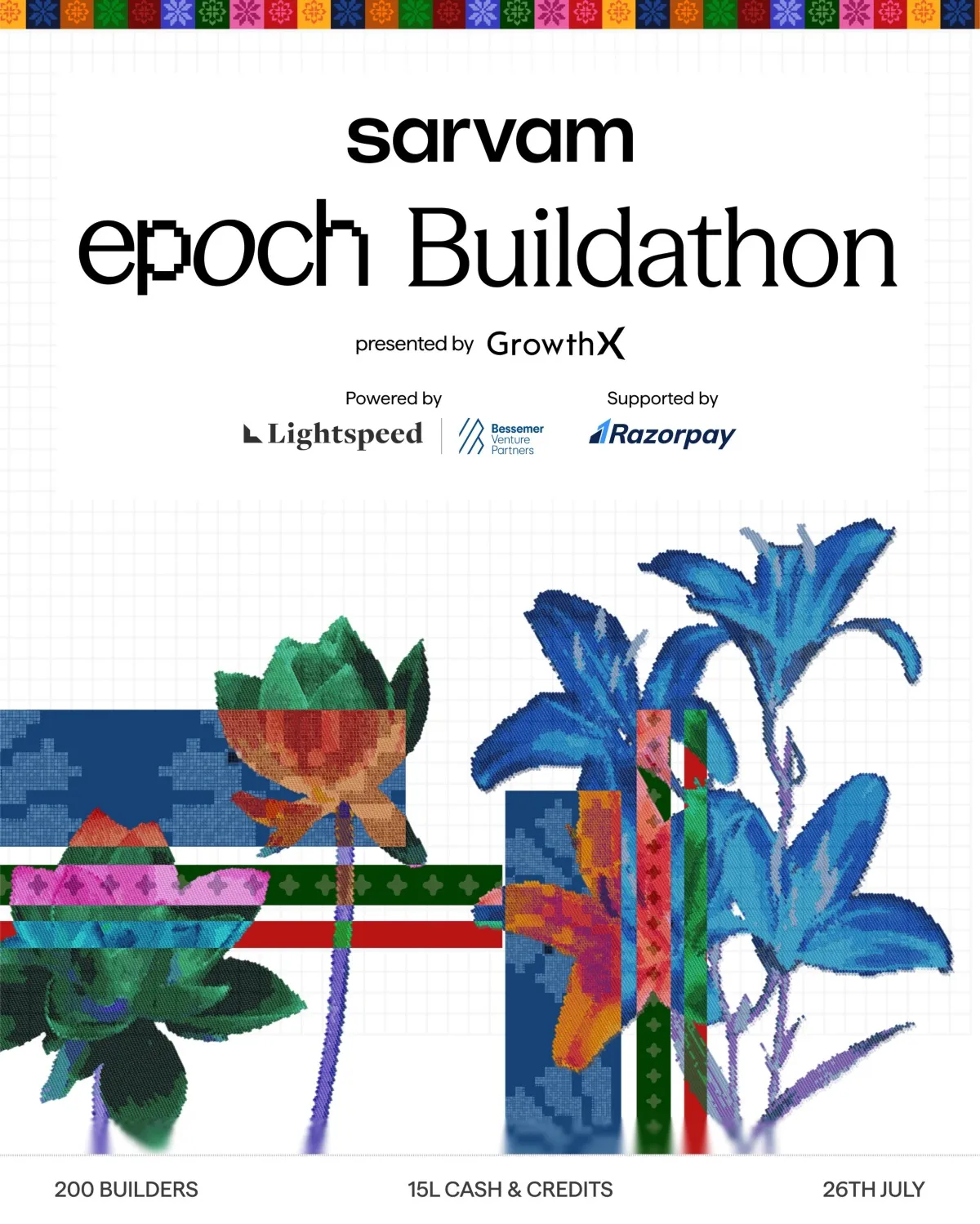
Before that, on July 26, GrowthX is running the Sarvam Epoch Buildathon — an 8-hour, 200-builder sprint with a ₹10 lakh prize pool, powered by Lightspeed and Bessemer Venture Partners. The hook is sharper than most buildathons: the top 10 teams don't just win cash. They get a demo slot on the Sarvam Epoch stage, in front of the same investors and founders attending the main conference.
What Sarvam Is Actually Building
Sarvam is one of the few AI companies in India attempting vertical integration at a national scale — building its own models, inference infrastructure, and application layer rather than reselling access to Western APIs. Sarvam Epoch is positioned as the company's moment to show what that stack looks like in production: new models, live demos, and technical deep dives rather than slide decks.
The conference is aimed squarely at the people who need to understand what sovereign AI means in practice — founders evaluating whether to build on Indian infrastructure, engineers assessing model capability against global alternatives, and investors deciding which bets in Indian AI are defensible over a three-to-five year horizon. India's push for domestic AI infrastructure has accelerated sharply in 2026, with Reliance Jio's satellite broadband network receiving regulatory clearance to deploy 1,600 LEO satellites — the kind of connectivity layer that makes large-scale AI deployment in tier-2 and tier-3 cities realistic.
The Buildathon Structure
The July 26 event runs 10:00 AM to 6:00 PM IST in Bengaluru. Every accepted builder gets 5,000 Sarvam credits to work with the company's AI stack, with the session explicitly structured around voice agents, document intelligence, and multilingual AI — all areas where Sarvam's Indian-language training data gives it a structural edge over generic Western models.
Participation is curated rather than open registration. Each team member requires individual approval, and GrowthX has drawn the room to include founders building AI companies, engineers shipping models and agents, product leaders, and technical researchers. The application window closes within 48 hours of the event listing going live, which means decisions are being made now.
The prize structure and the stage access are designed to do the same thing: create a direct pipeline from builder to the Sarvam Epoch audience. For early-stage founders, presenting in front of Lightspeed and Bessemer partners at an event they are co-sponsoring is a different category of outcome than a standard hackathon prize. The global AI developer market has seen this dynamic play out repeatedly — Kimi K3's launch overwhelmed Moonshot AI's GPU capacity within 48 hours because developer interest, when properly activated, converts to platform adoption faster than any marketing campaign.
Why This Moment Matters for Indian AI
India's position in the global AI race is more nuanced than it appears from the outside. The country has significant software engineering depth but has historically been a consumer of AI infrastructure rather than a builder of it. Sarvam's bet is that language-specific, culturally-grounded AI — built on sovereign infrastructure — solves problems that GPT-4o and Claude cannot, simply because those models were not trained to serve 22 scheduled languages across radically different literacy and connectivity contexts.
Sarvam Epoch is the first time that argument gets made publicly, at scale, in front of the people who can fund and deploy it. National AI infrastructure programs are moving fast globally — Japan's government recently committed to a physical AI system backed by 27,500 Rubin GPUs — and India has the talent base to compete, provided the infrastructure and the capital stack align.
The Buildathon registration link is available here. Applications close within 48 hours.
July 30 will show whether Sarvam has built something worth betting on. July 26 is how builders get a seat in the room when that verdict lands.