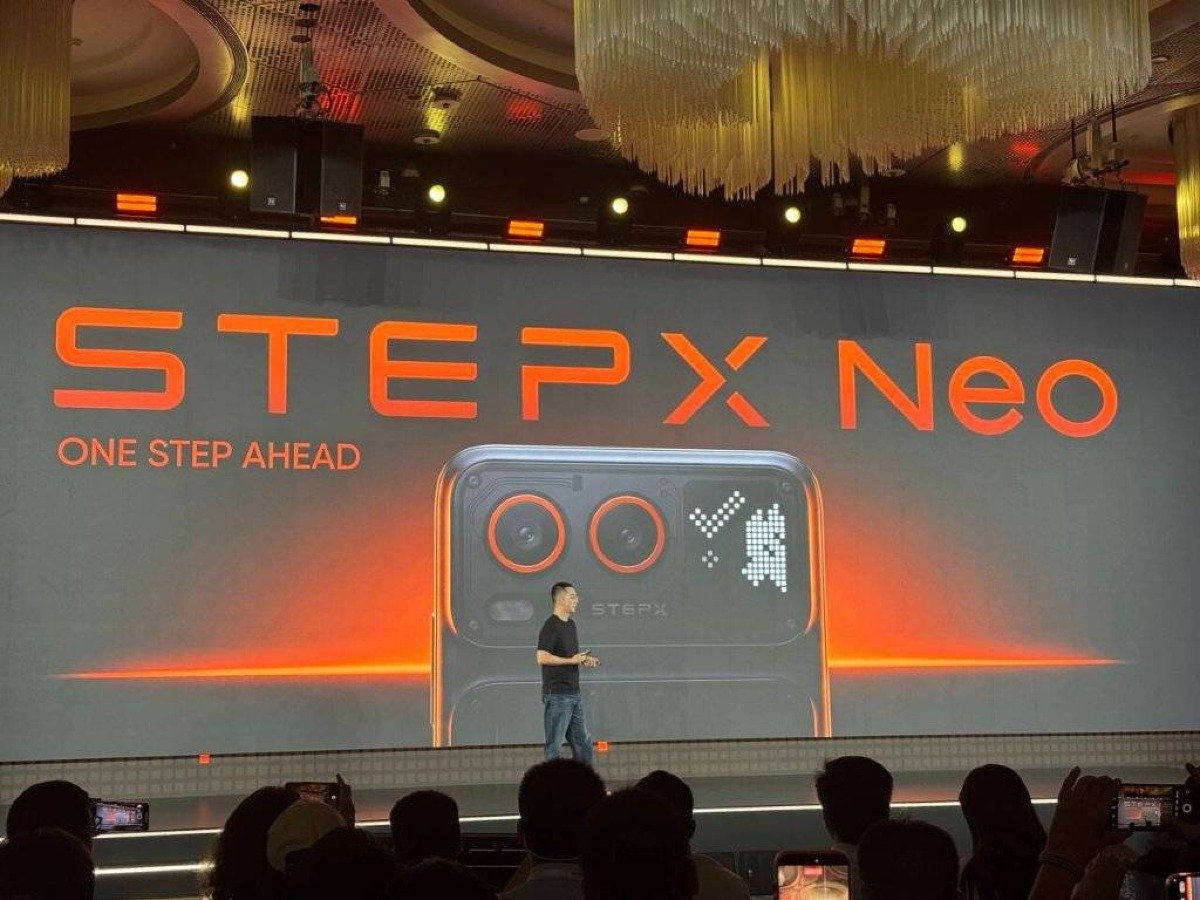
While the industry has spent months speculating about which Silicon Valley giant would release the first true AI-native smartphone, a Chinese company called StepX has quietly beaten everyone to it. The company has officially unveiled the StepX Neo — and it is claiming the title of the world's first agentic phone.
This isn't a regular flagship with a chatbot bolted on. StepX has rebuilt the phone from the hardware up around a native large language model, creating what it calls a complete AI ecosystem where the model, operating system, and hardware function as one unified system.
What Makes the StepX Neo an "Agentic Phone"?
The difference between an AI feature and an agentic AI device is significant. Most smartphones today layer AI assistants on top of a conventional OS — voice commands, photo enhancements, suggested replies. The StepX Neo takes a fundamentally different approach.
At its core, the Neo runs on Step AOS, an operating system designed specifically for AI agents rather than adapted from Android or iOS conventions. Paired with this is Amoo, StepX's built-in AI agent that is deeply integrated at the system level — not a third-party app, not a plugin, but a native intelligence woven into every layer of the device.
According to StepX, Amoo can perform tasks that go far beyond what a standard voice assistant or chatbot can handle. The AI model, operating system, and hardware have been co-designed to work as a single cohesive ecosystem — which is the architectural distinction that earns the "agentic" label.
For those exploring what agentic AI actually means in practice, our deep dive on building agentic AI systems as a developer is a useful primer on the underlying concepts at work here.
Hardware: What We Know So Far
Hardware details remain tightly controlled, but a few things have been confirmed or glimpsed:
- Secondary rear display: The Neo features an interactive screen on the back of the device. StepX hasn't detailed its full functionality, but the secondary display is expected to provide quick access to notifications, Amoo interactions, and smart controls without waking the main screen.
- Dual rear cameras: A dual-camera system is visible in early images, though specific sensor specs haven't been disclosed.
- Core specs still under wraps: RAM, storage tiers, processor, and battery capacity have not been announced at the time of writing.
What StepX has confirmed is a set of deep app partnerships. The Neo will launch with native integrations for Meituan, WPS, CapCut, Ctrip, Gaode Maps, and Alipay — a lineup that points firmly at a Chinese consumer market launch. These partnerships are designed to allow Amoo to complete real-world tasks across apps seamlessly, rather than requiring users to manually switch between services.
The Significance of the Timing
It is worth stepping back to appreciate what StepX has done here strategically. OpenAI, Google, Apple, and Samsung have all been circling the concept of a more deeply AI-integrated device for some time. Reports of an "OpenAI phone" concept have floated through the industry press for over a year. StepX, a company most Western observers weren't tracking closely, has moved first.
The announcement positions the agentic smartphone era as already begun — not a future promise, but a present reality. Whether StepX Neo delivers on that claim in daily use remains to be seen, but the category has been named and a product exists.
This also signals a wider trend: the most aggressive AI hardware moves in 2026 are increasingly coming from Chinese manufacturers operating with shorter development cycles and less public scrutiny. Compare this to the Google Pixel 11 leaks, where the most exciting detail remains marginally larger storage — a stark contrast in ambition.
Launch Timeline and Pricing
StepX has not confirmed a launch date or retail price for the Neo. Industry observers expect the device to debut in the Chinese market, likely in 2027, and to target the premium segment given the depth of its AI integration. An international rollout — including markets like India — has not been confirmed.
Given the aggressive spec positioning, a premium price tag would be expected. Whether that puts it in direct competition with devices like the Samsung Galaxy Z Fold 8 or carves out an entirely new "agentic device" price category is an open question.
For context on where the broader smartphone market is heading this year, our July 2026 smartphone launch roundup covers the six major devices landing this month alone.
What to Watch For
The StepX Neo raises more questions than it currently answers, and that is partly by design — controlled information releases build anticipation. The key unknowns that will determine whether this is a genuine category-defining device or an ambitious prototype include:
- How capable is Amoo in real-world cross-app task completion, versus demo conditions?
- Does Step AOS allow third-party developers to build agentic integrations, or is it a closed system?
- What is the native LLM powering Amoo — on-device inference, cloud-dependent, or a hybrid architecture?
- Will it reach markets outside China, and on what timeline?
These answers will come with the full launch. For now, the StepX Neo has done something no other device has managed: it has made the agentic smartphone era feel real and immediate rather than theoretical.
Related Reading
- How to Become an Agentic AI Engineer: A 6-Month Roadmap for Developers
- Google Pixel 11 Leaks Roundup: Bigger Storage, Higher Prices, and a First Look at 'Pine'
- July 2026 Smartphone Launch Roundup: 6 New Phones Landing This Month
- Loop Engineering: The Four Layers That Separate Toy Agents from Production Agents