Odyssey Opens Odyssey-3 Research Preview: Vendor Claims Physics-IQ 66.1 for Pro, Free Flash Demo Generates Worlds in Real Time
Odyssey launched Odyssey-3 on Oct 8, 2026 with a free Flash research preview. Pro posts vendor Physics-IQ Verified 66.1 with a best-of-8 footnote; robot and India driving demos need partnership access.
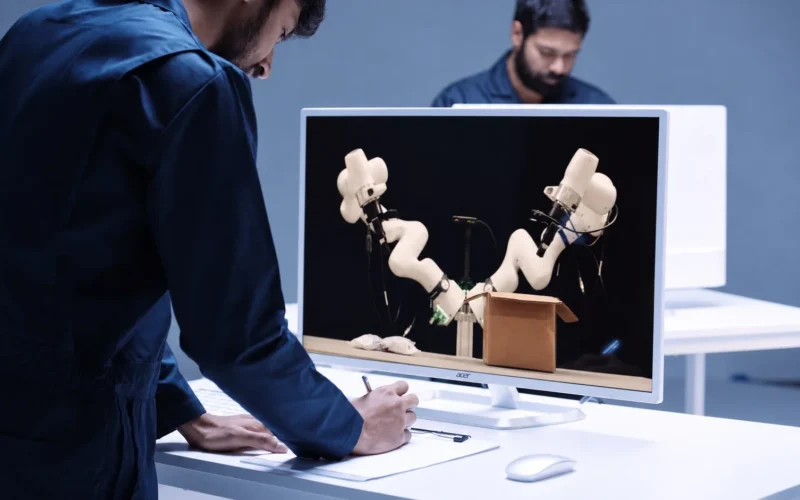
Odyssey launched Odyssey-3 on October 8, 2026, calling it the company’s most powerful foundation world model yet. Co-founders Oliver Cameron and Jeff Hawke say the model is an autoregressive diffusion transformer that predicts how scenes evolve as people or agents act inside them.
The public piece is a free research preview branded Odyssey-3 Flash. You can prompt an environment, walk through it in first or third person, move an independent camera, and watch the model react. Physical AI developers who want to build on the foundation are told to get in touch rather than grab open weights or a self-serve price sheet.
That split matters. The flashy benchmark numbers sit on Odyssey-3 Pro. The browser demo is Flash. Treating them as the same product is how hype spreads faster than the footnotes.
What Odyssey-3 actually is
Odyssey describes Odyssey-3 as a learned dynamical system. It is trained to continue visual observations conditioned on prior frames and action-like inputs, not to answer chat prompts. The September 15 technical unveil, Introducing Odyssey-3, framed the same backbone as a general-purpose physical intelligence for robots, cars, drones, agent training, and games.
Training data, per the October launch post, mixes internet video with time-localized event annotations, gameplay recordings aligned to keyboard and mouse inputs, and simulated rigid-body scenes with captions. Post-training uses distillation so a few-step variant can run in real time. That distilled path is what makes the interactive preview feel responsive instead of like a slow offline render.
In the preview, Odyssey says you can introduce events during generation and inspect how the world responds. That is closer to a controllable simulator than to a one-shot video clip generator, even if the underlying engine is still video-native.
Physics-IQ Verified claims, with Odyssey’s own caveats
Odyssey says Odyssey-3 Pro sets a new state of the art on Physics-IQ Verified’s video-to-video track at 66.1, and scores 54.7 on image-to-video. Physics-IQ, credited to Anates Labs and DeepMind in Odyssey’s own materials, asks models to continue videos of real physical experiments across fluid dynamics, optics, solid mechanics, magnetism, and thermodynamics.
Read the chart footnote on the launch page carefully. Odyssey states that scores average four runs, while best-of-8 uses one run with the same prompts. Costs on their chart assume about $1 per MI355X GPU-hour, excluding prompt-rewriting fees. Resolution notes: Odyssey-3 at 832×480, Pro at 1280×720. Source date on the chart: Physics-IQ Verified leaderboard, October 7, 2026.
Those submissions are vendor-reported. Independent labs have not signed off in Odyssey’s public posts. Secondary coverage has also flagged that the headline 66.1 figure lines up with a best-of-8 style entry rather than a plain four-run mean. Odyssey’s own footnote already separates the two reporting modes. Until the leaderboard methodology is crystal clear to outsiders, treat 66.1 as a company-submitted high watermark, not a settled third-party crown.
| Item | Confirmed in Odyssey posts | Still soft |
|---|---|---|
| Public Flash research preview | Yes, try link live on Oct 8 launch | Session limits and queue rules not spelled out in the posts |
| Pro Physics-IQ V2V 66.1 | Vendor chart + Oct 7 leaderboard cite | Best-of-8 vs four-run average needs careful reading |
| Pro Physics-IQ I2V 54.7 | Stated on launch page | Same vendor-submission caveat |
| WorldMark ranks | 1st in 3 of 4 categories in Odyssey’s eval | Company evaluation using the benchmark’s captions |
| Open weights / public API price | Not published | Contact sales / get-in-touch flow only |
| Robot, humanoid, India driving demos | Described with limited hours of data | No open eval suite released with the posts |
WorldMark: first in three splits, on Odyssey’s scorecard
WorldMark measures control-following, visual quality, and world memory. Odyssey says that in its evaluation, using the benchmark’s own captions and the mean of 13 reported metrics, Odyssey-3 ranks first in first-person stylized, third-person real, and third-person stylized environments. The company also notes that those scores measure properties of generated worlds, and that applying the model to a real machine still needs task-specific behavior checks.
That last sentence is the useful one. A high WorldMark mean does not automatically mean a warehouse robot will stop dropping boxes. Odyssey is explicit that control policies still need paired observation-action data for each body.
Robots, humanoids, India roads, and games
The same foundation, Odyssey argues, can be adapted by training a relatively small action decoder or policy while keeping much of the backbone frozen.
On robot arms, the company says tens of hours of demonstrations were enough to complete manipulation tasks, including recovery behaviors that were not in the demos, such as reorienting a gripper after a miss or retrieving a dropped object. For humanoids, Odyssey cites work with Flexion: policies built on Odyssey-3 supposedly held up better under lighting and environment changes than the vision-language-action baselines they tested.
On vehicles, Odyssey says it adapted the model to drive on real roads in India with about 20 hours of driving data and a frozen Odyssey-3 backbone. The policy predicts waypoints from the model’s visual representations. An earlier September write-up also compared sim-trained and real-footage-trained policies, saying sim-trained policies traveled about 77% as far between safety-driver interventions as real-footage ones on busy roads. That 77% figure comes from the September post, not the October launch brief.
Other demos include multi-camera driving sequence generation after short fine-tuning, drone waypoint policies in simulation, and game policies that play titles such as GTA V, with early transfer anecdotes into other games. All of that is company demo material, impressive if reproducible, not a public robotics leaderboard win.
What it means for Indian developers
Two details land close to home. First, Odyssey’s own driving adaptation story is set on Indian roads, which is rare honesty about where closed-loop tests actually ran. Second, the free Flash preview needs only a browser, so students and indie labs in India can poke at interactive world generation without buying a rack of GPUs first.
What you cannot do yet from the public posts alone is deploy Odyssey-3 as a drop-in robot brain. There is no published USD API tariff, no Hugging Face weight dump in the launch materials, and no self-serve fine-tune recipe. If you build physical systems, the path Odyssey advertises is partnership contact. If you build games, media tools, or agent sandboxes, Flash is the concrete thing you can try today, then decide whether the physics fidelity is good enough for your loop.
For context on neighboring world-model work already covered here, see our earlier notes on LingBot-World 2.0 and Japan’s push into national physical AI infrastructure. Multimodal generation that touches physical robotics also showed up in our FLUX 3 coverage, and everyday visual judgment gaps remain stark on benchmarks like Scale AI’s Humanity’s Sixth Sense.
Access, money, and what is still missing
Odyssey’s writing index lists both the September unveil and the October launch, plus a June 2026 note on a $310 million raise. The October post does not publish a consumer Flash price beyond “try,” or Pro rates beyond the internal $1/GPU-hour chart assumption.
Missing from the public package: open weights, a documented rate card in USD, third-party Physics-IQ replication notes written by Odyssey itself, and a clear statement of Flash versus Pro capability parity inside the browser. The company is selling a foundation story. Buyers still have to do the systems work.
FAQ
What is Odyssey-3 Flash?
Flash is the free hosted research preview tied to the October 8, 2026 launch. Odyssey says you can prompt environments and navigate them in real time. It is not described as identical to Odyssey-3 Pro, which Odyssey uses for the headline Physics-IQ numbers and higher 1280×720 resolution.
Did Odyssey-3 independently win Physics-IQ Verified?
Odyssey reports Pro at 66.1 on video-to-video and 54.7 on image-to-video, citing the Physics-IQ Verified leaderboard dated October 7, 2026. The company’s own footnote separates averaged four-run scores from best-of-8 reporting. Treat the numbers as vendor-submitted until outsiders reproduce them under the same protocol.
Can developers download the weights?
Not from the launch posts. Odyssey points physical AI developers to a contact form. Public materials emphasize the Flash try experience and partnership outreach, not an open checkpoint.
How much does API access cost in USD?
No public USD list price appears on the Meet Odyssey-3 or Introducing Odyssey-3 pages. Benchmark cost charts assume about $1 per MI355X GPU-hour for Odyssey’s own comparisons. That is an accounting assumption, not a customer invoice.
Is this useful for robotics teams in India right now?
The free preview is useful for exploring interactive world generation today. Odyssey’s India road-driving anecdote is interesting context, but production robot control still requires paired data, safety processes, and likely a direct Odyssey engagement. Flash alone is not a certified autonomy stack.