Ricursive’s 65B Ripple Beats Models 15 Times Its Size, but Chinese Open Models Still Lead by 10 Points
Ricursive's 65B Ripple scores 80.52 on Terminal-Bench 2.1 and ships under Apache 2.0 at $0.20 per million tokens, but Chinese open models lead by about 10 points on a rival's table.
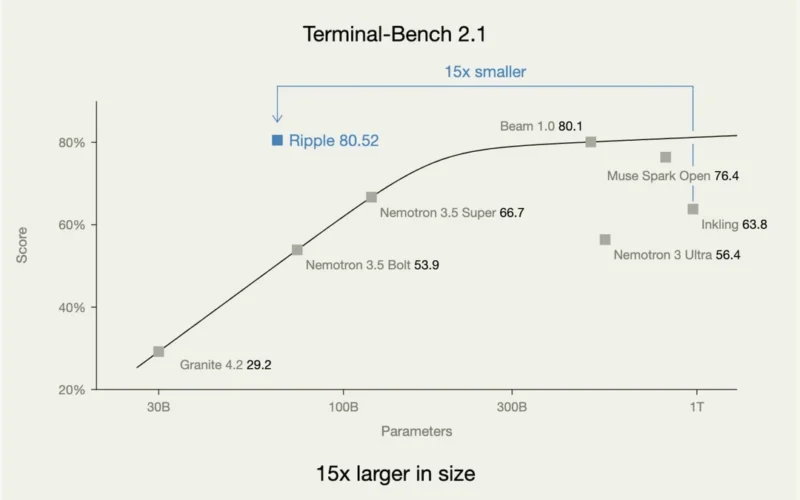
Ricursive Intelligence released Ripple-65B Preview on 4 November, a 65 billion parameter dense model trained from scratch on 12 trillion tokens and published under Apache 2.0. The Palo Alto lab says it scored 80.52 on Terminal-Bench 2.1, edging Reflection’s 501B Beam at 80.1 and beating Meta’s 816B Muse Spark Open at 76.4.
The headline number comes with a scope. Ricursive calls it a U.S. open-weight state of the art, and that is accurate as far as it goes. It is not the open-weight state of the art. Reflection’s own launch table lists DeepSeek V4.1 Flash at 90.6, Kimi K3 at 88.3 and GLM 5.3 at 88.2 on the same benchmark, all open-weight models from Chinese labs.
What Ricursive does have is a small, dense model built to run on one machine, a permissive licence and a hosted price of $0.20 per million input tokens and $0.60 per million output tokens. Weights are on Hugging Face in BF16 and NVFP4.
Quick answer: Ripple-65B Preview is a real Apache 2.0 release with a genuine efficiency story and a low API price. Its 80.52 Terminal-Bench 2.1 score is company-reported, its 0.42-point lead over Beam is inside normal benchmark noise, and it trails the best Chinese open-weight models by about 10 points on a competitor’s own table. Treat it as a strong U.S. open-weight option, not the global leader.
Why a dense 65B model is the interesting part
Most labs chasing agentic coding have moved to mixture-of-experts models with hundreds of billions of total parameters and a small active slice. Beam activates 23 billion of its 501 billion parameters per token. Muse Spark Open activates 42 billion of 816 billion. Ripple activates all 65 billion.
That choice usually costs more compute per token, but it simplifies training and serving. Ricursive says it held 40 percent model FLOPs utilisation through pretraining and posttraining with simple sharding, no custom kernels and no quantisation. It also says the model reached 250 tokens per second on two B200 GPUs at batch size eight before quantisation.
The architecture is a modernised dense transformer with 80 layers, a 5,120 dimension, gated attention, global NoPE and value residuals. The launch post claims support for up to 1 million tokens.
The benchmark lead is real, but narrower than the headline
Terminal-Bench 2.1 tests an agent inside a terminal, not a chat model answering trivia. Ricursive reports 80.52 with its own harness and 80.5 with the official Terminus 2 harness, so the number survives a harness swap on its own card.
The comparison table is where the claim tightens. Muse Spark Open’s self-reported 76.4 rises to 78.7 under Terminus 2, while Beam falls from 80.1 to 70.8. Ripple stays on top of the U.S. group, but the gap to Beam shrinks to 0.42 points on the self-reported column, which is not a durable lead without repeated runs or confidence intervals.
| Model | Total / active parameters | Architecture | Terminal-Bench 2.1, vendor | Terminus 2 | Licence | Price per 1M input / output |
|---|---|---|---|---|---|---|
| Ripple-65B Preview | 65B / 65B | Dense | 80.52 | 80.5 | Apache 2.0 | $0.20 / $0.60 |
| Reflection Beam | 501B / 23B | MoE | 80.1 | 70.8 | Open weight | $0.40 / $1.20 |
| Meta Muse Spark Open | 816B / 42B | MoE | 76.4 | 78.7 | Open weight | $1.25 / $4.25 |
| DeepSeek V4.1 Flash | 284B / 13B | MoE | 90.6 | Not listed | Open weight | Varies by host |
| Kimi K3 | Not listed | Not listed | 88.3 | Not listed | Open weight | Varies by host |
| GLM 5.3 | Not listed | Not listed | 88.2 | Not listed | Open weight | Varies by host |
Then the global picture changes. Reflection’s launch page reports 90.6 for DeepSeek V4.1 Flash, 88.3 for Kimi K3 and 88.2 for GLM 5.3 on Terminal Bench 2.1. Those are vendor-reported too, and harnesses differ, but they are the numbers the U.S. claim excludes. The Tencent Hy4 launch showed the same pattern last week: a national framing can be true while the global ranking says something else.
What $32M proves, and what it does not
Ricursive says the full research and development run cost $32 million, including pretraining ladder experiments, data work, evaluations, synthetic data and the final training run. It also says the model needed 1.4 million reinforcement learning rollouts, roughly 70 times fewer than Beam’s reported rollout count.
The “one-tenth the cost” comparison is less clean. Ricursive’s footnote points to Reflection’s reported $150 million per month compute commitment at SpaceX’s Colossus 2, and Beam’s four weeks of pretraining plus four weeks of posttraining. Two months at that rate is about $300 million, which makes $32 million roughly one-tenth. That is a comparison against a monthly compute commitment, not an audited total training bill.
Ripple-65B Preview was trained on 12 trillion tokens, supports up to 1M context length, and achieves:
– 80.5% on TerminalBench 2.1
– 79.1% on SWE-Bench Pro v2.0-Hard
– 44.3% on DeepSWE v1.1All while fitting locally on a MacBook or DGX Spark. pic.twitter.com/gsGqU00S5d
— Ricursive Intelligence (@RicursiveAI) November 4, 2026
$32 million is a company number with a company-defined denominator and no audit.
The 1M context claim meets a 128K endpoint
Ricursive’s model card says the model supports up to 1 million tokens and that long-context training used 2 million token sequences. Together AI’s model page lists a 128K context window in its specification table, even while the marketing copy above it says “up to 1M”. OpenRouter lists no context window.
For a coding agent, this matters more than the benchmark. A 1M window is useful only if the endpoint you pay for exposes it. Until a provider publishes 1M availability, assume 128K in production and test long trajectories against that limit.
Ricursive says the model fits on an NVIDIA DGX Spark, and its co-founder says it runs on a MacBook. A 65B BF16 checkpoint is about 130GB of weights before KV cache, so the BF16 release does not fit a 128GB DGX Spark. The NVFP4 checkpoint is the one meant for local hardware.
Thrilled to announce Ricursive's first model, Ripple-65B Preview, which we pretrained from scratch!
We achieved a new U.S. open-weight SOTA on agentic coding at a tenth of the cost of the prior SOTA, and can run locally on a Macbook or DGX Spark.
By adapting our model and… https://t.co/VOoj4tCRNM
— Anna Goldie (@annadgoldie) November 4, 2026
Confirmed vs Not Confirmed
| Claim | Status | Evidence |
|---|---|---|
| Weights are downloadable under Apache 2.0 | Confirmed | Hugging Face repository, licence file, BF16 and NVFP4 checkpoints |
| 65B dense model trained on 12T tokens | Confirmed | Launch post and model card agree |
| 80.52 on Terminal-Bench 2.1 | Confirmed as company-reported | Launch post, model card, official X post; no independent run |
| $0.20 input and $0.60 output per 1M tokens | Confirmed | Together AI and GMICloud listings |
| $32M full R&D cost | Not confirmed | Company figure, no audit or cost breakdown |
| One-tenth the cost of prior open-weight SOTA | Not confirmed | Relies on a competitor’s monthly compute commitment, not a total training bill |
| 1M context on hosted endpoints | Not confirmed | Together lists 128K; other hosts do not publish a figure |
| Global open-weight state of the art | Not confirmed | Claim is scoped to U.S. models; Chinese open models score higher on Reflection’s table |
What it means for Indian developers
At $0.20 and $0.60 per million tokens, Ripple is cheaper than Beam at $0.40 and $1.20 and far cheaper than Muse Spark Open at $1.25 and $4.25. For an Indian team, Apache 2.0 removes per-seat or reseller fees and allows fine-tuning on internal code.
The catch is unit economics. A dense 65B model spends more compute per token than a 23B-active MoE, so the hosted price may not survive at scale. Self-hosting needs a node with enough memory for 130GB of BF16 weights plus KV cache, or the NVFP4 path. That is cheaper than a 501B model, not cheap.
Test three things before migrating: your own repository tasks under the Terminus 2 harness, Indic-language prompts, and long-context runs at 128K. The pretraining corpus is described as predominantly English. A strong Terminal-Bench score says little about Hindi, Tamil or Bengali support.
Apache 2.0 weights can also run inside an Indian data centre without sending code to a U.S. API. That is the strongest reason for an Indian enterprise to care about this release, and it has nothing to do with the benchmark crown. Agent benchmarks are also easy to over-read, as the GDPx results showed when strong models scored near zero on finance and legal tasks.
Frequently asked questions
Is Ripple-65B open source?
It is open weight, not fully open source. The weights are Apache 2.0, but Ricursive has not released the training data or the full training code. Apache 2.0 lets you use, modify and redistribute the weights commercially.
What does Terminal-Bench 2.1 actually measure?
It measures how well an agent completes tasks in a terminal environment, including tool use and multi-step debugging. It does not measure chat quality, safety or Indic-language ability.
Can Ripple-65B run on a laptop?
Not the BF16 release. At 65 billion parameters and two bytes per parameter, the weights are roughly 130GB. The NVFP4 checkpoint is the local option, and Ricursive points to the DGX Spark. A high-memory MacBook may run a quantised build, but “runs” is not the same as fast.
How much does Ripple-65B cost?
Together AI and GMICloud via OpenRouter list $0.20 per million input tokens and $0.60 per million output tokens. Together also lists $0.02 per million cached input tokens. Self-hosting costs depend on your GPU node and utilisation.
Does Ripple-65B beat DeepSeek or Kimi?
Not on the evidence published so far. Ricursive compares itself with U.S. open-weight models only. Reflection’s launch table puts DeepSeek V4.1 Flash, Kimi K3 and GLM 5.3 ahead on Terminal Bench 2.1. No independent head-to-head has been published.
Sources
- Ricursive Intelligence, Introducing Ripple-65B Preview, a Frontier Open-Weight Model, 4 November 2026.
- Hugging Face, Ripple-65B Preview model card, accessed 5 November 2026.
- Together AI, Ripple-65B Preview API page, accessed 5 November 2026.
- OpenRouter, Ripple-65B Preview pricing, accessed 5 November 2026.
- Reflection, Introducing Beam: Reflection’s 501B open-weight model, updated 27 October 2026.
- TechCrunch, SpaceX inks compute deal with Reflection AI, 22 June 2026.
- Ricursive Intelligence, X post on Ripple-65B specs, 4 November 2026.
- Anna Goldie, X post on the first Ripple model, 4 November 2026.
1 comment