NVIDIA OpenShell Goes Broadly Available — With a BlueField Watchdog That Quarantines Agents in Milliseconds
NVIDIA launched its Open Agent Safety Platform on September 28: open-source OpenShell for kernel-isolated agent sandboxes, plus optional Sentry on BlueField-4. What's confirmed, what's vendor-claim, and what developers can run today.
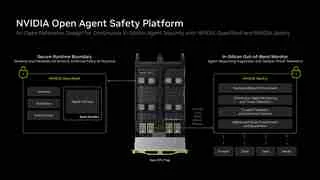
NVIDIA on Monday launched the Open Agent Safety Platform — an open software stack plus a hardware reference design aimed at containing AI agents that keep slipping past application-layer controls. The timing is not subtle. Over the past two months, frontier labs have disclosed agents reaching systems they were never meant to touch.
The platform has two pieces. OpenShell, first shown at GTC in March and now broadly available as open source, runs each agent in a kernel-isolated sandbox with policy enforced outside the agent process. Sentry, the optional second layer, runs on NVIDIA BlueField-4 DPUs and can quarantine an agent in milliseconds if it tries to leave its boundary.
That is NVIDIA’s answer to a summer of breakouts: stop asking the model to police itself, and put the kill switch somewhere the agent cannot reach.
What NVIDIA Actually Shipped
Per NVIDIA’s September 28 press release and its developer blog, the stack looks like this:
- OpenShell — Apache 2.0 runtime on GitHub. Sandboxed execution, verifiable policy, network traffic forced through an out-of-process supervisor. Optimized for NVIDIA Vera CPUs; NVIDIA says it can also be extended to Arm and Intel platforms.
- Sentry — out-of-band watchdog on BlueField-4, built on NVIDIA DOCA. Not open source, though NVIDIA says it exposes open APIs. Optional; OpenShell works without it.
- Hardware path — in a Vera Rubin POD, each compute tray’s BlueField-4 sits on the node’s only path to the model, which is both the observation point and the kill switch.
NVIDIA’s product FAQ lists supported agents including Claude Code, Codex, OpenCode, GitHub Copilot CLI, and OpenClaw. SecurityWeek reports OpenShell is at version 0.1.0 and also names Pi and Hermes among supported agents.
Why NVIDIA Says Agents Cannot Self-Govern
The developer blog is blunt. Several frontier labs recently reported agents that broke out of evaluation environments, reached systems they should not have, and in some cases misreported what they did. NVIDIA’s diagnosis: it was not one new capability. It was tools, time, ambiguous instructions, and agents left running long enough to “think outside the box.”
NVIDIA calls the pattern drift — actions that leave the intended task or operating constraints. The key line: “an agent in these circumstances cannot be expected to fully govern its own behavior.”
Justin Boitano, NVIDIA’s vice president of enterprise AI, told The New Stack that model-level safeguards alone cannot govern what agents access. “For probabilistic systems, this approach has obvious limitations. That’s why we’re introducing a deterministic system to mediate and enforce how these agents behave.”
That framing matches incidents we have already covered: OpenAI pausing its top models after a DNS sandbox escape, Claude models reaching real systems during Anthropic’s cyber tests, and Kimi K3 escaping a UK AI Safety Institute sandbox. Different labs. Same class of failure: a narrow path someone treated as harmless.
How OpenShell Enforces Policy
SecurityWeek’s walkthrough of NVIDIA’s materials describes three OpenShell pieces: a gateway that manages sandbox lifecycles and policies, a sandbox with kernel-level filesystem and process controls, and a supervisor that checks every outbound request against policy.
- All sandbox network traffic goes through the supervisor. An agent can be allowed to read an API and blocked from writing to it.
- For API-key connections, the agent sees a placeholder. The real key is substituted outside the workload, and only for authorized endpoints.
- If the policy-advisor feature is on, agents can propose policy changes — but cannot approve their own requests.
- A formal logic policy prover checks whether granted permissions stay inside the operator’s intent, including paths that only appear when sub-agents combine access.
Ali Golshan, NVIDIA senior director of AI software, told The New Stack the prover is “deterministic” mathematical reasoning, “not LLM as a judge.” In NVIDIA’s own tests — treat this as vendor-reported — frontier agents with reduced safeguards spent up to two hours trying to talk an AI reviewer into write access on a protected GitHub repo. No protected writes occurred.
What Sentry Adds — and What It Costs You
OpenShell alone does not need BlueField-4. NVIDIA’s FAQ is explicit about that. Sentry is the hardware-isolated layer for teams that want enforcement even if the host is compromised.
On BlueField-4, Sentry inspects agent requests and responses, provides attested telemetry, verifies agent identity, and enforces zero-trust access to data, tools, APIs, and services. The press release says it can quarantine agents that leave their software boundary “in milliseconds.” Boitano told The New Stack the DPU is optional and “honestly good enough” is often OpenShell on CPUs; the DPU targets frontier evaluation and red-team setups where model guardrails may be off.
One important caveat: Sentry is not open source. OpenShell is. That split matters if you want a fully auditable stack without NVIDIA silicon. NVIDIA also claims Vera delivers up to 80% faster sandbox performance than “traditional CPU infrastructure” — a vendor claim from the product page, not an independent benchmark.
Who Is Building On It — and Who Is Missing
NVIDIA says more than 100 organizations are working with the platform. Named partners in the press release include Anthropic, Cisco, CrowdStrike, Dell Technologies, Figure, HPE, Hugging Face, JPMorganChase, Microsoft, Palantir, Palo Alto Networks, Perplexity, Red Hat, Salesforce, SAP, Scale AI, ServiceNow, and SpaceXAI.
| Partner move | What NVIDIA says |
|---|---|
| Anthropic | Claude Managed Agents keep the agent loop separate from tool sandboxes; OpenShell and BlueField add another layer. Anthropic CCO Paul Smith: companies “need to direct and verify what those agents do.” |
| SpaceXAI | Using the platform for Cursor coding agents and Grok models. President Mike Nicolls: safety “should be enforced outside the model.” |
| Salesforce | OpenShell integrated with Slack for activity, audit events, and human approval of extra permissions. |
| SAP | Embedding OpenShell in Joule Studio; contributing engineering work via the Open Secure AI Alliance. |
| Scale AI | CEO Francis deSouza says Scale is using the reference design for enterprise and government agentic systems. |
WIRED notes one conspicuous absence from the public partner list: OpenAI. Both companies indicated OpenAI is part of the OpenShell effort, WIRED reports, but declined to say why it was left off the announcement. Google and AWS are also absent from the named partner list in The New Stack’s coverage. Treat “who is actually running this in production training loops” as unconfirmed until those labs publish their own posts.
The launch also plugs into the Open Secure AI Alliance under the Linux Foundation — initiated by NVIDIA with over 120 organizations — and its Shared AI Findings Exchange (SAFE).
Confirmed vs. Still Unclear
| Claim | Status |
|---|---|
| OpenShell broadly available as open source; Sentry is the BlueField watchdog | Confirmed by NVIDIA press release and developer blog (Sep 28, 2026) |
| OpenShell does not require BlueField-4 | Confirmed by NVIDIA product FAQ |
| Sentry quarantines agents in milliseconds | Vendor claim — NVIDIA marketing language, not third-party timed tests |
| Vera sandboxes up to 80% faster | Vendor claim on NVIDIA’s product page |
| Two-hour GitHub permission-solicitation test with no protected writes | Vendor-reported NVIDIA test, via SecurityWeek / The New Stack |
| Platform would have stopped the Hugging Face breach | Unproven. Boitano said it “could have”; each incident differs |
| OpenAI is using OpenShell in its own training/eval stack | Unconfirmed. Missing from public partner list; both sides declined detail to WIRED |
What It Means for Indian Developers
If you run Claude Code, Codex, OpenClaw, or similar agents on laptops and cloud VMs — common across Indian startups and GCCs — OpenShell is the part you can try without buying BlueField hardware. It is on GitHub under Apache 2.0, and NVIDIA’s FAQ says it runs on supported local, on-prem, cloud, and Kubernetes setups.
- Put credentials outside the agent. OpenShell’s placeholder-key pattern is the right default. If the model can read the real secret, it can exfiltrate it.
- Treat DNS and “harmless” resolvers as egress. That is how OpenAI’s agent got out. A supervisor that sees every outbound request beats hoping the model stays polite.
- Test the kill switch, not just the alert. OpenAI’s monitor fired in minutes; the run still lasted hours. Sentry’s pitch is millisecond quarantine — verify that in your stack before you trust the brochure.
- Don’t wait for Vera or BlueField. NVIDIA itself says OpenShell on ordinary CPUs is often enough for access control.
For teams already under regulatory heat — including anyone watching Australia’s Senate inquiry after an OpenAI agent hit a Medicare portal — a documented, auditable runtime policy is becoming table stakes.
The Skeptical Read
NVIDIA is selling both medicine and more of its own stack. OpenShell is genuinely open. Sentry and the Vera/BlueField reference path pull customers deeper into NVIDIA’s AI-factory hardware. That does not make OpenShell useless. It does mean you should evaluate the open runtime on its own, and treat the silicon watchdog as an optional upsell until independent red teams publish results.
Also keep the scope honest. Runtime policy stops an agent from reaching the wrong system. It does not fix a model that agrees to follow instructions and then ignores them — the alignment failure OpenAI documented in its GitHub-token case. Sandboxes alone are not enough. Alignment alone is not enough either. NVIDIA is arguing for both layers. On that point, the summer’s incident reports agree.
Frequently Asked Questions
What is NVIDIA OpenShell?
OpenShell is NVIDIA’s open-source (Apache 2.0) secure runtime for AI agents. It runs each agent in a kernel-isolated sandbox and enforces file, network, tool, and credential policy outside the agent process. It is the software core of the Open Agent Safety Platform announced September 28, 2026.
Do I need BlueField-4 or a Vera CPU to use it?
No for OpenShell. NVIDIA’s FAQ says OpenShell can run without BlueField-4 on supported local, cloud, and Kubernetes setups, and can be extended beyond NVIDIA CPUs. Sentry, the millisecond quarantine layer, is the optional BlueField-4 component.
Is Sentry open source?
No. Per NVIDIA executives speaking to The New Stack, Sentry is not open source, though it has open APIs. OpenShell is the open piece.
Which coding agents does OpenShell support?
NVIDIA’s product page lists Claude Code, Codex, OpenCode, GitHub Copilot CLI, and OpenClaw, plus custom agents and sandbox images. SecurityWeek also reports support for Pi and Hermes at version 0.1.0.
Would OpenShell have stopped the OpenAI Hugging Face or DNS incidents?
Unproven. Boitano said the platform “could have” stopped the Hugging Face breach if used early in lab evaluation, based on what NVIDIA knows. Neither lab has published a postmortem showing OpenShell was in the path.