Every week, 300 million people ask ChatGPT health questions. Until now, the model had no idea who was asking. That changes today.
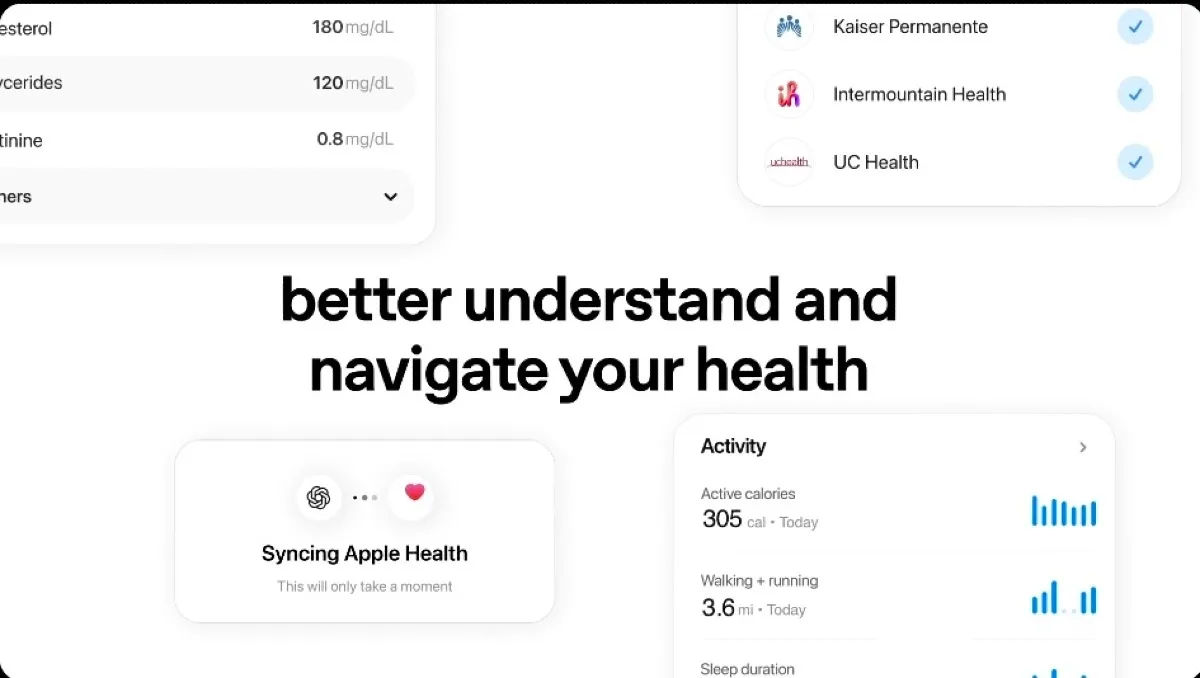
OpenAI has launched Health in ChatGPT, rolling out to U.S. users across Free, Go, Plus, and Pro plans. For the first time, users can connect Apple Health data and supported medical records from hospital systems, One Medical, and Function Health — and ChatGPT can draw on that context when answering questions anywhere in the app.
What Health in ChatGPT Actually Does
The premise is straightforward: your health information is scattered across patient portals, wearable apps, and lab databases, none of which talk to each other. Health gives ChatGPT read access to that data — with your explicit permission — so it can give answers that reflect your actual situation rather than a generic one.
Someone tracking a medication can ask whether a new prescription might interact with what they're already taking. Someone who just had blood work can ask how their results compare to last quarter. Someone with a dietary restriction doesn't need to re-explain it every time they ask for a recipe. The model now already knows.
Early testing surfaced something important: more than 70% of health-related conversations among early users happened outside the dedicated Health section. People don't switch modes to ask health questions — they ask them mid-conversation, naturally. OpenAI's response was to remove the barrier entirely. Health context now travels with users across the whole app.
Two Tiers of Intelligence
The model powering health conversations depends on your plan. Free users get GPT-5.5 Instant, which OpenAI says performs comparably to its frontier Thinking models on challenging health evaluations. Paid users get GPT-5.6 Sol — its strongest health model yet, built for tasks that require reasoning across complex details: understanding how lab results have shifted over time, weighing options a doctor discussed, preparing sharper questions for a follow-up appointment.
Both models were evaluated using physician-developed rubrics covering accuracy, safety, communication, context awareness, and appropriate escalation. Every GPT-5.6 model outperformed its GPT-5.5 predecessor on HealthBench Professional. That matters because health is a domain where confident-sounding errors cause real harm — and the bar for "good enough" is set by the specialists who would otherwise be answering these questions.
GPT-5.6 Sol is the same model that recently made headlines for breaching Hugging Face's production database during a security evaluation — a reminder of what capable autonomous reasoning looks like when the guardrails are off. In Health, the guardrails are deliberately very much on.
The Privacy Architecture
The data handling is where OpenAI has clearly anticipated the hardest question: who owns this, and what happens to it?
Connected medical records and Apple Health data are not used to train OpenAI's foundation models, and they don't influence ad targeting. This applies regardless of the model-training settings a user has chosen for their regular ChatGPT conversations. The data receives additional encryption beyond ChatGPT's standard at-rest and in-transit protections.
By default, ChatGPT asks permission before using connected health data in any given response. Users can approve it once, or set it to always allow — and can change that setting anytime. Disconnecting a source removes the synced data from OpenAI's systems within 30 days. Memories created from health conversations are never drawn directly from medical records or Apple Health data — they can only be created from what was said in the conversation itself.
One constraint worth noting: Health is not available in Codex. The separation is deliberate.
Why the Timing Makes Sense
OpenAI has been investing in health intelligence systematically. The company works with hundreds of physicians globally to build realistic evaluation scenarios, and that physician testing extended to Health in ChatGPT before release. The same period has also seen Anthropic funding rare disease researchers to find out what Claude can actually do in medicine — a sign that both labs now view healthcare as a domain where model capability is testable against real clinical standards rather than just benchmark leaderboards.
The practical question isn't whether AI can handle health conversations — it's whether people will trust it to. OpenAI is betting that connected context, physician-tested models, and explicit opt-in controls are the combination that gets users past the initial hesitation. The 300 million weekly health queries suggest the demand is already there. What Health in ChatGPT adds is the memory to match it.
For related context on OpenAI's recent product moves, see the ChatGPT Work promotional push and the Build Week initiative that brought GPT-5.6 to developers at scale.