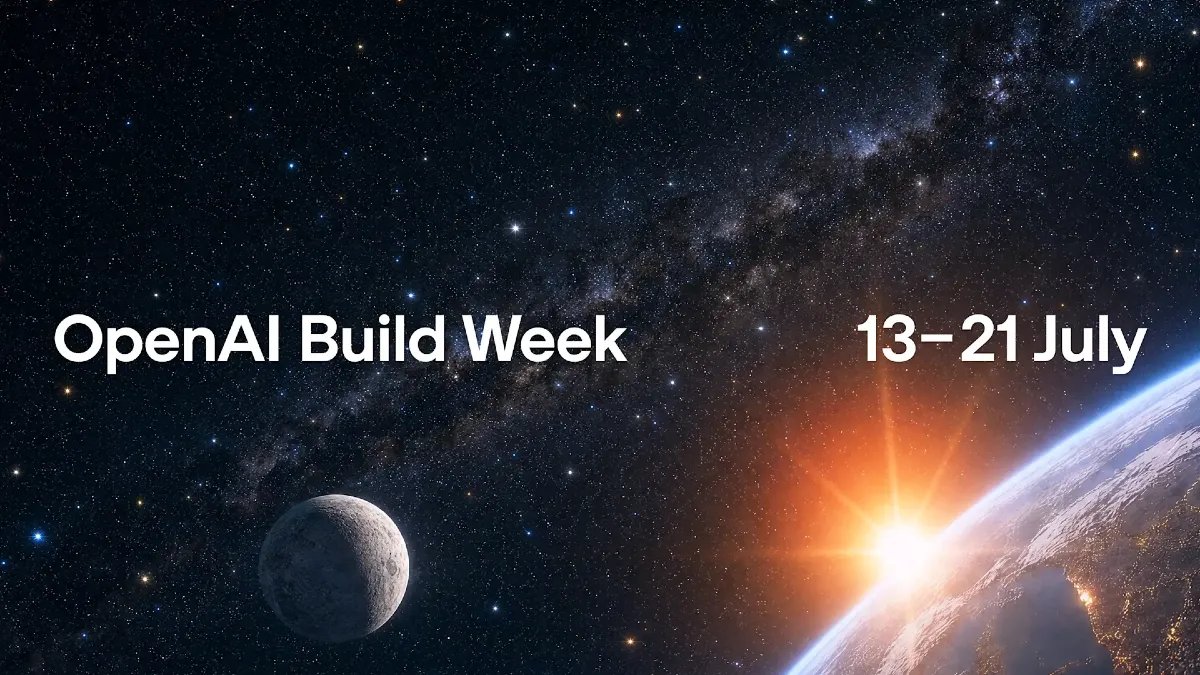
OpenAI has launched Build Week — a global, week-long hackathon inviting developers to ship real projects using GPT-5.6 and Codex, OpenAI's coding agent that is now available directly inside ChatGPT. With $100,000 in total cash prizes and over 8,600 registered participants, it's one of the most competitive AI hackathons of 2026.
The submission deadline is Tuesday, July 21, 2026 at 5:00 PM PT. If you haven't signed up yet, you still have time — but you'll need to request your free Codex credits by Friday, July 17 at 12:00 PM PT.
What Is the OpenAI Build Week Challenge?
Build Week is an official OpenAI hackathon, managed through Devpost, designed around one idea: explore what's possible when GPT-5.6 and Codex work together. Every submission must use both — the coding agent and the model — in a meaningful way.
Submit a project built with Codex for a chance to be recognized by OpenAI, with prizes that include cash awards, OpenAI credits, Dev Day passes, spotlight opportunities, and special experiences with the OpenAI team.
OpenAI has also released a Devpost Hackathons plugin that runs inside ChatGPT itself, letting participants brainstorm, plan, and submit their project without ever leaving the Codex environment. It's a meta touch that reinforces the event's core thesis: that AI-native workflows are the future of software development.
Key Dates
- July 13, 2026 — Challenge opens
- July 17, 2026, 12:00 PM PT — Deadline to request free Codex credits
- July 21, 2026, 5:00 PM PT — Submission deadline
- July 22 – August 7, 2026 — Judging period
- July 31, 2026 — Free Codex credits expire
- August 12, 2026 — Winners announced
Free Codex Credits for Registered Entrants
OpenAI is offering registered participants $100 in free Codex credits to use during the hackathon — while supplies last and subject to approval. A few things to know:
- Credits are available only to registered entrants — you must sign up for the hackathon first.
- Sign up for an OpenAI account, then request your free Codex credits on the Resources tab of the challenge page.
- The request deadline is July 17, 2026 at 12:00 PM PT — don't miss it.
- Credits expire on July 31, 2026, so plan to use them before the month ends.
Given that supplies are limited, submit your request as early as possible rather than waiting until the deadline.
The Four Tracks
Participants must submit to one of four categories, each with its own $25,000 prize pool split between first and second place:
- Apps for Your Life — Consumer apps for everyday needs: productivity, health, travel, family, personal finance, and creativity.
- Work & Productivity — B2B tools that make teams faster: workflow automation, customer support, analytics, sales, and back-office operations.
- Developer Tools — Infrastructure for builders: testing frameworks, DevOps pipelines, agentic workflows, and security tooling.
- Education — AI that moves the needle for students, teachers, or educational institutions.
Prize Breakdown
Each track awards the same structure: $15,000 for first place and $10,000 for second place. First-place winners in every track also receive:
- Dev Day / Exchange passes (up to 2 per team, valued at $650 each)
- Promotion by the OpenAI Developers team
- A meeting with the Codex team
- A one-year OpenAI Pro account
Second-place winners receive the cash, promotion, and the Pro account. Total prize pool across all tracks: $100,000 in cash.
How to Participate
- Read the Official Rules. Review the challenge requirements, eligibility, and submission guidelines.
- Install the Devpost Hackathons Plugin. Access the challenge details, rules, and submission flow directly from the ChatGPT desktop or mobile app.
- Get set up with OpenAI. Sign up for an OpenAI account, then request your free Codex credits on the Resources tab by Friday, July 17 at 12:00 PM PT.
- Explore the docs. Learn about GPT-5.6 and Codex with the available quickstart guide before you begin.
- Pick your track and build. Find the track that best fits your idea, then submit your project by Tuesday, July 21 at 5:00 PM PT.
Submission Requirements
A valid Build Week submission must include:
- A working project built with Codex and GPT-5.6
- A project description explaining what you built and how it works
- A demo video under 3 minutes (public YouTube), with audio explaining how you used both GPT-5.6 and Codex
- A code repository (public, or private and shared with
testing@devpost.comandbuild-week-event@openai.com) - A README with setup instructions and sample data if needed
- Your Codex Session ID (via
/feedback) for the session where the core functionality was built
If you're submitting a plugin or developer tool, also include installation instructions, supported platforms, and a way for judges to test it without rebuilding from scratch — a sandbox instance or demo account works.
How Projects Are Judged
The judging panel includes senior OpenAI staff: Thibault Sottiaux (Head of Product & Platform), Kath Korevec, Tara Seshan, Leah Belsky (VP of Education), and Peter Steinberger (Member of Technical Staff). They'll evaluate submissions on four dimensions:
- Technological Implementation — How skillfully and thoroughly does the project use Codex? Is it a real, working, non-trivial implementation?
- Design — Does it deliver a complete product experience, not just a technical proof of concept?
- Potential Impact — Does it solve a real problem for a real audience in a credible, specific way?
- Quality of the Idea — Is it creative? Does the team demonstrate genuine domain understanding?
Tips for a Strong Submission
A few patterns separate hackathon winners from also-rans, and they apply here directly:
- Make Codex visible. Judges are explicitly evaluating how well you used the coding agent. Highlight in your README and video where Codex accelerated your workflow and where it made key architectural decisions.
- Don't demo a prototype — demo a product. The design criterion rewards complete, coherent experiences. Polish the UI, handle edge cases, and make it runnable without your help.
- Pick a real problem. The impact criterion asks whether your solution actually addresses the problem it claims to solve. Pick a narrow, genuine use case rather than a broad, vague one.
- Document obsessively. Judges shouldn't have to chase you for setup instructions. A crisp README with clear steps, sample data, and fallback demos removes friction and signals professionalism.