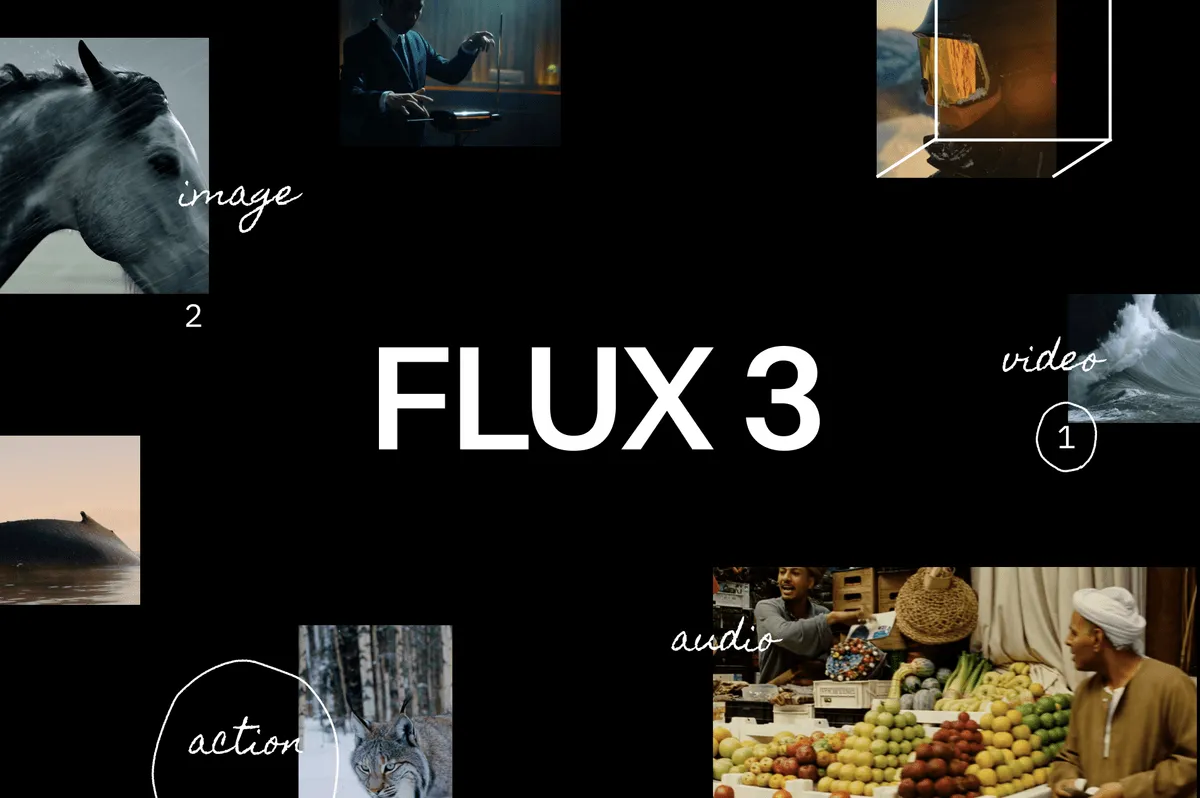
Most generative AI models are trained on one thing. Image models learn images. Video models learn video. Audio models learn audio. Black Forest Labs has spent two years arguing that this is the wrong approach, and on July 23 it shipped the evidence: FLUX 3, a multimodal foundation model that trains on all three simultaneously, inside a single architecture.
The reasoning is deceptively simple. Images, video, and audio are not separate domains. They are different projections of the same physical reality, each captured by a different sensor, each losing some information in the process. A video of a glass shattering shows the trajectory of the shards. The audio of the same event encodes the acoustic signature of the impact. The relationship between those two signals carries causal information that neither modality alone can provide. FLUX 3 is built on the premise that learning from all three simultaneously lets the model use those mutual constraints to build a more accurate model of the world.
The technical foundation is Self-Flow, Black Forest Labs' approach for aligning multimodal generation and understanding within the same underlying architecture. Compared to standard flow matching, Self-Flow reduces generation error across all three modalities while also improving downstream performance on manipulation tasks. FLUX 3 scales that approach substantially, trained across video, images, and audio at the same time.
What FLUX 3 Actually Produces
The video capability is the most immediately striking. FLUX 3 can generate clips up to 20 seconds long with native audio in a single pass, without a separate audio model bolted on after the fact. The model handles text-to-video, image-to-video animation, video-to-video style transfer, generative continuation from an input clip, and keyframe-to-video generation for controlled scene transitions. It also supports agentic chaining of individual clips into longer multi-shot sequences, which matters for anyone building narrative video rather than disconnected snippets.
In preliminary head-to-head comparisons, FLUX 3 Video was preferred over Runway Gen-4.5 in 77% of comparisons and over Luma Ray 3.2 in 93%. Against more recent competition, it came out ahead of Kling v3 Pro in 60% of comparisons and Seedance 2.0 in 52%. Black Forest Labs is explicit that these are early numbers and expects improvement during the early access phase.
The image model is still a few weeks from public release, but preliminary evaluations from midtraining show meaningful gains over earlier FLUX versions, particularly on complex prompt handling and text rendering across multiple languages. The architectural shift toward multimodal pretraining appears to have strengthened the image backbone even before any image-specific fine-tuning.
This stands in contrast to recent image generation approaches that optimize narrowly for prompt adherence. Alibaba's Qwen-Image-3.0 took a different route, focusing on knowledge density and text accuracy within a purely image-trained system. FLUX 3 is betting that learning from richer multimodal data produces a better image model as a byproduct.
The Physical AI Angle
The most consequential part of the FLUX 3 announcement may be the one with the least public visibility. Black Forest Labs has been working with mimic robotics on FLUX-mimic, a video-action model that uses the FLUX 3 backbone for dexterous manipulation tasks currently running in Audi production environments.
The underlying argument is that content creation and physical AI share the same foundation. A model that accurately predicts how objects move, how impacts sound, and how physical events unfold is a model that can be fine-tuned for robot control with limited task-specific data. The FLUX 3 video backbone functions as a dynamics-aware prior that generalizes across domains. This is a sharply different thesis from the specialized perception stacks that currently dominate industrial robotics.
For comparison, Thinking Machines' Inkling release showed that large open-weight MoE architectures can be released with full fine-tuning permissions and still find commercial traction quickly. FLUX 3 is attempting something harder: using the same pretrained backbone for both generative content and action prediction, which means the commercial case rests on whether physical AI customers value the video pretraining as a starting point or prefer task-specific approaches from scratch.
Rollout and Open Weights
Black Forest Labs is releasing FLUX 3 in stages. Video generation with audio is available now in early access. Image generation follows in the next few weeks. FLUX 3 Dev, an open-weight multimodal backbone covering video, audio, image, and action prediction, comes after that. API access and private weight options are included in the plan.
The open-weight commitment is notable. FLUX's earlier releases established a developer community that built significant downstream infrastructure. FLUX 3 Dev extends that to the multimodal and physical AI domains, which could accelerate research in both areas simultaneously.
The efficiency question will become clearer once the full model is publicly benchmarked. Google's Gemini 3.6 Flash demonstrated that efficiency gains and capability gains are not mutually exclusive, cutting token costs 17% while improving benchmark scores. Whether FLUX 3's unified architecture is more or less efficient than separate specialized models at inference time is an open question that early access users will answer quickly.
The competitive field for video generation has moved fast in 2026, with Seedance, Kling, and Runway all shipping major updates. FLUX 3 arrives with a structural argument rather than a benchmark argument: that the right foundation for any visual AI task is a model that understands how the physical world works, not one trained to mimic the appearance of it.
The robotics results at Audi are where that argument will be tested most seriously.