Something notable just happened on LMArena's Code Arena leaderboard, and the AI community is still processing what it means.
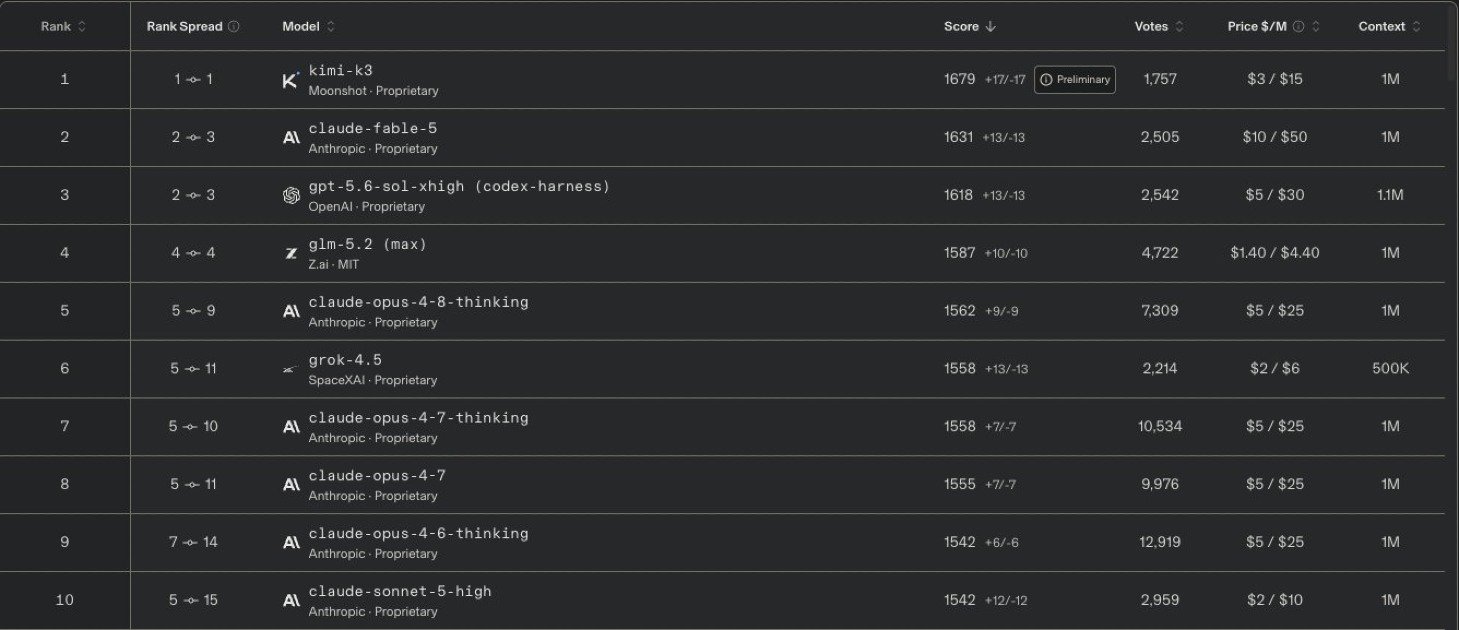
Moonshot AI's Kimi K3 has debuted at #1 on LMArena's Code Arena — the blind, human-preference benchmark widely regarded as the gold standard for evaluating real-world coding quality. It didn't creep up the rankings. It entered at the top, ahead of every major Western frontier model including GPT-5.6, Claude Sonnet, and Gemini 2.5 Pro. And the category it dominated? Frontend development.
For many developers, that last detail is the surprising part. Frontend work — crafting clean, functional, visually coherent UI from a prompt — has long been treated as the domain where the best American models shine. Not anymore.
What Is LMArena's Code Arena?
LMArena (formerly LMSYS) runs one of the most trusted AI evaluation platforms in the industry. Unlike static benchmarks that models can inadvertently overfit to during training, Code Arena uses live, anonymous human preference voting. Two models are shown side-by-side on an identical coding prompt — without labels — and real developers vote for whichever output they'd actually use.
This makes it exceptionally hard to game. There are no leaked test sets. No prompt-tuned shortcuts. Just head-to-head output quality, judged by the people who write code for a living.
Reaching #1 on that leaderboard — especially in a specialized coding subcategory — is a meaningful signal, not a marketing claim.
Why Frontend Development Is the Surprising Battleground
Coding benchmarks have historically rewarded models that excel at algorithmic problem-solving: data structures, competitive programming, mathematical reasoning expressed in code. Frontend development is a different skill set entirely.
Good frontend output requires:
- Semantic HTML structure that's accessible and logically organized
- CSS that actually renders well — handling layout, spacing, and responsiveness correctly on first try
- JavaScript that wires up interactivity without over-engineering or introducing subtle state bugs
- Visual taste — producing UI that looks intentional rather than generated
It's a domain where "technically correct" and "actually good" diverge sharply. A model can produce valid HTML that looks terrible. It can write working JavaScript that buries an interaction bug three user actions deep. Human preference voting in Code Arena catches these failures in a way that automated tests simply can't.
Kimi K3 ranking #1 on this dimension suggests something specific: the model has internalized not just the rules of frontend code, but the judgment that makes frontend output usable.
The Context: Kimi K3's Architecture
This result doesn't come out of nowhere. As covered in our Kimi K3 launch breakdown, Moonshot AI built this model at extraordinary scale — a 2.8-trillion-parameter Mixture-of-Experts architecture with a native 1-million-token context window, trained end-to-end on custom silicon the team designed themselves.
What's relevant to the Code Arena result is how the model was trained. Moonshot invested heavily in reinforcement learning from human feedback specifically tuned for code quality — including the kinds of subjective quality signals that show up in preference voting. The model wasn't just trained to produce code that compiles; it was trained to produce code that developers actually prefer.
For a deeper look at the architecture choices that enabled this, see our earlier Kimi K3 deep dive.
What This Tells Us About the Broader Competitive Landscape
Kimi K3's Code Arena debut isn't an isolated data point — it's part of a pattern. Chinese AI models have been closing the gap with Western frontier labs at a pace the industry consistently underestimates.
As we reported earlier this month, Chinese models now account for 45% of all traffic on OpenRouter — driven by cost efficiency and rapidly improving capability. Kimi K3 is the first case where a Chinese model hasn't just matched Western performance on aggregate benchmarks, but led a specific high-value category on the most credible human-preference leaderboard in the field.
That's a different kind of milestone. It signals that the competitive gap isn't narrowing uniformly — it's collapsing in targeted domains first. Frontend development today. What's next is an open question.
Practical Implications for Developers
If you're building UI-heavy applications and you've been defaulting to GPT or Claude for frontend generation, Kimi K3 is worth a direct comparison test right now. The LMArena result is the kind of signal worth acting on rather than waiting for a consensus to form around.
Kimi K3 is available via Moonshot AI's API and is open-weight, meaning teams can self-host it for production workloads where latency and data privacy matter. The 1M-token context window also makes it unusually capable at ingesting large component libraries, design system documentation, or full codebase context before generating output — a practical advantage for real projects rather than toy prompts.
For developers evaluating AI coding tools more broadly, it's also worth noting that the tooling landscape itself is evolving fast. We recently covered Agnes-2.5-Flash, another new entrant targeting the coding assistant space — the competitive pressure is coming from multiple directions simultaneously.
The Bigger Picture
The fact that a Chinese model now holds the top spot on the world's most trusted code benchmark for frontend development is genuinely significant — not because it changes anything overnight, but because of what it signals about the trajectory.
Western AI labs have operated with an assumption that capability leadership is theirs to lose slowly. Kimi K3's Code Arena debut suggests that assumption deserves revisiting. When a model built outside the US, trained on custom hardware, with a team operating under significant compute constraints, outperforms GPT and Claude on a human-preference benchmark in one of the most practically important coding domains — that's not noise. That's a signal.
The frontend leaderboard just changed. The question now is how quickly the rest of the rankings follow.
Related Reading
- Kimi K3 Is Official: The 2.8T Open Model That Built Its Own Compiler and Designed Its Own Chip
- Kimi K3 Deep Dive: What 2.5T Parameters and a 1M-Token Window Actually Change
- Chinese Models Now Own 45% of OpenRouter Traffic — and the West Hasn't Noticed
- Agnes-2.5-Flash Is Free, Unlimited, and Coming for Your Coding Stack