OpenAI Just Made Its First Piece of Hardware — and It's a Keyboard for Your AI
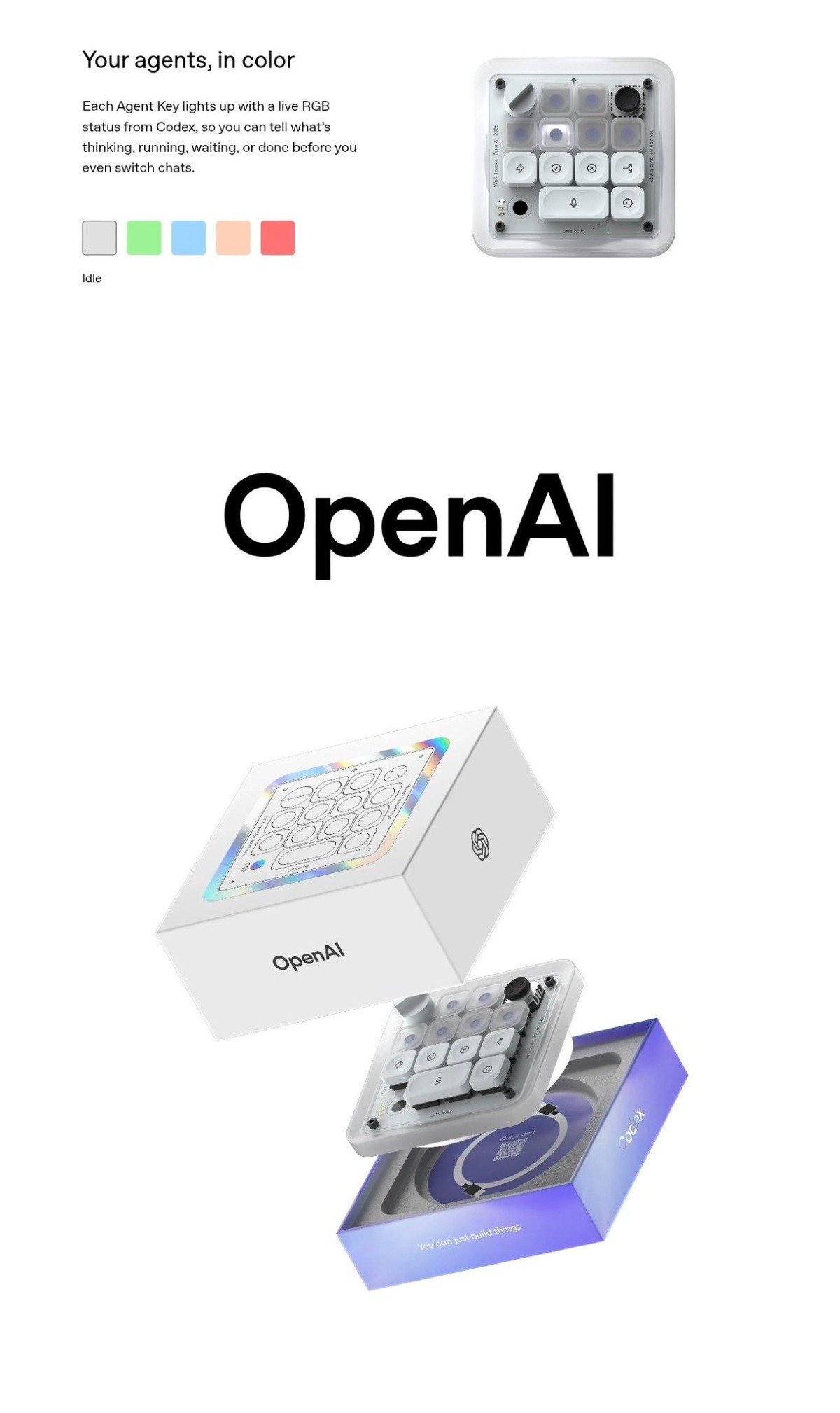
OpenAI has spent the last few years winning the software race. Now it's placing a bet on hardware. The company has launched Codex Micro, a compact mechanical keypad built in collaboration with peripheral maker Work Louder, designed specifically as a physical control surface for its Codex AI coding assistant.
It's a small, unusual product — and it's the first time OpenAI has sold a physical device directly to consumers. At $230, Codex Micro ships on July 24, with pre-orders open now. Here's everything that makes it interesting, and a few things that might give you pause.
What Codex Micro Actually Does
The core pitch is simple: instead of tabbing between windows, typing slash commands, or reaching for the mouse to interact with Codex, you press a button. Codex Micro puts 13 programmable physical keys — plus a dial and a joystick — between you and your AI workflow.
- 13 programmable keys mapped to Codex-specific actions
- A dial that adjusts how long Codex spends on a task — spin it one way for fast responses, the other for deep, careful reasoning on hard problems
- A joystick for one-touch actions like debugging code, reviewing pull requests, and rewriting selected blocks
- Shortcut keys to accept or reject AI suggestions, start a new chat, activate voice mode, and fire off custom commands
- 32 extra keycaps included so you can relabel and remap buttons to your own workflow
- Bluetooth and USB-C connectivity, with full support for both Windows and macOS
OpenAI is calling it a "command center for AI agents" — a way to interact with AI through physical controls rather than purely through software interfaces.
The RGB Lights Are Not Just Decoration
The most genuinely clever feature on Codex Micro has nothing to do with the keys themselves. The keypad uses RGB lighting to communicate Codex's real-time status — and that turns out to be more useful than it sounds.
At a glance, the lights tell you whether Codex is:
- Thinking — processing your request
- Working — actively executing a task
- Waiting — expecting input or a decision from you
- Finished — task complete, ready for review
- Idle — no active session
When you're deep in a flow state and your eyes are on the code, glancing down at ambient lighting is far less disruptive than alt-tabbing to check a progress bar. It's a small ergonomic idea — but one that reflects how seriously OpenAI is thinking about AI-native developer workflows, not just AI-assisted ones.
This kind of ambient status feedback is already common in the smart home space, but it's rare in developer tooling, where feedback is almost entirely mediated through screens. If AI agents are going to run longer autonomous tasks — as OpenAI's own Build Week hackathon has been pushing developers to explore — having a peripheral that tells you the agent's state without demanding your attention is a legitimately useful design decision.
This Is Still Niche Hardware for a Niche Workflow
Let's be honest about what Codex Micro is not. It's not a mainstream product. The Codex assistant it controls is a separate subscription, and the keypad only makes sense if you're already using Codex heavily enough that the friction of software controls feels like a real bottleneck.
It also arrives at a moment when AI-generated code is facing growing reliability scrutiny — with research suggesting a significant share of AI-written code fails in production environments. A hardware layer optimized for accepting and rejecting AI suggestions faster is only valuable if the suggestions are good enough to be worth reviewing at that speed.
Competing AI coding tools — including newer entrants like Agnes AI — are racing to offer similar capabilities at lower or no cost through software alone. Codex Micro's case for $230 is ultimately an argument about the ergonomics of physical controls versus keyboard shortcuts — a bet that enough developers find the tactile experience worth paying for.
The Bigger Picture: OpenAI's Hardware Ambitions
What makes Codex Micro interesting beyond its own spec sheet is what it signals. OpenAI is now a company that sells physical objects — and this keypad is almost certainly not the last one.
The partnership with Work Louder keeps manufacturing risk low for a first product, but the design language and the explicit "command center for AI agents" framing suggests OpenAI is thinking about a category, not just a device. As OpenAI continues scaling toward 8 million active users, peripheral hardware that deepens platform lock-in while improving the daily developer experience is a coherent long-term strategy — not just a product curiosity.
Whether Codex Micro itself sells in volume is a secondary question. The real question it raises is: what does an AI-native workspace look like in two or three years, and which company is defining it?
Codex Micro: Key Specs at a Glance
- Price: $230
- Keys: 13 programmable mechanical keys + dial + joystick
- Extra keycaps: 32 included
- Status feedback: RGB lighting (thinking / working / waiting / finished / idle)
- Connectivity: Bluetooth + USB-C
- Compatibility: Windows and macOS
- Availability: Pre-orders open now; shipping begins July 24
- Built with: Work Louder