In Salem Township, Pennsylvania — a community of roughly 4,000 people tucked into Luzerne County's rural northeast — 96 farming families have quietly become multimillionaires. They didn't strike oil or gas. They didn't develop their land. They simply agreed to sell it to a data center developer at a price that, to anyone in agriculture, sounds like fiction: an average of $330,000 per acre, in a state where farmland typically sells for around $9,560 per acre.
The buyer was QTS, a data center operator owned by private equity giant Blackstone. The total bill: $586 million for approximately 1,700 acres of what was, until recently, ordinary farm country. That's a 35x premium over agricultural market value — and for QTS, it was essentially a rounding error on the way to building one of the most strategically valuable compute campuses in the United States.
The deal is one of the starkest illustrations yet of what happens when the AI infrastructure buildout collides with rural American land markets — and the implications go well beyond Pennsylvania.
Why Salem Township? The Nuclear Equation
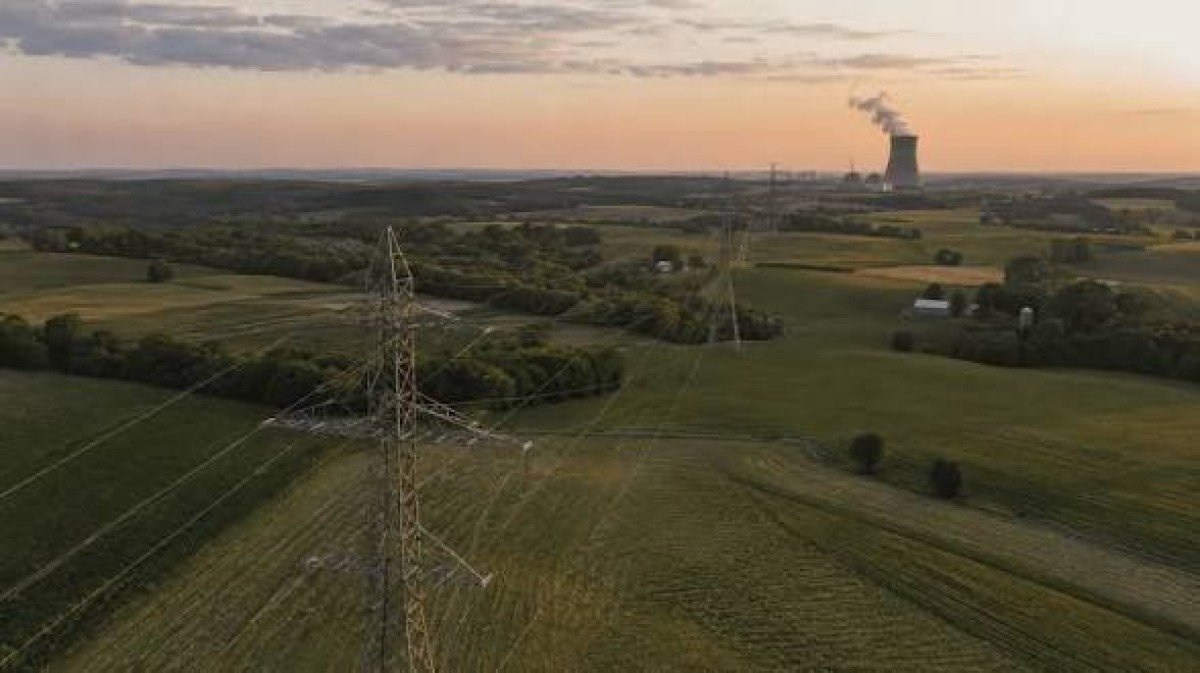
The answer has nothing to do with soil quality. It has everything to do with what sits next door: Talen Energy's Susquehanna Steam Electric Station, a two-unit nuclear plant with a nameplate capacity of roughly 2,500 megawatts. For data center developers chasing power-dense, low-carbon electricity with guaranteed uptime, proximity to nuclear generation is the single most valuable siting factor available.
The Susquehanna corridor was already a hyperscale destination before QTS arrived. In 2024, Talen sold its adjacent 1,200-acre Cumulus data center campus to Amazon Web Services for $650 million — a deal that included a direct nuclear interconnect. By 2025, Amazon and Talen had expanded that arrangement into a long-term power purchase agreement running to 2042, targeting 1,920 megawatts of capacity.
QTS effectively bought the field across the road. In 2024, $650 million purchased a built, interconnected campus. In 2026, $586 million purchased raw farmland with no infrastructure. The compression of that gap — nearly equivalent pricing for finished infrastructure versus empty ground — reflects just how aggressively AI capex has repriced anything adjacent to reliable power.
The parcels also fall inside a township overlay zone where data center development is permitted by right. In an industry where permitting uncertainty can add years and hundreds of millions in carrying costs to a project, that pre-cleared status strips out the single most expensive variable in land acquisition. QTS wasn't just buying acres. It was buying certainty.
What the Sellers Got — and What They Gave Up
For families like Marilee and David Kiliti, the transaction was life-changing in the most literal sense. The Kilitis had raised hogs on 89 acres for years, taking on debt to expand their operation and facing years of community opposition to a proposed barn expansion. When land representatives approached them two years ago with an offer exceeding $20 million, they assumed they were being misled. They ultimately sold for more than $22 million and are now building a home with a theater room and a second-story hot tub. David Kiliti had been working construction jobs on the side. Marilee had driven forklifts. They are now comfortably retired.
Across 96 families, the average payout was approximately $5.5 million. Several sellers lived in double-wide trailers. Others were successful small business owners. The deal was organized by Jack Sordoni of 4-3 Consulting, who spent years assembling the consortium, navigating negotiations, securing zoning approvals, and keeping nearly 100 independent landowners aligned through a process that stretched through marketing, due diligence, and a township master plan approval. Construction is expected to begin in fall 2026, with QTS planning to develop between 12 and 17 individual data centers on the assembled site.
But there's a structural dimension to this story that the headline numbers obscure. The families converted a perpetual income-producing asset — farmland — into a one-time lump sum. What they sold was not just acreage. It was the right to participate in whatever the land generates for the next several decades.
QTS and Blackstone will lease those 12 to 17 data centers to hyperscale tenants on long-term contracts, typically 10 to 15 years, with fixed annual escalators. That contractual cash flow — predictable, inflation-linked, backed by the creditworthiness of companies like Amazon and Microsoft — is precisely the asset Blackstone packages and monetizes at institutional scale. The landowners received a fair price for dirt. The buyer received a platform for one of the most profitable recurring revenue streams in modern real estate. None of the 96 families will see a dollar of it going forward.
Pennsylvania's Marcellus Shale boom a generation earlier offered a useful contrast. Landowners in that era typically negotiated royalties — a percentage of production revenues for as long as the wells produced — while retaining title to the land. The data center model is structurally different: a single payment, full deed transfer, no downstream participation. The families who sold are not wrong to have done so. They received far more than any alternative buyer would have offered. But the asymmetry of what each side walked away with is significant, and largely invisible in the celebratory coverage the deals have received.
The Political Fault Line
Not everyone in Pennsylvania is celebrating. The same dynamics playing out in Salem Township are generating organized opposition across the state — and creating a genuinely unusual political problem for Republican incumbents in competitive House districts.
Pennsylvania already hosts more than 100 data centers, with Amazon, Microsoft, and QTS driving a buildout that the state's own figures suggest represents more than $100 billion in committed private investment. Governor Josh Shapiro has championed the buildout as central to Pennsylvania's AI economy strategy, and both Shapiro and Senator Dave McCormick have framed the state's combination of diverse energy sources, research institutions, and regulatory environment as a competitive advantage for attracting hyperscale investment.
But residents in communities across the state are pushing back. In Montour County — the state's smallest county geographically, which had already lost 22% of its land and 28% of its farms between 2017 and 2022 — residents organized against a Talen Energy proposal to rezone more than 800 agricultural acres for a new Amazon-linked data center campus. County commissioners unanimously rejected the rezoning request. In Lower Mount Bethel Township, similar coalitions formed to resist industrialization of local farmland. In Maine, a statewide moratorium on data center construction became the first of its kind in the country.
The grievances are consistent across geographies: noise and light pollution, pressure on water supplies, rising electricity rates (Pennsylvania retail electricity prices climbed 21.7% in 2025 alone), declining property values for surrounding homes, and the industrialization of land that defined rural communities for generations.
In response, Governor Shapiro announced the GRID framework — Governor's Responsible Infrastructure Development standards — in his February 2026 budget address, designed to impose accountability requirements on large-scale infrastructure projects. State Senator Katie Muth has gone further, proposing a three-year statewide moratorium on hyperscale data center development. The political calculus is complicated by the fact that data centers remain one of the few infrastructure issues that does not fall neatly along partisan lines: rural Republicans in competitive districts are hearing directly from constituents opposed to the buildout, even as the broader economic argument for data center investment is broadly supported by leadership in both parties.
The Arithmetic That Makes 35x Cheap
To understand why Blackstone paid $330,000 an acre for farmland worth $9,560, it helps to understand what QTS is actually buying at the system level. Electrical infrastructure typically absorbs 40% to 45% of a data center project budget. Land, even at $586 million, is closer to the construction cost of a single average US facility — spread across a site designed to house 12 to 17 of them. When the four largest hyperscalers are collectively guiding toward approximately $725 billion in combined capital expenditure this year — a figure roughly 77% higher than 2025 — a 35x premium on raw land near reliable nuclear power is, in their terms, cheap insurance against a five-year interconnection queue somewhere less advantageous.
QTS was not bidding against other farmers for these parcels. It was bidding against the cost of not securing the site at all, in a market where the limiting factor is not capital but power access and permitting certainty. Under those conditions, almost any price for the right land becomes rational from the buyer's perspective. The sellers, who were negotiating against farmers and developers of comparable plots, had no reference point for what the land was actually worth to a buyer facing that alternative.
A follow-on deal is already forming in the same region: approximately 200 additional landowners are expected to sell their properties for a combined $1.3 billion — further extending the nuclear-adjacent data center campus and deepening the concentration of AI compute in a single northeastern Pennsylvania corridor.
Pennsylvania's total data center capacity grew from 231 megawatts in 2021 to approximately 7.8 gigawatts in 2025. The trajectory suggests the farmland conversion underway in Luzerne County is not a one-time event but the early phase of a structural land-use shift — one that the state's regulatory framework, its farmland preservation program, and its political institutions are still racing to catch up with.
What Comes Next
Pennsylvania leads the nation in preserved farmland, with more than 6,700 farms and 665,000 acres protected under a program that has invested $1.84 billion in state, county, and local funds since 1988. Agriculture contributes $132.5 billion annually to the state economy and supports nearly 600,000 jobs. The Shapiro administration has framed both data center investment and farmland preservation as priorities — a combination that is increasingly difficult to sustain as hyperscale demand expands into areas not previously considered industrial candidates.
The GRID standards, the proposed moratorium, and the county-level zoning battles now underway across Pennsylvania represent the first serious attempts to define the rules of engagement for a conflict that has no established playbook. The Montour County rejection demonstrated that community opposition can prevail — but it required months of organized effort against a well-resourced developer and the backing of a county commission willing to hold the line. Most communities facing these proposals will have fewer resources and less time.
For the families who sold in Salem Township, the outcome was unambiguously transformative. For the industry building on top of what they gave up, it was a foundational land acquisition at a price that barely registers against the broader capital program. The gap between those two realities — one measured in generational wealth, the other in quarterly capex guidance — is where the most consequential negotiations about American land use in the AI era are quietly taking place.
Related Reading
- Switch's $80 Billion IPO and the Data Center Gold Rush Financing the AI Era
- Goldman Sachs Says AI Spent $700B in 2025 — and Gave the US Almost Nothing Back
- Jim Cramer Thinks AI Will Make You Rich — and Also Wipe You Out
- OpenAI's $852 Billion IPO: Inside the S-1 That Could Reshape Silicon Valley Forever