Germany Drops a Serious Open-Source LLM — Meet Soofi S 30B
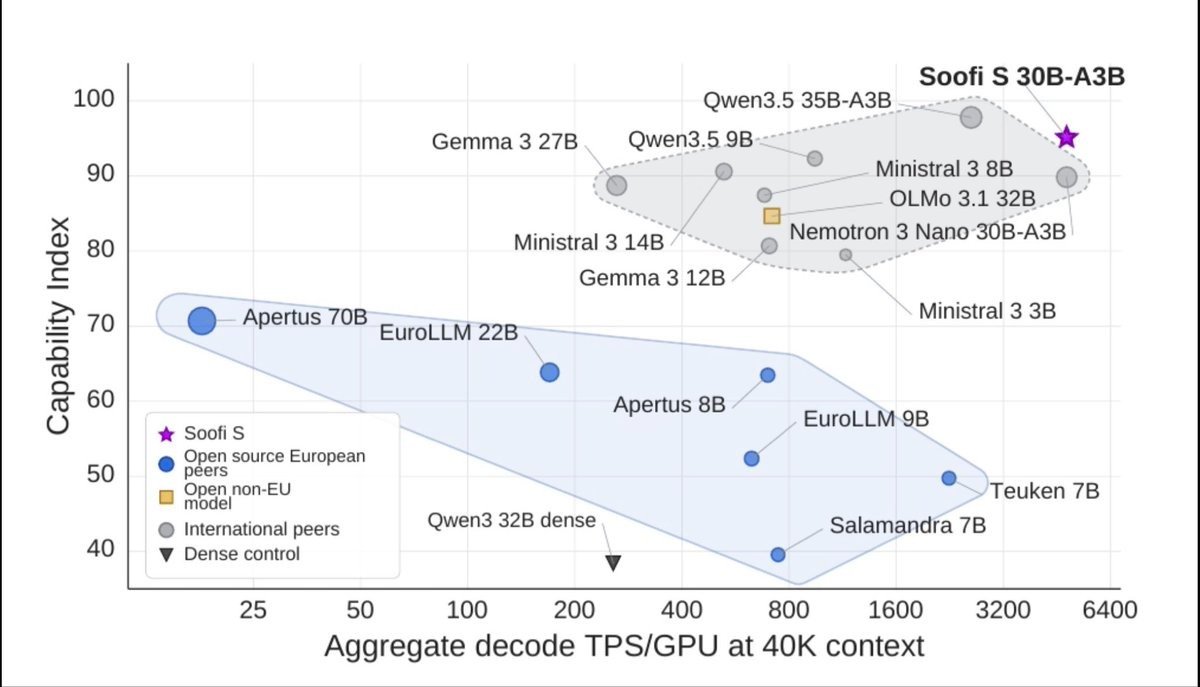
A German research consortium coordinated by the KI Bundesverband (German AI Association) has released Soofi S 30B-A3B, an open-source language model that claims the top spot among fully open models on both English and German benchmarks. The model beats out previous leaders including OLMo 3 32B from the Allen Institute for AI and Apertus 70B from ETH Zurich and EPFL — the latter being a considerably larger model.
What makes Soofi S especially notable isn't just its benchmark performance. It was trained entirely on Deutsche Telekom's Industrial AI Cloud in Munich, making it one of the first large-scale LLM training runs on sovereign European infrastructure. For the open-source AI community keeping an eye on Europe's ambitions in this space, this is a significant milestone.
A Lean Hybrid Architecture Built for Long Contexts
Soofi S is a mixture-of-experts (MoE) model with 31.6 billion total parameters, but it only activates around 3.2 billion parameters per generated token. In practice, this means its compute cost is closer to running a 3B model than a conventional 30B one — a meaningful efficiency advantage for deployment at scale.
The consortium adopted the architecture of Nvidia's Nemotron 3 Nano without modification: a hybrid design combining Mamba-2 layers with standard attention layers. This is a key differentiator from typical transformer-only models.
In standard transformers, the KV cache — which stores previous tokens for attention computation — grows linearly with context length. Long inputs and large batch sizes turn KV cache reloading into a serious throughput bottleneck. Soofi S sidesteps this: only 6 of its 52 layers maintain a KV cache at all.
The practical result is impressive. At a context length of 40,000 tokens with 32 parallel requests, Soofi S generates roughly eight times more tokens per second per GPU than comparable dense models in the 14–24B parameter range. While throughput degrades sharply for conventional models as context grows, Soofi S remains nearly flat across contexts from 4,000 to 256,000 tokens. The only model showing similar behavior in published measurements is Alibaba's Qwen3.5 35B-A3B, which also uses a hybrid architecture. This makes Soofi S an interesting comparison point to models like Tencent's Hy3 295B MoE, which takes a very different approach to efficient inference at scale.
A Training Mix Deliberately Weighted Toward German
The training process covered roughly 27 trillion tokens across three phases:
- Phase 1 (~20 trillion tokens): Broad language fundamentals from web, code, math, and domain-specific texts. German makes up 7.2% of the mix.
- Phase 2 (~6 trillion tokens): Higher-quality sources to sharpen learned patterns. The German share rises to 15.3%.
- Phase 3 (~188 billion tokens): Long-context extension training on documents up to one million tokens.
For context, in Nvidia's Nemotron reference recipe, all non-English languages combined account for only about 5% of training data. The consortium's deliberate over-representation of German — built from sources including HPLT, the openly licensed German Commons corpus, FineWiki, FinePDFs, and the commercially licensed Genios corpus containing 193 million newspaper articles from 916 German publications — pays off clearly in benchmark results.
Benchmark Performance: Strong in English and Dominant in German
Across 16 open models evaluated, Soofi S leads all fully open models on aggregate scores for both English and German. Against every European sovereign AI baseline in the comparison suite, it finishes first on all German benchmarks — sometimes by double-digit margins.
Standout scores include:
- HumanEval: 73.8% (best among open-source peers)
- MBPP: 70.2%
- MBPP-DE (German): 84.2%
- ARC-Challenge-DE: 92.3%
- GLP-DE: 88.8%
- INCLUDE-DE (Germany-specific regional knowledge): 61.2 — tied for first with Qwen3.5 35B-A3B
Compared to the Nemotron architectural baseline, the German-weighted data recipe improved language proficiency by 15.1 points and the science benchmark GPQA-Diamond by 9.6 points, without any sacrifice in English performance.
Where Soofi S Falls Short
It's not all clean wins. Soofi S struggles on German competition mathematics, scoring 56 points on Minerva MATH-DE versus 76.5 for Qwen3.5 35B-A3B and 65.6 for Gemma 3 27B. It also lags on open-domain factual retrieval in NaturalQuestions — a likely consequence of having only 3 billion active parameters, which simply stores less world knowledge than a dense 27B model.
There's also a notable weakness in long-context extraction: on the RULER benchmark's frequent-word extraction task, Soofi S's hit rate drops to around 3% beyond 32,000 tokens, while the comparable Nemotron model holds 60–64% accuracy. The team attributes this to a lack of synthetic extraction-oriented data in the long-context training phase — a gap they can address in future iterations.
Sovereign Infrastructure: Renewable Energy, Canal Water, and Waste Heat
The training run took place between March and May 2026 on up to 512 Nvidia B200 GPUs at Deutsche Telekom's Industrial AI Cloud in Munich, totaling approximately 253,000 GPU-hours. The facility runs entirely on renewable energy, is cooled using water from the Eisbach canal, and feeds waste heat into the surrounding Tucherpark neighborhood. Soofi S was among the first major training runs on this infrastructure.
The consortium backing the project includes the Fraunhofer Institutes IAIS and IIS, the German Research Center for Artificial Intelligence (DFKI), TU Darmstadt, the University of Würzburg, the L3S Research Center, the Berlin University of Applied Sciences, and AI companies Ellamind and Merantix Momentum. Funding comes from the German Federal Ministry for Economic Affairs and Energy as part of the European IPCEI-CIS program.
How Open Is It, Really?
The team is releasing model weights, selected intermediate checkpoints, the complete training and evaluation code, and a detailed data inventory with raw token counts, epoch numbers, and per-source contributions. Even sources that were reviewed but ultimately excluded are documented. According to the consortium, this satisfies the Open Source AI Definition 1.0 from the Open Source Initiative.
One caveat: a stricter European proposal requiring every training token to be freely distributable isn't met, because the Genios corpus (about 1.3% of training data) carries a commercial license. Around 99% of the training mix can be independently reconstructed. The exact release license for the model weights hasn't been finalized.
Lead author Michael Fromm describes Soofi S as sitting between broadly multilingual European sovereignty projects like EuroLLM or Teuken and the highest-performing international open-weight models — a deliberate positioning that prioritizes depth in German rather than broad multilingual coverage.
What It Means for Open-Source AI in Europe
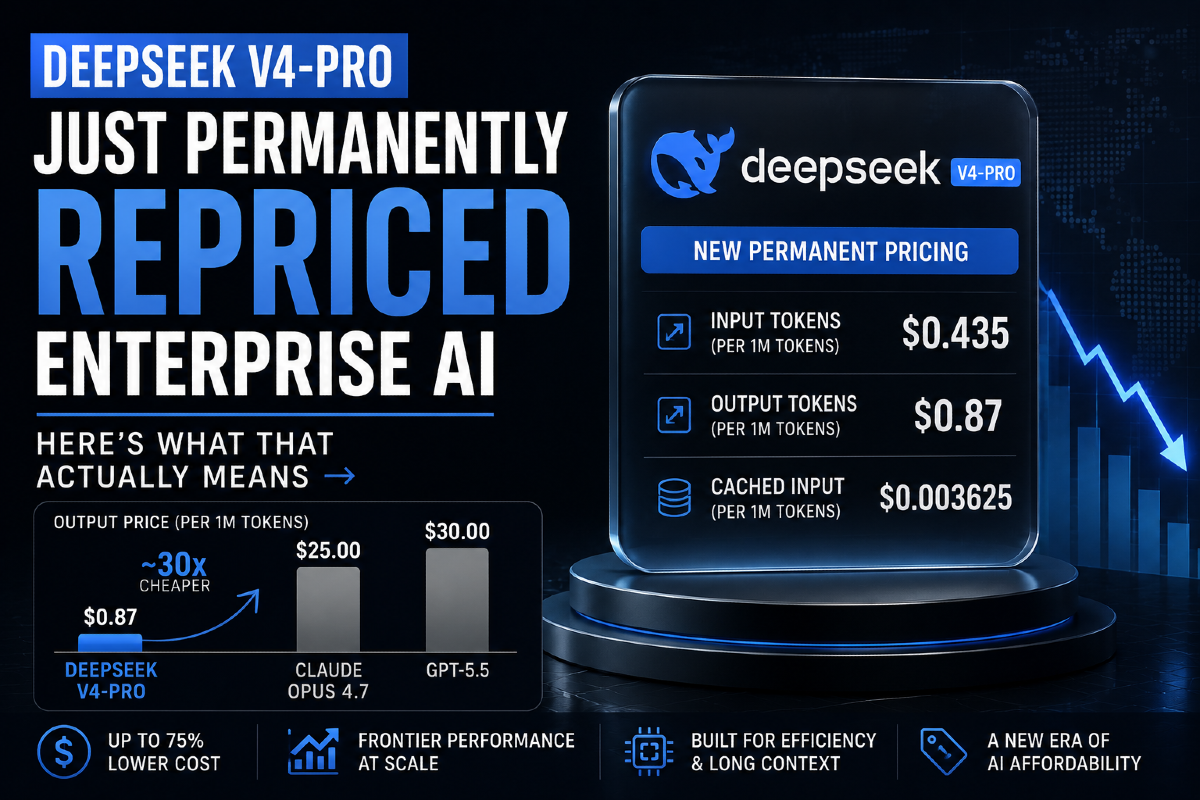
Soofi S arrives at a moment when the open-source LLM field is seeing fierce competition from both East and West. Models like Kimi K3 from Moonshot AI and DeepSeek V4-Pro are raising the bar on English and coding performance while aggressively pricing API access. A European model that competes credibly on those dimensions while adding dominant German-language capability and sovereign training infrastructure is a genuinely distinct proposition.
The consortium is actively seeking industry partners for the next development phase, focused on technical document processing, code generation, and agent-based systems. For teams building enterprise AI products for German-speaking markets, Soofi S is now likely the most interesting open-source starting point available.
For developers interested in self-hosting large open-weight models, it's also worth exploring the inference tooling landscape — tools like Mesh LLM can help distribute MoE model inference across multiple machines with a single OpenAI-compatible API endpoint.
Related Reading
- Tencent Hy3: Run a 295B Flagship MoE Model on a Single GPU with GGUF and llama.cpp
- Kimi K3 Launch Imminent: Moonshot AI's 2.5T-Parameter Model Set to Drop on July 15
- DeepSeek V4-Pro Just Permanently Repriced Enterprise AI — Here's What That Actually Means
- Mesh LLM: Run Any Model Across Multiple Machines With One OpenAI-Compatible API