ChatGPT Now Answers With Charts, Buttons and Mini Apps as GPT-6 Reaches Free Users on October 8
OpenAI is rolling out GPT-6 with Intelligent UI, which lets ChatGPT answer with charts, maps, buttons and small tools. Paid plans got GPT-6 Sol on Oct 7; Free and Go get GPT-6 Luna from Oct 8.
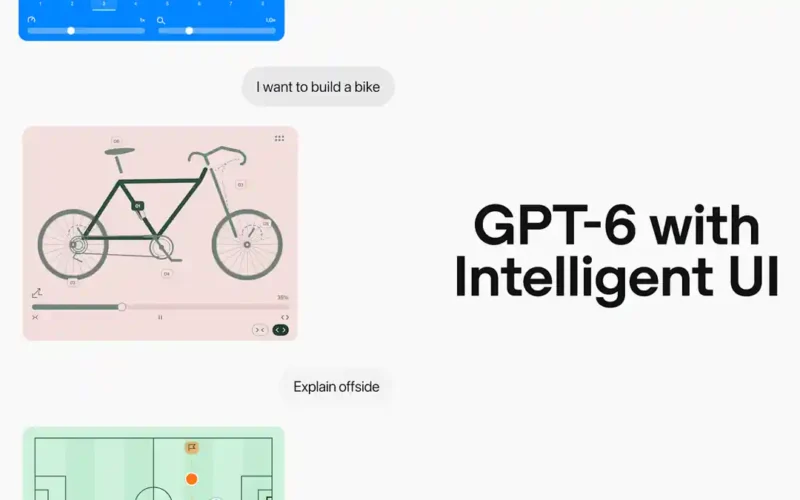
OpenAI is swapping the plain wall of text in ChatGPT for answers that can include charts, maps, tappable buttons, forms and small working tools. The feature is called Intelligent UI, and it ships with a new GPT-6 model in the Chat tab.
Paid users on Plus, Pro, Business and Enterprise started getting it on October 7. OpenAI says Free and Go users get it “starting tomorrow,” which is Thursday, October 8. That makes this the first time GPT-6 reaches ChatGPT’s free tier.
OpenAI announced it on X at 11:35 PM IST on October 7, and Sam Altman’s post saying “ChatGPT can now generate a custom UI for you!” passed 688,000 views within hours. Below is what OpenAI actually confirmed, what its own system card admits, and what is still missing.
What Intelligent UI actually does
According to OpenAI’s announcement, GPT-6 was trained to “compose responses using text, visuals and interactive elements,” and to pick the format based on the question. A comparison can appear side by side. An explanation can turn into a diagram you can click through.
OpenAI’s demo asks ChatGPT to break down a 7-speed bike. The answer is a labelled diagram with buttons for the frame, wheels, drivetrain, brakes and cockpit, and each one opens a short explanation. Other examples include a Sunday roast plan with a guest-count table, a road trip on a map, and interactive walkthroughs of the Monty Hall problem and the central limit theorem.
You can also ask it to build a tool on the spot. OpenAI lists a bill splitter, a retirement savings calculator and a retro game you play inside the chat.
OpenAI also says that “when a simple text answer is the most useful response, ChatGPT can give you that.” The model decides. The announcement does not mention a setting that lets you switch the visual answers off.
How OpenAI says it works
OpenAI describes something more structured than the model writing raw code for every reply. It says it built “a library of native, streamable components, along with a compiler that processes the interface as the model generates it.” The interface appears piece by piece while the answer is still being written.
The company says it trained the model to judge “content, layout, visuals, and interaction,” and graded the interfaces it produced for clarity, usefulness and completeness. It also admits there is “still work ahead to improve the model’s design judgment.”
That admission matters. A chart that looks authoritative is more persuasive than a paragraph, even when the numbers behind it are wrong. Interactive answers raise the cost of a hallucination, not lower it.
Which GPT-6 model you get
The rollout splits by plan. OpenAI’s post on X says paid tiers get GPT-6 Sol while Free and Go get GPT-6 Luna, and that “both are tuned for everyday conversation.”
| Plan | Model in Chat | Start date | Instant context window |
|---|---|---|---|
| Free | GPT-6 Luna | From October 8 | 27K tokens |
| Go | GPT-6 Luna | From October 8 | 54K tokens |
| Plus | GPT-6 Sol | October 7 | 54K tokens |
| Pro | GPT-6 Sol | October 7 | 128K tokens |
| Business and Enterprise | GPT-6 Sol | October 7 (admin settings apply for Enterprise) | Not compared here |
The context figures come from OpenAI’s ChatGPT pricing page as of October 8. The change only touches the Chat tab. OpenAI says “the models powering Work and Codex are not changing as part of this release.”
Developers should note these are not the same Sol and Luna sold through the API last month. The October system card says Codex and ChatGPT Work still run “previously released versions,” and labels the new ChatGPT models “October” to tell them apart. Our earlier look at GPT-6 Sol and Luna API pricing covers the September versions.
Faster answers, with OpenAI’s numbers only
The other big change is speed. GPT-6 can “interleave thinking with answering,” which means ChatGPT starts writing while it is still reasoning instead of making you wait for the full chain of thought.
OpenAI gives two figures. For questions that need web search, it says GPT-6 Instant starts answering 44% sooner on average than GPT-5.6 Instant. In an internal test of everyday agentic tasks, it says GPT-6 Extra High begins answering as fast as GPT-5.6 Medium while scoring better than GPT-5.6 Extra High.
Both are internal evaluations. OpenAI did not publish the task set, and no independent benchmark has checked them yet.
What the system card admits
The marketing post says GPT-6 is safer. The system card mostly agrees, but it is more specific about where the new models slipped.
| Area | What OpenAI reports for the October models |
|---|---|
| Disallowed content | Sol shows a statistically significant regression on standard self-harm. Luna shows regressions on self-harm, gore and sexual content, compared with GPT-5.6 counterparts. |
| OpenAI’s reading of that | Manual review found violations “borderline but still generally safe,” with the models more willing to answer informational self-harm questions while pointing to professional help. |
| Multiturn jailbreaks | Slightly lower point estimates than the September versions, with overlapping confidence intervals, but better than GPT-5.6 Sol at every attacker budget tested. |
| Prompt injection | 99.99% (Sol) and 99.79% (Luna) on instruction hierarchy tests. |
| Factuality | Improved over GPT-5.6 on nearly all metrics, except claim-level errors on factuality-heavy prompts. |
| Preparedness | Treated as High capability in cybersecurity and in biological and chemical domains. Below High in AI self-improvement. |
The Luna regressions are worth flagging because Luna is the model going to every Free and Go account, the plans with the widest reach. OpenAI shared progress on ChatGPT for Teens on the same day, and says under-18 protections apply by default to accounts it identifies as teens.
Confirmed vs not yet confirmed
| Confirmed by OpenAI | Not stated or not verified |
|---|---|
| Global rollout to paid tiers on October 7, Free and Go from October 8 | An exact hour, or how long the free rollout will take |
| Sol for paid plans, Luna for Free and Go | Message limits for GPT-6 Luna on the free plan |
| Chat tab only; Work and Codex models unchanged | Whether developers can use Intelligent UI components through the API |
| 44% faster first answer on web search questions (internal test) | Any independent speed or quality benchmark |
| Replaces GPT-5.6 Sol and Luna in ChatGPT | A user setting to turn interactive answers off |
What it means for Indian developers
The free and Go tiers are getting a meaningful upgrade, but the gap with Plus stays real. Free accounts get a 27K token Instant context window, half of what Go and Plus get, so long pasted logs or documents will hit the ceiling sooner.
If you build on ChatGPT, the developer path for now is plugins, not Intelligent UI. OpenAI Developers announced plugin extensions on October 7, which let plugins launch from the sidebar, support @ mentions and add file viewers. Adobe, Canva, Figma, Shopify, Instacart, Atlassian, tldraw and MagicPath are named as early builders.
Expect clients and managers to ask why your internal tools cannot do what ChatGPT now does in a chat window. A bill splitter or calculator built on demand is the kind of small utility that agencies are often paid to build.
And if your product depends on users copying text answers out of ChatGPT, test what those answers look like now. A response that used to be a list may arrive as a widget.
Our take
Intelligent UI is the most visible change to ChatGPT’s interface in a long time, and the demos are genuinely useful. Altman wrote that he “would hate to have to go back to the old version of Chat,” and Greg Brockman called it a way of “answering quickly with fully interactive user interfaces.”
The open question is trust. The speed claims are internal, the design judgment is admittedly unfinished, and the free-tier model shows safety regressions in OpenAI’s own testing. OpenAI has had a busy few weeks, from its DevDay launches to 722 math papers from an unreleased model. This one lands with the most people at once.
FAQ
When do free ChatGPT users get GPT-6 and Intelligent UI?
OpenAI says the rollout to Free and Go tiers starts on October 8, 2026, the day after paid tiers. It has not given an exact time, so some accounts may see it later than others.
Which GPT-6 model does the free plan use?
Free and Go users get GPT-6 Luna. Plus, Pro, Business and Enterprise get GPT-6 Sol. OpenAI says both are tuned for everyday conversation.
Does this change Codex or ChatGPT Work?
No. OpenAI says the update applies to the Chat tab only, and the models powering Work and Codex are not changing in this release.
Can developers use Intelligent UI in their own apps?
OpenAI has not said so. Its announcement covers ChatGPT only. For now, developers can build richer ChatGPT plugins using the plugin extensions OpenAI announced on October 7.
Is GPT-6 in ChatGPT safer than GPT-5.6?
OpenAI’s system card reports stronger jailbreak resistance and fewer factual errors on most tests. It also reports regressions on some disallowed content categories, especially for GPT-6 Luna, which OpenAI says were generally low severity after manual review.
2 comments