AMD Helion Packs Up to 32,768 Zen 6 Cores Into One Rack for AI Agents, but Partner Systems Only Arrive in November
AMD unveiled Helion on 12 Oct 2026, an open rack blueprint with up to 32,768 Zen 6 cores and 16 MI350P GPUs for AI agents. No price or power figure yet. We check the specs, AMD's footnotes and the USD math.
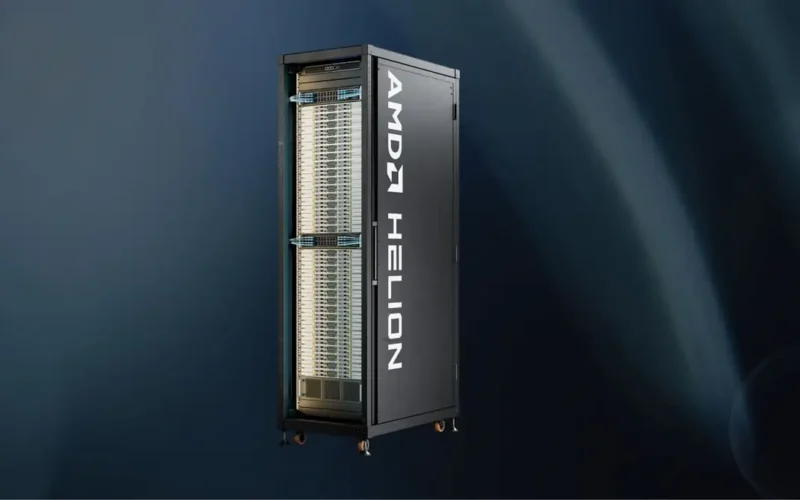
AMD on October 12, 2026 introduced Helion, an open rack blueprint built for AI agents rather than for model training. The headline number is up to 32,768 “Zen 6” CPU cores in a single rack, according to AMD’s press release. That is a CPU story at a time when almost every AI rack pitch is about GPUs.
You cannot buy one yet. AMD says partner configurations are “planned to be available in November 2026,” and the company has published no rack price, no rack power figure and no independent benchmark. What it has published is a detailed spec page, a list of eight hardware partners and a set of footnotes that are worth reading closely.
Helion was shown at the Open Compute Project Summit 2026 in San Jose, as The Register reported, which also noted that the name sits awkwardly close to Helios, AMD’s existing GPU rack.
What AMD actually announced
Helion is a reference design, not a box with an AMD price tag. AMD defines the blueprint and OEM and ODM partners build and sell the systems. AMD also says it plans to contribute the Helion specification to the Open Compute Project.
There are two base configurations. The hyperscale version is CPU only and aimed at “hyperscalers, neoclouds, and sovereign AI operators” who already run separate inference hardware, per the AMD Helion product page. The enterprise version mixes CPU blades, AMD Instinct MI350P GPU blades and general purpose blades in one rack.
Dan McNamara, AMD’s senior vice president for Compute and Enterprise AI, put the pitch this way: “Agentic AI is not a single workload. It spans personal agents, enterprise applications, code execution and complex workflows, each with different compute requirements.”
Two racks, three CPU blades
The spec page is more specific than the press release. Here is what AMD lists.
| Building block | What AMD lists | Intended use |
|---|---|---|
| Dense CPU blade | EPYC 9006, 256 cores at 400W | Personal agents, most agents per watt |
| Balanced CPU blade | EPYC 9006, 256 cores at 600W | Enterprise agents |
| Performance CPU blade | EPYC 9006, 96 cores at 5.0 GHz | Technical agents, latency sensitive work |
| GPU inference blade | Instinct MI350P, eight GPUs in a 5U server, up to two per rack | Inference inside the enterprise rack |
| General purpose blade | EPYC 9006 SP7 and SP8, 9006X SP7 | Databases, storage, technical compute |
| Rack | 21 inch ORv3, 44OU, liquid or air cooled, up to 102 Tbps networking | Both configurations |
Two details stand out. The 16 GPUs in the enterprise rack are two independent nodes of eight with “no scale-up GPU fabric between them,” AMD says in its FAQ. This is not a training machine. For that, AMD points buyers to Helios.
The enterprise rack also includes what AMD calls a token router, which sends an agent’s model calls either to frontier models in the cloud or to open source models running in the same rack. AMD has not published how the routing decisions are made.
Why AMD thinks agents need racks full of CPUs
The argument is simple. An agent does a lot of work between model calls. It runs code, calls tools, queries databases and retries. AMD’s EPYC 9006 page says that “planning, retrieval, and tool execution run on CPUs.”
Matt Kimball of Moor Insights & Strategy called Helion “one of the clearer attempts I’ve seen to design the rack around the full agentic workflow rather than just the accelerator.” He also flagged the token router as the feature to watch and said he had not seen much detail on how it works or how it is managed.
If you have read our coverage of Claude Managed Agents running up to 1,000 agents in phases, you can see the demand AMD is chasing. Each of those agents needs a sandbox somewhere, and sandboxes run on CPU cores, not tensor cores.
The numbers, and the fine print
The 32,768 core figure is a maximum. It works out to 128 processors at 256 cores each. AMD has not said how many nodes that is or what the full rack draws at load.
AMD’s comparisons with rivals come from its own footnotes. One says a rack of 256 core EPYC 9996 chips holds 2.08 times the cores of a rack built on Nvidia’s 88 core Vera CPU inside a 100 kW power budget. That is a core count comparison, not measured agent throughput, and AMD labels these figures “preliminary performance estimates based on AMD engineering projections or measurements as of July 22, 2026.”
AMD’s own fine print is blunt about agent counts: “Agent counts are estimates derived from available CPU thread resources used as a proxy under a consistent theoretical workload.” In other words, a thread is being counted as a unit of agent capacity. Real agents that sit idle waiting on an API, or that need lots of memory, will not map neatly to that.
There is also a SKU question. AMD’s spec listing shows the 256 core EPYC 9996 at a 600W default with a 400W to 600W power range. StorageReview noted that the separate 400W 256 core part AMD used in its July rack density footnotes has no product page yet. So it is not yet clear which chip fills the dense blade.
What a full CPU rack could cost
AMD has not priced Helion, and partners have not either. We can still estimate the CPU bill, which is the part AMD does publish guidance for.
StorageReview reports AMD’s 1,000 unit pricing guidance for the 256 core EPYC 9996 at USD 14,904. At 128 chips, that is about USD 1.9 million in processors alone, before memory, networking, storage, power shelves, cooling, integration and margin. That is our calculation using list guidance; real deals at this scale are negotiated.
Power is the other unknown. 128 chips at 400W is 51.2 kW of CPU power. At 600W it is 76.8 kW. Those are CPU figures only, and AMD’s own competitive modelling assumes a 100 kW rack. Many existing enterprise data centers cannot feed that, which is one reason the air cooled option matters.
Confirmed vs unconfirmed
| Claim | Status | Source |
|---|---|---|
| Up to 32,768 Zen 6 cores, up to 16 MI350P GPUs, up to 102 Tbps networking | Confirmed (AMD spec) | AMD product page |
| Partner configurations planned for November 2026 | Confirmed as a plan, not shipped | AMD press release |
| Partners: Cisco, Dell, Hon Hai, HPE, Lenovo, QCT, Supermicro, Wiwynn | Confirmed (quotes in release) | AMD press release |
| Spec contributed to OCP | Planned, not done | AMD press release |
| Rack price in USD | Not published | None |
| Full rack power draw and measured agent throughput | Not published | None |
| How the token router chooses models | Not published | AMD describes the feature only |
| Which 256 core chip ships in the dense 400W blade | Unclear | StorageReview, AMD spec listing |
What it means for Indian developers
Most developers in India will never buy a Helion rack. You are more likely to meet it indirectly, through a cloud or GPU provider that rents out agent sandboxes. AMD names neoclouds and sovereign AI operators as target buyers, and that is the slice of the market where Indian providers compete. AMD has announced no India specific availability or pricing.
The practical lesson is cheaper than a rack. If you run agents, measure how much of each task is model time and how much is CPU time spent on tool calls, builds, tests and retrieval. Many teams only budget for tokens. If your agents spend most of their wall clock time compiling code or scraping pages, CPU and memory are your real bottleneck, and you should size and price for that.
The token router idea is also worth copying in software today. Sending easy calls to a cheaper open model and hard ones to a frontier model is a policy you can write yourself, and it often moves the bill more than any hardware choice. Our look at DigitalOcean’s Agent Learning Services covers a related cloud approach to routing and improving agents. For a different hardware angle, see our piece on the AWS Physical AI toolchain.
Who should care now
Infrastructure buyers at clouds and large enterprises should treat Helion as a signal that CPU to GPU ratios for agent fleets are about to become a sales conversation. Ask partners for measured agents per rack on your own workload, not thread counts.
Everyone else can wait for November. The first partner quotes, the first power numbers and the first independent tests will say far more than a reference design and a set of projections.
FAQ
What is AMD Helion?
AMD Helion is an open rack reference design for agentic AI, announced on October 12, 2026. It comes as a CPU only hyperscale rack or an enterprise rack that mixes EPYC CPUs, Instinct MI350P GPUs and general purpose servers.
How many cores does an AMD Helion rack have?
Up to 32,768 Zen 6 CPU cores, according to AMD’s product page. That equals 128 processors at 256 cores each. The enterprise configuration can also hold up to 16 MI350P GPUs.
When can you buy AMD Helion and how much does it cost?
AMD says partner configurations are planned for November 2026. No rack price has been published. At AMD’s reported USD 14,904 guidance for the 256 core EPYC 9996, 128 chips would cost about USD 1.9 million before the rest of the system.
Is Helion the same as AMD Helios?
No. Helios is AMD’s GPU rack for frontier scale training and large scale inference with a unified scale-up GPU domain. Helion is built for running agents, and its enterprise GPU nodes have no scale-up fabric between them.
Which companies will build Helion systems?
AMD’s release includes supporting quotes from Cisco, Dell Technologies, Hon Hai, HPE, Lenovo, QCT, Supermicro and Wiwynn. None has published a Helion price or ship date beyond AMD’s November target.