Datadog Scout 1.0 Matches Opus 5.5 on Incident Investigations at 3 to 8x Lower Cost, but Only on Datadog’s Own Benchmark, and GPT-6.1 Sol Still Wins the Public Test
Datadog's Scout 1.0, built on GLM-5.3 Flash, powers Bits Investigation in a closed preview. It claims frontier-level incident triage at 3 to 8x lower cost on Datadog's own benchmark, but ties for second on public SREGym.
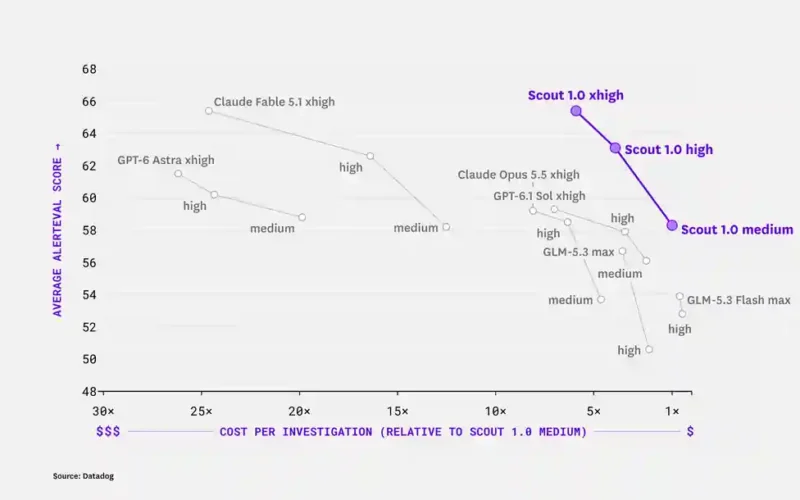
Datadog has trained its own AI model for one job: working out why production broke. Scout 1.0, announced on October 15, 2026, now powers Bits Investigation, the company’s AI site reliability engineering (SRE) agent, in a closed preview.
The headline claim is cost. Datadog says Scout 1.0 medium matches GPT-6.1 Sol high and Claude Opus 5.5 high on investigation quality at 3 to 8 times lower estimated inference cost, and that its xhigh mode matches Claude Fable 5.1 xhigh at 4 times lower cost.
Those wins come from Datadog’s own internal benchmark. On the one public test in its 22-page technical report, Scout comes close to the top but does not finish first. Here is what Datadog actually showed, and what it left out.
What Datadog launched
Scout 1.0 is not a general chatbot. Datadog calls it its “first AI model specialized for investigating production issues.” It sits inside Bits Investigation, which picks up an alert, forms hypotheses, queries metrics, logs and traces, and decides whether the evidence supports a root cause.
Each investigation needs many model calls. Datadog’s argument is simple: if each call is cheaper, Bits can look at far more alerts, and look earlier. The blog says the goal is investigations “cheap enough to run an order of magnitude more often.”
The post is signed by six Datadog staff, including Othmane Abou-Amal, Director of AI Research, and Chief Scientist Ameet Talwalkar.
How Scout was built
Scout starts from GLM-5.3 Flash, the open-weight model from Z.ai. The GLM-5.3 Flash model card on Hugging Face lists an MIT license. Datadog then post-trained it with reinforcement learning inside simulated investigations.
Those simulations are seeded from real historical incidents and real alert telemetry, but Datadog says they “don’t contain any customer data.” A framework it calls GenSim injects a known fault into a simulated service setup, so the model gets rewarded for finding a cause that is already known.
The report adds a few technical details:
- The training stack is a fork of the open source SkyRL project running on Ray.
- Datadog uses a modified version of GRPO that tolerates stale rollouts and discourages overly long investigations.
- The reward mixes correctness, exploration and evidence grounding.
- “Harness fuzzing” varies the optional tools and turn budgets during training, so the model does not overfit to one exact setup.
The AlertEval numbers, and how to read them
Datadog’s main scorecard is AlertEval, an internal benchmark built from real alerts, archived telemetry and root cause explanations written by Datadog engineers. An LLM judge Datadog calls DeepJudge scores each investigation from 0 to 100 against that reference.
This is the detail most people will miss. The report says plainly that a score of 57.5 “does not mean that the model solves 57.5 percent of incidents.” The rubric gives partial credit for matching the main cause and the deeper findings, and it penalises made-up findings.
| Datadog claim (AlertEval) | Compared with | Cost gap claimed |
|---|---|---|
| Scout 1.0 medium matches | GPT-6.1 Sol high, Claude Opus 5.5 high | 3 to 8 times cheaper |
| Scout 1.0 medium comparable to | Claude Fable 5.1 medium | 12 times cheaper |
| Scout 1.0 medium comparable to | GPT-6 Astra medium | 19 times cheaper |
| Scout 1.0 xhigh matches | Claude Fable 5.1 xhigh | 4 times cheaper |
Reading Datadog’s chart, Scout medium lands at roughly 58 and Scout xhigh at roughly 65. Every cost figure is an estimated inference cost relative to Scout 1.0 medium. Datadog publishes no dollar figure per investigation for Scout itself.
The public test: close to the top, not first
To show Scout is not simply tuned to its own exam, Datadog also ran SREGym, a public benchmark from the University of Illinois Urbana-Champaign. It used all 90 faults with the supplied Stratus harness, one attempt per fault. A fault counts only if the model both diagnoses and mitigates it.
| Model (effort) | SREGym faults resolved (of 90) |
|---|---|
| GPT-6.1 Sol xhigh | 82 |
| Scout 1.0 xhigh | 80 |
| GPT-6 Astra xhigh | 80 |
| Scout 1.0 high | 79 |
| Claude Opus 5.5 xhigh | 79 |
| Claude Fable 5.1 high | 76 |
| Scout 1.0 medium | 71 |
| GLM-5.3 | 68 |
| GLM-5.3 Flash (Scout’s base) | 66 |
Source: Figure 2 of Datadog’s technical report. Datadog ran these rows itself. One footnote matters: when Claude Fable’s safety classifier declined a task, Datadog fell back to Claude Opus 5.5 for it, so the Fable row is partly Opus.
So the honest summary is this. Post-training lifted the base model from 66 to 71 at medium effort, and Scout’s top mode gets within two faults of the leader. GPT-6.1 Sol xhigh still resolves the most. Datadog says Scout keeps at least a 2 times cost saving over every rival here and about 10 times over Astra and Fable class models.
There is also a small wording mismatch. The blog and the figure caption say Scout 1.0 high is competitive with frontier models on SREGym, while the report body says xhigh. The chart supports both readings, since they score 79 and 80.
Confirmed vs not yet known
| Confirmed by Datadog | Not stated or unconfirmed |
|---|---|
| Scout 1.0 is built on GLM-5.3 Flash and post-trained with RL | Whether Scout’s weights will ever be released |
| It powers Bits Investigation in a closed preview | A general availability date |
| Datadog engineering teams and a small group of customers use it on production alerts | Which customers, or how many |
| Training simulations contain no customer data | Independent replication of the AlertEval scores |
| Costs are estimated and relative to Scout medium | Whether Scout changes what customers pay per investigation |
What it costs today
Bits Investigation is billed through Datadog AI Credits. Datadog’s AI Credits pricing page lists $500 per 500 credits a month billed annually, or $1.30 per credit on demand. It estimates an autonomous Bits investigation at about 6.5 credits, with the caveat that real use varies with task complexity.
That works out to roughly $6.50 per investigation on an annual plan and about $8.45 on demand. Datadog has not said whether Scout lowers the credit count, so the inference saving it reports may or may not reach your bill. Unused credits reset each month and do not roll over.
The real incident Datadog used as proof
The report closes with an internal case. A Postgres alert fired because all 30 autovacuum workers had been busy for more than an hour while dead rows piled up, reaching about 4.5 million.
The cause was two hours and several components away. A Kubernetes node drain had removed a read replica along with its local disk, and the replacement replica started on another node with an empty disk. The primary kept the old replication slot, which stopped cleanup from moving forward.
According to Datadog, Bits with Scout linked the alert to that earlier node drain and recommended dropping the slot and rebuilding the replica. It is one hand-picked example, but it shows the kind of multi-hop reasoning on-call engineers actually need.
What it means for Indian developers
For Indian SaaS and platform teams already on Datadog, the price is what matters. At ₹95.10 to the dollar, about 6.5 credits comes to roughly ₹618 per investigation on an annual plan and about ₹804 on demand. Run that against your monthly alert volume before you switch on investigations for every alert.
The bigger lesson is the recipe. Datadog took an MIT-licensed open model, built simulations from its own incident history and post-trained a narrow specialist that competes with frontier models at a fraction of the cost. Teams in Bengaluru or Pune with rich incident logs could try the same idea on a smaller scale, and SREGym is public for anyone who wants to test an agent.
If you are building agents yourself, pair this with tracing. Our look at Claude’s new OpenTelemetry export and DigitalOcean’s Agent Learning Services covers the observability side. And before you give any agent production access, read how most coding agent setups erased their own logs when asked.
Our take
Scout is a good example of a trend we flagged with Cloudflare’s Clef models: companies with deep domain data are training small specialists instead of paying frontier prices for every call. The SREGym result is the most convincing part, because it is public and Scout lands within two faults of the leader.
The rest needs caution. AlertEval is Datadog’s benchmark, judged by Datadog’s LLM judge, on Datadog’s tools. Until Scout reaches general availability with clear per-investigation pricing, treat “frontier performance at a fraction of the cost” as a strong vendor claim with one good public data point behind it.
FAQ
What is Datadog Scout 1.0?
Scout 1.0 is Datadog’s first AI model trained specifically to investigate production incidents. It powers Bits Investigation, Datadog’s AI SRE agent, and was announced on October 15, 2026.
Is Scout 1.0 open source?
No release of Scout’s weights has been announced. It is built on GLM-5.3 Flash, which Z.ai publishes under an MIT license, but Scout itself is only available inside Bits Investigation.
Does a score of 58 on AlertEval mean Scout solves 58% of incidents?
No. Datadog says AlertEval scores measure agreement with expert reference explanations on a 0 to 100 scale with partial credit. They are not the share of incidents solved.
How much does a Bits investigation cost?
Datadog estimates about 6.5 AI Credits per autonomous investigation. That is roughly $6.50 on an annual plan or about $8.45 at the $1.30 on-demand rate. Datadog has not said whether Scout changes this.
Can I use Scout today?
Only through the closed preview. Datadog has a preview sign-up form and has not given a general availability date.