DeepSeek’s Super-Agent Pulled 4,340 GitHub Stars in a Day, but Its Own README Says Do Not Ship It
DeepSeek’s dsh-superagent is MIT licensed and drew thousands of stars in a day, but it is a research prototype for one GitHub repository, not a Claude Code replacement.
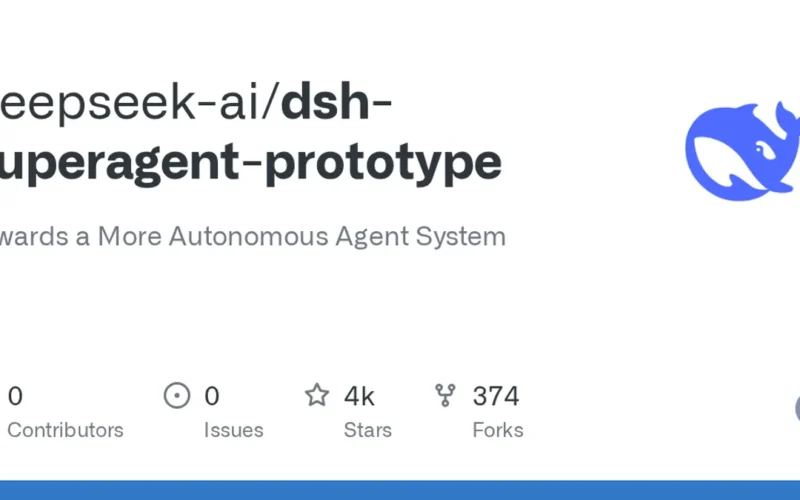
DeepSeek published dsh-superagent on GitHub at 09:32 UTC on 31 October 2026. About 22 hours later it had 4,340 stars and 401 forks. It is TypeScript, MIT licensed, and version 0.1.0.
Bloomberg framed the release as DeepSeek’s attempt to challenge Anthropic’s Claude Code. The repository is narrower. Its first line calls it a “research prototype for reference only, not an official DeepSeek product.” It has one commit, no releases, and warns of bugs.
The gap is the story. DeepSeek has published an authorization model for a coding agent, not a finished rival to Claude Code.
Quick answer: dsh-superagent is DeepSeek’s MIT-licensed research prototype that turns an @mention or a written rule in one GitHub repository into an authorized work ticket, runs it in a separate DeepSeek Harness session, and replies in the original conversation with a pull request or an answer. It is not an autonomous employee. It acts only when asked or allowed by policy, starts in observe mode by default, and has no published benchmark against Claude Code.
What DeepSeek actually shipped
The project is a bundle for DeepSeek Harness, the company’s open-source agent runtime. It listens to one github.com repository, and optionally to Feishu chats. When an allowed person asks for work, it creates a Ticket, gives that Ticket its own agent session and working directory, and replies in the original thread.
A web panel on port 3082 lists what needs a human: an undelivered message, a question waiting for an answer, a result waiting for review, or a blocked run. There is no hosted service or managed cloud.
It expects Node.js 22.19 or newer, pnpm, git 2.32 or newer, tmux, Python 3.8 or newer, GitHub CLI 2.48 or newer, and a compatible DeepSeek Harness version. GitHub Enterprise Server is explicitly unsupported.
| Feature | dsh-superagent | Claude Code | OpenAI Codex |
|---|---|---|---|
| Licence | MIT | Proprietary | Proprietary |
| Where it runs | DeepSeek Harness web panel, local process | Terminal, IDE, desktop, and web | CLI, IDE, cloud, and ChatGPT apps |
| How work starts | @mention, issue, comment, or a written policy rule | Human prompt, scheduled task, or GitHub Actions | Human prompt, cloud task, or @codex on GitHub |
| Scope | One github.com repository per deployment | Project or repository in the current session | Local repository or cloud environment |
| Permissions | Policy allow list, workers run as the operator’s OS user | Permission modes and approval prompts | Sandbox and approval modes |
| Starting price | Free software, model usage billed separately | $20 per month on Claude Pro | $20 per month on ChatGPT Plus, with a free tier |
| Maturity | v0.1.0 prototype with one commit | Shipping product | Shipping product |
The proactive part is a policy engine, not a personality
DeepSeek’s design describes a flow of Source, Trigger, Thread, Eval, Ticket, Assignment, and Channel. In plain English: something happens in GitHub or Feishu, the agent decides whether that event is a request for work, checks whether the sender is allowed to ask, and only then creates a ticket. A later human message can resume a ticket.
The README states the principle directly: “take as little human attention as possible, and give as much value as possible.” The philosophy document turns that into rules. It confirms a request once, stays quiet while it works, and writes again only for a result, a decision, or a failure. It asks one concrete question at a time.
This is more thoughtful than the average autonomous coding demo. The default accept mode is observe, which records what the agent would have done without doing it. The agent acts only for GitHub logins on an allowed list. The panel is designed to show only what needs a person.
The defaults also expose the limit. One deployment handles one repository, polls GitHub about once a minute, and runs each ticket in its own directory. Background shell jobs get 30 minutes after a turn ends. That fits a small team, not a fleet of agents running an engineering organization.
The numbers do not prove a Claude Code rival
Stars measure curiosity, not capability. The repository has no benchmark table, no evaluation results, and no comparison with Claude Code, Codex, or GitHub Copilot. Its package manifest is marked private, its version is 0.1.0, and its README says the published code has been adapted for release and is not identical to DeepSeek’s internal version. It also says some designs in the accompanying article are future directions that the prototype does not implement.
That does not make the release unimportant. It makes the Bloomberg framing premature. “Aims to rival” is a statement about intent, not a measured result. There is also no evidence that the policy model improves code quality. The tests check the software, not the agent’s judgement. Claims that it reduces interruptions or produces better pull requests have no published measurement.
Security is the catch for teams that try it early
The deployment documentation is unusually candid. Both the router and worker presets run with danger-full-access as the operator’s OS user. A worker can execute programs by path and read the operator’s home directory. The docs recommend a dedicated OS account containing only the agent’s credentials if isolation matters.
That is a disclosed design choice for a local developer tool, not a hidden vulnerability. But it changes the risk calculation. Anyone who can get a request onto the allowed list is asking a process with the operator’s file access to run code. The policy checks who may ask. It is not a content filter.
The Cursor extension backdoor showed how quickly a coding agent’s trust boundary becomes a supply-chain problem. This project has a different exposure: it is not distributing a poisoned update, it is running with the permissions of whoever installs it. Indian teams testing it should use a separate OS account or disposable VM, start in observe mode, and leave auto-merge off until the agent’s pull requests have been reviewed for several weeks.
What it means for Indian developers
The appeal is obvious for a small Indian team already living in GitHub issues. The software is free under the MIT licence and the setup is designed to be driven by an existing coding agent. A team can test the workflow without buying seats or asking a vendor for access.
The constraints matter more than the licence. One deployment handles one repository, so a company with twenty repositories needs twenty deployments. GitLab and Bitbucket are not supported. Feishu is the only chat source, which is useful for teams working with Chinese partners but not a substitute for Slack or Microsoft Teams.
The setup also assumes tmux and a Unix shell, which points to Linux, macOS, or WSL rather than a native Windows workstation. Under India’s Digital Personal Data Protection Act, teams also need to know where prompts and repository context are processed. The agent runs locally, but model calls leave the machine.
Open-weight alternatives are moving quickly, and licensing is becoming the differentiator. Mistral’s recent release showed that “open weights” can still come with paid reseller terms, while Kimi’s latest coding model arrived with a date for its weights. DeepSeek’s contribution is different: a permissive licence for the orchestration layer, not for a model. The durable lesson is the policy design, which other teams can copy.
Confirmed vs Not Confirmed
| Claim | Status | Evidence |
|---|---|---|
| DeepSeek published dsh-superagent under the MIT licence on 31 October 2026 | Confirmed | GitHub repository and LICENSE file |
| The repository had 4,340 stars and 401 forks about 22 hours after creation | Confirmed at the time of writing | GitHub API, 1 November 2026, 08:10 UTC |
| It is a research prototype, not an official DeepSeek product | Confirmed | README warning |
| It can monitor group chats for coding issues | Not confirmed as described | Only configured Feishu chats, and the bot reads mentions by default |
| It is a rival to Claude Code | Not confirmed | No benchmark or capability comparison published |
| It is production ready | Not confirmed | README says it is not production-ready software |
FAQ
Is dsh-superagent free?
The orchestration code is free under the MIT licence, and DeepSeek Harness is open source. Model usage is not free unless the configured provider offers a free tier.
Does it act without being mentioned?
Only when a written policy rule allows it. The default accept mode is observe, which records what the agent would have done without taking action.
Which repositories does it support?
One github.com repository per deployment. GitHub Enterprise Server is not supported, and there is no GitLab or Bitbucket source.
Has DeepSeek published benchmarks against Claude Code?
No. The repository contains no benchmark comparison, so the “rival” framing comes from press coverage, not a published evaluation.
Sources
DeepSeek, “dsh-superagent” repository, README, SETUP.md, and docs, published 31 October 2026. github.com/deepseek-ai/dsh-superagent-prototype
DeepSeek, “DeepSeek Harness” product page, accessed 1 November 2026. deepseek.com/en/harness
Debby Wu, “DeepSeek Drops Enhanced Coding Agent With Aim to Rival Anthropic”, Bloomberg, 1 November 2026. Bloomberg
GitHub API, repository metadata, retrieved 1 November 2026 at 08:10 UTC. api.github.com
Anthropic, “Claude Code overview” and “Plans and pricing”, accessed 1 November 2026. Overview, Pricing
OpenAI, “Codex” documentation and pricing, accessed 1 November 2026. Documentation, Pricing