DeepSeek V5 Rumor Claims a Huawei-Only Training Run — The Reporting Behind It Says Something Else
A viral post claims DeepSeek V5 is imminent and was trained fully on Huawei Ascend chips. DeepSeek hasn't confirmed any of it, and the real reporting underneath the rumor points to a narrower, still-unfinished bet on Huawei silicon.
A post that spread across X on September 26 made a big claim: DeepSeek is about to launch V5, its largest model yet, and it is the “first DeepSeek model to train fully on Huawei Ascend chips instead of Nvidia.” It also suggested the job took roughly four times as many Ascend chips as it would have needed Nvidia GPUs.
DeepSeek hasn’t said a word about V5. And when you trace each piece of the claim back to its source, most of it turns out to be real reporting that has been stitched together into a conclusion none of those reports actually makes.
Where the V5 Rumor Came From
According to a claim-by-claim breakdown published by CellCog, the viral post said DeepSeek was “reportedly preparing an imminent V5 launch,” that the model was “Rumored at 2 trillion parameters (not 3T),” and that it would be the first DeepSeek model trained fully on Ascend. It ran under a “Beats Astra” headline, but the image attached was just DeepSeek’s whale logo with “v5” typed next to it. No chart, no benchmark table, no score.
We could not independently confirm who wrote the original post, so we are not naming an account here. What we can do is check each claim against the record.
What Liang Wenfeng Actually Told Investors
The real news underneath the rumor broke on September 21. The Information reported that DeepSeek CEO Liang Wenfeng told investors that training on Huawei chips is one of the company’s biggest bets, and that Huawei is set to deliver a new batch of training chips as early as Q4 2026, or Q1 2027 at the latest.
Follow-up coverage summarized by TrendForce, citing Commercial Times and Chosun Biz, added three more details:
- DeepSeek is reportedly training a model of about 2 trillion parameters, and plans to eventually push to 8 trillion.
- Liang estimated that training a model comparable to OpenAI’s largest model in development would take around 50,000 Nvidia GB300 chips or roughly 200,000 Huawei Ascend 950 chips.
- Liang said he believes Huawei’s chips could catch up with Nvidia’s within a few years.
That 50,000-versus-200,000 figure is where the “four times as many Ascend chips” line comes from. It was an estimate for a hypothetical frontier-scale training run, not a disclosure about a finished model. And nothing in any of these reports calls the 2-trillion-parameter model “V5.”
The Timeline Doesn’t Fit a Huawei-Only V5
The “fully trained on Ascend” claim runs into a basic scheduling problem. If Huawei’s new training chips won’t arrive until Q4 2026 at the earliest, a model already trained entirely on them is hard to square with the reporting.
Bloomberg’s reporting points the same way. On September 4, Bloomberg reported that DeepSeek plans to deploy at least 160,000 Huawei Ascend 950DT chips at a data center it is building in Inner Mongolia. But the company intends to use them for running its models, and according to one person familiar with the matter, “doesn’t currently plan to use the 950DT chips for training.” Bloomberg also reported that while DeepSeek tried to train earlier models on Huawei chips, it has so far relied on Nvidia accelerators for that step.
Supply is another constraint. Per Bloomberg, component shortages, including top-end memory, will cap Huawei’s 950DT output at the low hundreds of thousands this year, and filling DeepSeek’s order could take more than a year.
What DeepSeek Has Officially Said
Nothing about V5. As of September 27, the newest entry on DeepSeek’s API change log is DeepSeek-V4.1-Flash, released September 10. DeepSeek describes it as “the smallest model in our new architecture family,” built for “a higher capability ceiling, faster inference, higher throughput, and scaling to larger models.” So a larger model on that architecture is clearly planned. DeepSeek just hasn’t said what it will be called, when it will ship, or what hardware trained it.
The only V5 timing in circulation is a sell-side forecast: CellCog points to a 36Kr roundup of a Bank of America outlook that expects DeepSeek V5 to debut in the second half of 2026. That’s an analyst’s expectation, not a launch notice.
What We Know vs. What’s Unconfirmed
| Claim | Status |
|---|---|
| Liang called Huawei-chip training one of DeepSeek’s biggest bets | Reported (The Information, Sep 21). It’s about the chip strategy, not V5. |
| DeepSeek is training a ~2T-parameter model | Reported, not confirmed by DeepSeek. No report names it V5. |
| ~4x more Ascend chips than Nvidia | An estimate Liang gave investors for a hypothetical run (50K GB300 vs ~200K Ascend 950). |
| V5 is launching imminently | Unconfirmed. No DeepSeek announcement. Only a Bank of America H2 2026 forecast. |
| V5 was trained fully on Huawei Ascend | Unsupported. Huawei training chips expected Q4 2026 at the earliest; the reported 950DT order is for inference. |
| V5 “beats” GPT-6 Astra | No source. No benchmark has been published. |
Why the Rumor Landed Anyway
The rumor spread because the direction of travel is real. When DeepSeek launched V4 in April, Reuters reported that the model had been adapted for Huawei’s most advanced Ascend chips, and Huawei said its chips were used for part of V4-Flash’s training. DeepSeek did not say whether V4 itself was trained on Nvidia hardware; its earlier V3 and R1 models were. (We covered that launch in our earlier piece on DeepSeek V4 and Huawei Ascend.)
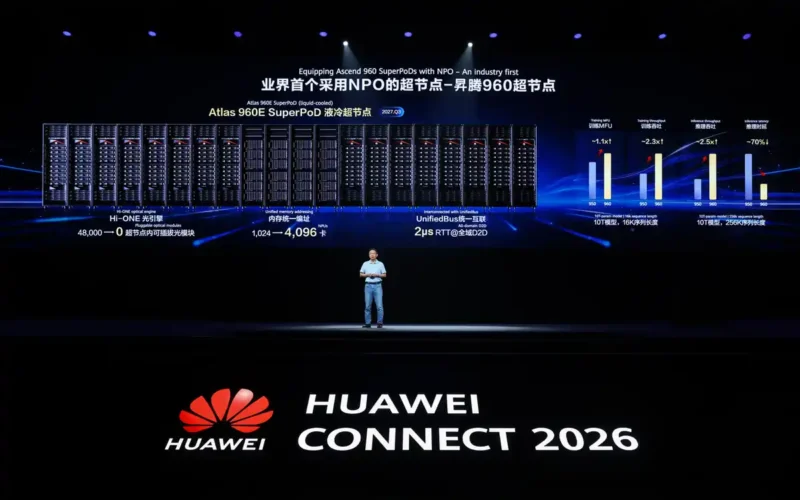
Huawei is also moving faster. At Huawei Connect this month, per Tom’s Hardware, the company said tests of the training-oriented Ascend 950DT (targeted for Q4 2026, with 144 GB of memory and 1 PFLOPS of FP8 compute) produced “good results,” and that it expects numerous Chinese AI developers to begin training on 950DT systems next year. It also pulled the Ascend 960DT forward to Q1 2027, while acknowledging its production capacity still falls short of domestic demand.
Then there’s the policy backdrop. Nvidia’s Blackwell GPUs remain off-limits to China: the ban survived May’s US-China summit, AI Weekly reported, citing CNN. In January, the US Commerce Department moved Nvidia H200 exports to China to case-by-case license review, but Bloomberg reports that Beijing has so far approved imports of only a fraction of the chips Washington was prepared to allow, and is urging its AI labs to switch to domestic hardware.
Put together, a Huawei-trained DeepSeek flagship looks plausible in the next year or so. It just isn’t confirmed today.
What to Watch
The confirmation that matters will come from DeepSeek, not X: a V5 (or V4.1 Pro) entry on its change log, a technical report that names the training hardware, or open weights on Hugging Face. Until then, treat V5 as a rumor built on real but narrower reporting. If DeepSeek does ship a large model trained mainly on Ascend, it would be the clearest test yet of whether export controls are slowing Chinese AI or just pushing DeepSeek to build on a different stack.
Frequently Asked Questions
Has DeepSeek announced V5?
No. As of September 27, 2026, DeepSeek’s newest official release is V4.1 Flash (September 10). Its API change log has no V5 entry.
Was DeepSeek V5 trained entirely on Huawei Ascend chips?
There’s no evidence for that. The Information reported Huawei’s new training chips could reach DeepSeek as early as Q4 2026, and Bloomberg reported DeepSeek’s planned 160,000-chip Ascend 950DT deployment is meant mainly for running models, not training them.
Where does the “four times as many chips” figure come from?
From an estimate Liang Wenfeng reportedly gave investors: roughly 50,000 Nvidia GB300 chips or about 200,000 Huawei Ascend 950 chips to train a model on the scale of OpenAI’s largest model in development. It describes a hypothetical training run, not V5.
Is DeepSeek training a 2-trillion-parameter model?
The Information reported it is, with 8 trillion as a later goal. DeepSeek hasn’t confirmed this, and no report has tied that model to the V5 name.