Apple Will Put a Health AI on 200,000 iPhones, but It Wonât Say How Long the Study Runs
Appleâs Health AI Usage Study will enroll up to 200,000 US adults with an OpenEvidence-powered app, but Apple has not published a duration, results date or product plan.
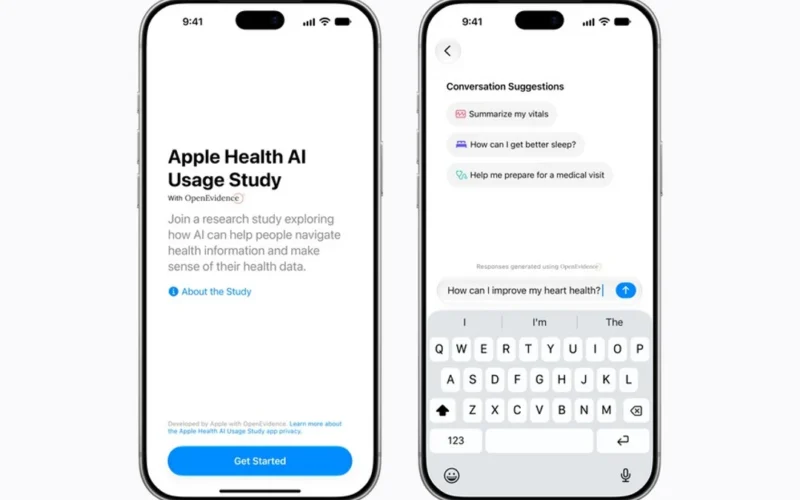
Apple opened the Apple Health AI Usage Study on 15 November, a virtual research study with an iPhone app built on OpenEvidence technology, and it will take up to 200,000 participants in the United States. The app answers everyday health questions with linked peer-reviewed citations, and participants can optionally share HealthKit data such as resting heart rate, activity, sleep or lab results.
The study is free, runs only on an Apple Intelligence-enabled iPhone, which Apple defines as iPhone 15 Pro or later, and needs iOS 26 or later. Participants must be 21 or older and live in the United States.
The catch is what Apple has not published. There is no stated study duration, no results date, no compensation details and no public protocol. Apple is asking people to hand over health questions and, optionally, personal health data, and it has not said when the research will end or what happens to the findings.
Quick answer: The Apple Health AI Usage Study is a US-only research program, not a shipping health feature. It caps enrollment at 200,000 adults aged 21 and over, requires an iPhone 15 Pro or later on iOS 26, and uses an Apple-built app powered by OpenEvidence, a clinical AI platform. Apple says study data will not be used to train AI models. It has not said how long the study runs, when results will be published, or whether a consumer health assistant will follow.
What Apple actually announced
Apple describes the project as a virtual study and an associated app designed to understand how people interact with conversational health AI. The company says it will examine what drives user trust, the quality of responses, comprehension, and the everyday health actions people take after using the tool.
The app lets participants ask health questions, read explanations written in plain language, and see peer-reviewed clinical citations linked to each answer. They can also choose to share specific HealthKit data types, including resting heart rate, activity, sleep and lab results, to see whether personal context changes how relevant or understandable an answer feels.
Apple says the study was designed with privacy protections, transparency and clinical guardrails. Study data will not be used to train AI models, and participants control whether to share HealthKit metrics or survey answers.
The health AI is the product decision, dressed as research
Sumbul Desai, Apple’s vice president of Health and Fitness, framed the study as the careful path. “Health is deeply personal, and conducting a dedicated research study is the most thoughtful way to understand how people engage with, comprehend, and evaluate health AI in everyday life,” she said in the announcement.
That is a reasonable position for a company whose health features carry regulatory weight. It is also a useful one. A study gives Apple a large, consented dataset and a reason to test an assistant without shipping it, while rivals race to put chatbots in front of patients.
The research questions are revealing. Apple is asking not only whether answers are accurate, but what makes people trust one and whether they act on it. Those are product questions as much as scientific ones, and they map onto the assistant Apple has been building toward in Siri AI and its app intents work.
Apple has spent the past year opening Siri to developers and shipping new hardware around it, including the HomeView display that puts Siri in the living room. A health assistant would be a harder launch than either, which helps explain why Apple is testing comprehension and clinician handoff before it tests a product name.
Who can join, and who cannot
The eligibility rules are narrow, and they matter more than the marketing. This is not a global beta. It is a US study with a hard device floor and an age gate, and the app is not listed in several major App Store storefronts.
| Requirement | Apple Health AI Usage Study |
|---|---|
| Participants | Up to 200,000 |
| Age | 21 or older |
| Country | United States only |
| Device | Apple Intelligence-enabled iPhone, defined by Apple as iPhone 15 Pro or later |
| Software | iOS 26 or later |
| App price | Free |
| App Store rating | 17+ |
| Health data sharing | Optional: resting heart rate, activity, sleep, lab results and survey answers |
| Compensation | Not stated in Apple’s announcement |
| Study end date | Not stated |
| Results publication | Not stated |
The App Store listing matches the announcement on the device and software floor: the app requires iOS 26.0, costs nothing, and is rated 17+. The listing shows version 1.0, a 15 November release date and a 16 November metadata update.
The storefront check makes the US-only claim concrete. A lookup of the app’s iTunes identifier returned it in the US store and zero results in the India, United Kingdom, Canada and Australia storefronts on 16 November. That is a snapshot, not a permanent policy.
The device requirement is not the barrier for India. Apple Intelligence and Siri AI are already presented on Apple’s India site, with Siri AI available in English. The barrier is the study’s geography and the app’s distribution, not whether an Indian iPhone can run the software.
The privacy promise is narrower than it sounds
Apple’s strongest claim is specific: study data will not be used to train AI models. That is a meaningful commitment, and it is narrower than “your data will never inform our AI.”
The App Store description says the quiet part in product language. “Questions you ask support research that can help Apple make health AI smarter for everyone,” it reads. Those two statements can coexist. Research findings can shape product decisions, evaluation criteria and future designs without the underlying study data becoming training data.
But the gap between the two sentences is where a reader should slow down. Apple has not published the study protocol, the institutional review board that oversees it, the retention period for questions and HealthKit data, or the process for withdrawing after enrollment. The announcement says participants retain control over sharing, and that Apple has security measures in place. Those are assurances, not auditable details.
The app’s own text says it does not provide medical advice, diagnosis or treatment. That is the correct disclaimer for a research tool, and it also places the clinical responsibility back on the user and their doctor.
The guardrails deserve credit. A system that detects concerning questions and routes people to a provider is better than one that answers everything with confidence. Whether those guardrails work, and how often they fire, is exactly the kind of finding Apple has not promised to publish. The company’s recent work on tightening macOS access for AI agents shows it knows how to ship privacy controls when it wants to.
What is confirmed and what is not
| Claim | Status | Basis |
|---|---|---|
| Study launched in the US on 15 November 2026 | Confirmed | Apple Newsroom announcement and App Store release date |
| Up to 200,000 participants, aged 21 and over | Confirmed | Apple Newsroom |
| Requires iPhone 15 Pro or later on iOS 26 | Confirmed | Apple Newsroom and App Store listing |
| Built with OpenEvidence technology | Confirmed | Apple Newsroom and App Store description |
| HealthKit sharing is optional | Confirmed | Apple Newsroom |
| Study data will not train AI models | Confirmed as Apple’s statement | Apple Newsroom |
| App is not for diagnosis or treatment | Confirmed | Apple Newsroom and App Store description |
| How long the study runs | Not confirmed | Not stated by Apple |
| When results will be published | Not confirmed | Not stated by Apple |
| Whether a consumer product will follow | Not confirmed | No Apple statement |
| Availability in India | Not available now | App absent from the India App Store on 16 November |
| Compensation for participants | Not confirmed | Not stated by Apple |
| Independent ethics review details | Not confirmed | No protocol or IRB details published |
| OpenEvidence user numbers and reach | Not confirmed | OpenEvidence’s site returned a location restriction to this server |
What it means for Indian developers
Indian developers cannot join the study today, and they should not plan a product around early access. The app is not in the India store, the study is US-only, and Apple has not announced an international expansion.
The design is still worth studying. Apple is testing citation grounding, plain-language comprehension, optional HealthKit context and clinician handoff as one package. That is a more defensible template for health AI than a chatbot that answers fluently and cites nothing. Indian teams building health tools can copy the evaluation questions even if they cannot copy the app.
Localisation is the harder lesson. An assistant validated on US participants, US lab conventions and US clinical workflows will not fit Indian users by default. Reference ranges, lab report formats, languages and care pathways differ. ABDM and ABHA also give developers a different integration surface from HealthKit, and India’s data protection law adds its own consent and retention duties.
Apple’s caution is a signal about the market, not a guarantee about the product. If the company eventually ships a health assistant, it will likely arrive in the US first and expand slowly. Indian developers should treat this study as evidence of where Apple is looking, not as validation for their own users. The company’s broader pattern of moving slowly on AI while rivals absorb legal risk fits the same strategy.
FAQ
What is the Apple Health AI Usage Study?
It is a US research study and iPhone app that lets up to 200,000 adults ask health questions and receive answers with linked peer-reviewed citations. Apple runs it with OpenEvidence technology to study trust, comprehension and real-world use of health AI.
Can I join from India?
No. Apple limits the study to the United States, and the study app was not listed in the India App Store when checked on 16 November. Apple Intelligence itself is available in India, so the restriction is the study, not the device software.
Does Apple use my health questions to train AI models?
Apple says study data will not be used to train AI models. The App Store listing also says questions support research that can help Apple make health AI smarter, which is broader than training. Apple has not published retention or withdrawal details.
Is the study app a medical device?
No. Apple says the app is not meant to diagnose or treat any condition or replace medical advice. It is a research tool with safety prompts that can point participants to a provider.
How long will the study last?
Apple has not said. The announcement gives no end date, no enrollment deadline and no timeline for publishing results.
Sources
- Apple Newsroom, “Apple launches research study to explore the use of AI for health,” 15 November 2026
- Apple App Store, “Apple Health AI Study App,” accessed 16 November 2026
- Apple iTunes Lookup API, app metadata, accessed 16 November 2026
- Apple India, “Apple Intelligence and Siri,” accessed 16 November 2026
- Apple Developer Documentation, HealthKit, accessed 16 November 2026
- Apple, Healthcare, accessed 16 November 2026