Is the AI Trade Over? What Korea’s Bear Market Really Tells Us
Korea's Kospi crashed 25%, sparking fears that the AI trade is over. However, evidence suggests a rotation rather than an end to the boom.
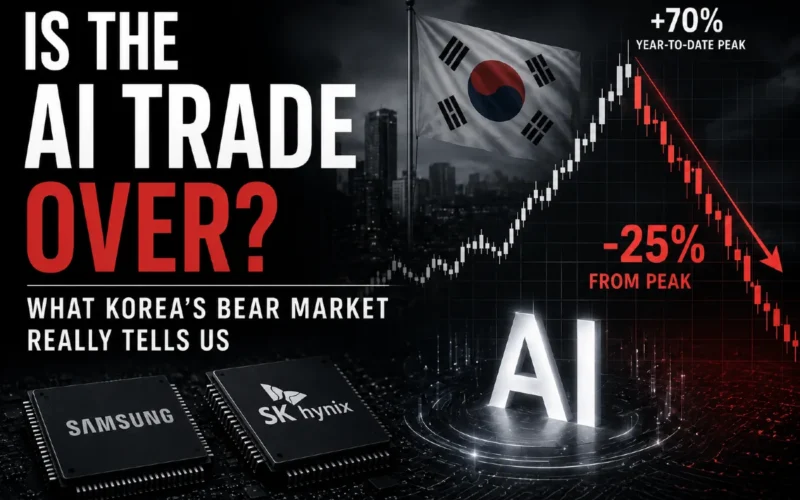
Many investors now ask if the AI trade is over after South Korea’s Kospi index fell 25%. This technical bear market hit in July 2026 following a massive rally. Samsung Electronics and SK Hynix drove most of that earlier growth. Therefore, this sharp decline naturally raises concerns about the entire sector. However, we must determine if the trend is actually cracking or just shifting.
Why Some Believe the AI Trade Is Over
The bear case begins with valuation concerns. Korean chip stocks rallied aggressively on optimism, creating a crowded trade globally. Consequently, profit-taking triggered easily once conditions shifted. Analysts at Kiwoom Securities noted genuine underlying worries beneath the surface. For example, memory-chip price growth may slow despite strong guidance from Samsung. Additionally, rising global rate uncertainty adds caution to the outlook.
Structural factors also amplified the collapse. Leveraged single-stock ETFs tied to chipmakers intensified one-directional trading. Regulators flagged these products as risks during momentum shifts. When markets are mechanically wired for concentration, sharp reversals become inevitable. Thus, sentiment changes cause outsized reactions regardless of fundamentals.
Evidence the AI Trade Is Rotating, Not Ending
Counter-evidence suggests the AI trade is not over. Samsung guided for strong second-quarter results right before the sell-off. Meanwhile, SK Hynix completed a $28 billion Nasdaq listing that was oversubscribed multiple times. Shares jumped over 13% on debut. Furthermore, the CEO warned of severe memory chip shortages heading into 2027. You can read more in SK Hynix’s $28B Nasdaq Listing: A Bright Spot Inside Korea’s Bear Market.
Capital did not leave artificial intelligence entirely; it simply rotated. Hong Kong’s Hang Seng China Enterprises Index posted its biggest daily gain since April 2025. AI-linked names and mainland chipmakers lifted that index during the same stretch. This pattern signals a rotation trade rather than a broad retreat. Therefore, investment themes remain intact despite regional volatility.
Expert Views on Whether the AI Trade Is Over
Strategists lean toward a reset rather than a reversal. Jung In Yun of Fibonacci Asset Management Global called the correction healthy. He believes foreign investors will revisit Korea once risk sentiment stabilizes. Similarly, Manishi Raychaudhuri of Emmer Capital blamed extreme concentration rather than collapsing earnings. These experts argue that positioning drove the drop, not broken fundamentals.
Peter Kim of KB Financial Group offered another useful perspective. He noted that retail flows and leveraged ETFs make 5-10% swings common today. News flow often drives these moves more than actual business performance. Ultimately, this reflects modern market structure rather than a verdict on artificial intelligence itself.
Conclusion: The AI Trade Is Maturing
The evidence indicates the AI trade is not over in the way bubble narratives imply. Investor tolerance has changed, but belief remains strong. Markets now demand proof that earnings can keep climbing. They also question whether valuations ran too far ahead of reality. This represents a maturing trade rather than a dying one.
Upcoming events like TSMC earnings and U.S. inflation data will provide clarity. Until then, the safest conclusion is simple. The opportunity is no longer a one-way bet, but the theme persists. Investors should watch for resets rather than expecting a total collapse.
