Latency Is the Product in Voice AI — and 354ms Changes Things
In most AI applications, a few hundred milliseconds is a rounding error. In real-time voice, it's the difference between a conversation that feels natural and one that feels like a satellite phone call from 2003.
That's what makes the latest addition to LiveKit Inference worth paying attention to. Google's Gemma 4 31B is now available on the platform, and the headline numbers are striking: 354ms time to first audio and 192ms time to first token. For anyone building voice agents — customer support bots, AI companions, real-time translators, or voice-enabled assistants — those are the metrics that determine whether users stay or hang up.
What LiveKit Inference Actually Is
LiveKit is best known as the open-source infrastructure layer for real-time audio and video applications. LiveKit Inference is its hosted model runtime, purpose-built to serve AI models with the kind of low-latency, low-jitter performance that real-time communication demands. It's not a general-purpose API endpoint — it's optimized for the specific constraints of voice pipelines, where every component in the chain (speech recognition, language model inference, text-to-speech) must contribute as little latency as possible.
Running a model on a standard LLM API and piping it into a voice pipeline will technically work. But the accumulated overhead from non-specialized infrastructure tends to push total response latency well past what feels acceptable in live conversation. LiveKit Inference is designed to close that gap.
Breaking Down the Numbers
The two key figures for Gemma 4 31B on LiveKit Inference:
- 192ms time to first token (TTFT) — how quickly the model begins generating output after receiving a prompt. This drives how fast the text-to-speech stage can start working.
- 354ms time to first audio — the end-to-end latency from input to the moment a user hears the first spoken word. This is the number users actually experience.
Sub-400ms time to first audio is generally considered the threshold for conversation that feels genuinely responsive rather than slightly delayed. Gemma 4 31B on LiveKit clears that bar with room to spare — a meaningful achievement for a 31-billion-parameter model that isn't a tiny, heavily-distilled latency special.
The Benchmark That Makes This More Than a Speed Story
Fast-but-dumb is a well-worn trade-off in voice AI. Smaller, faster models often struggle with the agentic workloads that make voice assistants genuinely useful — tool calls, multi-step reasoning, structured outputs from unstructured speech.
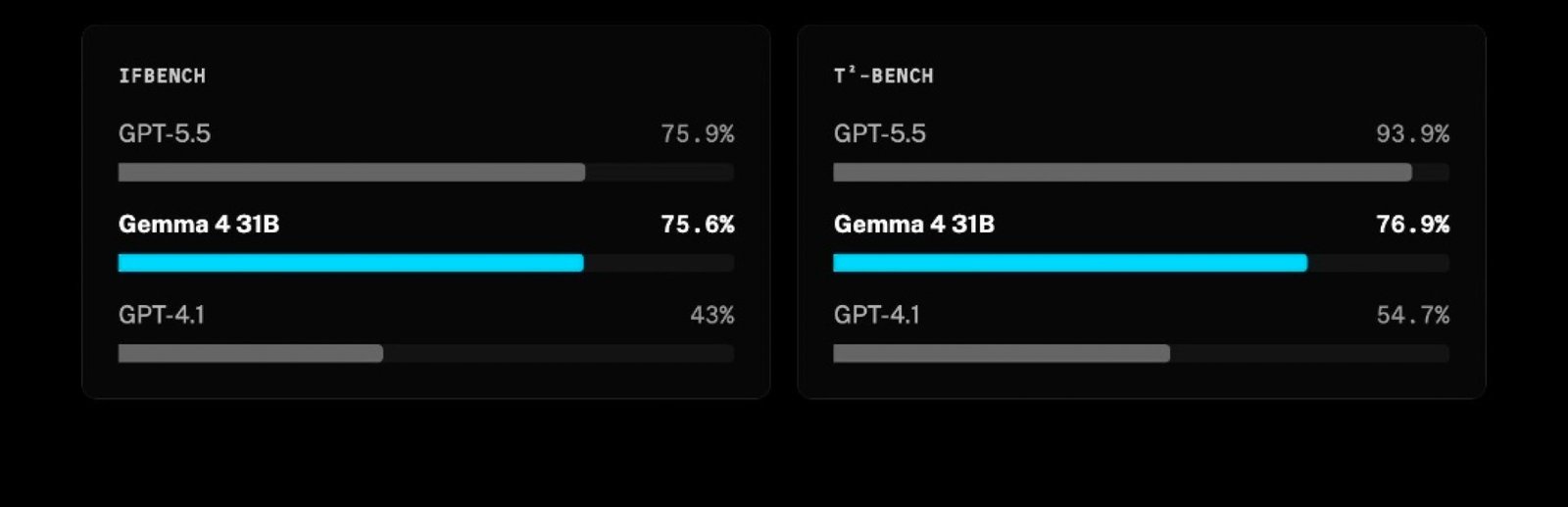
Gemma 4 31B complicates that trade-off. On tau2bench, a benchmark specifically designed to evaluate agentic tool-use performance — the kind of real-world reasoning required when a voice agent needs to look up an account, book an appointment, or escalate a ticket — the 31B model scores 76.9%. That figure, according to LiveKit's data, beats GPT-4.1 on the same benchmark.
That's not a trivial claim. GPT-4.1 is OpenAI's task-focused API model, explicitly tuned for instruction-following and agentic workloads. A 31B open model clearing it on tau2bench while also delivering sub-400ms first audio suggests that the latency-capability frontier for voice AI has moved faster than the broader industry has absorbed.
Why Model Size Still Matters Here
At 31 billion parameters, Gemma 4 31B sits in an interesting operational band. It's large enough to handle nuanced conversational context and complex tool orchestration, but small enough to run efficiently on modern inference infrastructure without the memory and compute overhead of frontier-scale models.
This mirrors a broader pattern in AI deployment. As we covered in our breakdown of AirLLM's layer-sharding approach for running 70B models on consumer hardware, the industry is increasingly focused on efficient inference techniques that extract more capability from a given compute budget — not just raw parameter scaling. LiveKit's optimization work on Gemma 4 31B is a production-grade expression of the same principle.
The Agentic Voice Agent Problem
Modern voice agents aren't just transcription-plus-response systems. They're increasingly expected to take actions: check inventory, update CRM records, retrieve account information, trigger workflows. This means the underlying model must handle not just language generation but structured tool calls, output parsing, and error recovery — all within the latency budget of a live conversation.
This is precisely where most small, fast models fall down. They generate tokens quickly but hallucinate tool call syntax, fail to handle ambiguous inputs gracefully, or break down under multi-turn context pressure. The tau2bench result suggests Gemma 4 31B handles these workloads more robustly than its size might suggest — and more robustly than at least one well-regarded larger model.
The reliability angle matters more than it might initially seem. We've documented how AI-generated outputs frequently fail in production environments — and voice agents are particularly unforgiving, since failures surface in real time, in front of real users, with no opportunity for quiet post-hoc correction.
What This Means for Voice AI Builders
For developers and teams actively building real-time voice products, Gemma 4 31B on LiveKit Inference represents a concrete option worth evaluating against a few key questions:
- Does your use case require agentic tool use? If yes, the tau2bench result is directly relevant — this model appears to handle structured tool orchestration well.
- What's your latency tolerance? Sub-400ms first audio is a meaningful bar. If your users are on high-latency connections or your pipeline adds overhead elsewhere, this baseline gives you margin.
- What's your cost and infrastructure story? A 31B open model on managed inference avoids the licensing and pricing structure of proprietary frontier models, which matters at scale.
- Is open-weight provenance important? Gemma 4 is a Google open-weight model. For teams with data residency requirements or fine-tuning ambitions, that's a different conversation than using a black-box API.
The Competitive Context
The voice AI infrastructure space is moving quickly. On the model side, the ongoing push to improve both reasoning capability and inference speed has intensified — as illustrated by the leaked Gemini 3.5 Pro specs pointing to continued aggressive investment from Google DeepMind in performance at the frontier. Gemma 4 31B sits in a different tier — open-weight, deployment-optimized, mid-size — but the release signals that Google's model family is increasingly covering the full deployment spectrum from on-device to frontier API.
On the infrastructure side, the demand for models purpose-built for real-time communication workloads is only growing. Voice is increasingly the interface layer for agentic AI — the modality that feels most natural for most users in most contexts. Getting the latency story right is foundational.
The agentic AI reliability challenge is also worth keeping in mind. As OpenAI's GPT-Red work demonstrates, robustness under adversarial and edge-case conditions is an ongoing challenge for all AI systems — including voice agents expected to handle unpredictable real-world inputs.
The Bottom Line
354ms time to first audio. 192ms time to first token. 76.9% on tau2bench, ahead of GPT-4.1. These aren't marketing approximations — they're specific, falsifiable claims on a platform designed for the workload they're describing.
For the voice AI community, Gemma 4 31B on LiveKit Inference is a meaningful data point: the latency-capability frontier for open-weight models in real-time voice has moved, and the new coordinates are worth knowing.