When South Korea's Kospi index plunged into a bear market in July 2026, the headlines focused on AI jitters and chip stock volatility. But underneath the noise was a much older and more universal lesson in investing: Kospi concentration risk — what happens when an entire index's fate rests on just two stocks. Understanding it can save you from getting blindsided by the next "unstoppable" market rally, wherever it happens to be.
What Is Concentration Risk?
Concentration risk is what happens when a small number of holdings account for a disproportionate share of a portfolio, fund, or index. It sounds obvious in theory — don't put all your eggs in one basket — but it quietly builds up inside diversified-looking products, including the index funds millions of people hold in retirement accounts.
Kospi Concentration Risk: A Textbook Case
The Kospi is the clearest recent example of concentration risk in action. As of June 2026, Samsung Electronics and SK Hynix together made up more than 66% of the MSCI Korea Index. That means an investor buying a "diversified" Korean index fund was really making a concentrated bet on two chipmakers and, by extension, on the global AI memory-chip cycle.
For most of 2026, that concentration was a tailwind. AI-driven demand for high-bandwidth memory chips pushed Samsung and SK Hynix sharply higher, and the Kospi became the world's best-performing major benchmark, up over 70% at its peak. Then sentiment shifted. When U.S. semiconductor stocks wobbled and questions emerged about memory pricing, the same two stocks that had powered the rally dragged the entire index down with them — a fall of roughly 25% from peak to trough within weeks.
A market strategist at KB Financial Group described the broader dynamic well: retail fund flows, leveraged ETFs, and heavy concentration in a handful of names have made 5-10% single-day swings increasingly common in modern markets. That's Kospi concentration risk compounding with the "gamification" of modern trading.
Where Else Concentration Risk Hides
- U.S. tech-heavy index funds. A handful of mega-cap technology companies now represent an outsized share of major U.S. indices, meaning "buying the market" is increasingly a bet on a small group of businesses.
- Sector ETFs. Funds marketed as broad exposure to "semiconductors" or "AI" can be dominated by two or three companies.
- Single-country emerging market funds. As Korea just demonstrated, country-specific funds can have even higher concentration than global benchmarks.
- Employer stock in retirement plans. A classic and often-overlooked form of concentration risk when a large share of a 401(k) sits in company stock.
How to Check Your Own Exposure
Most funds publish a "top holdings" breakdown in their fact sheet or prospectus. A useful rule of thumb: if the top five holdings account for more than 30-40% of the fund, you're holding something closer to a concentrated bet than a diversified position — even if the fund's name suggests otherwise. It's also worth checking whether multiple funds in your portfolio overlap in their largest holdings, since that can create hidden concentration across what looks like a diversified set of accounts.
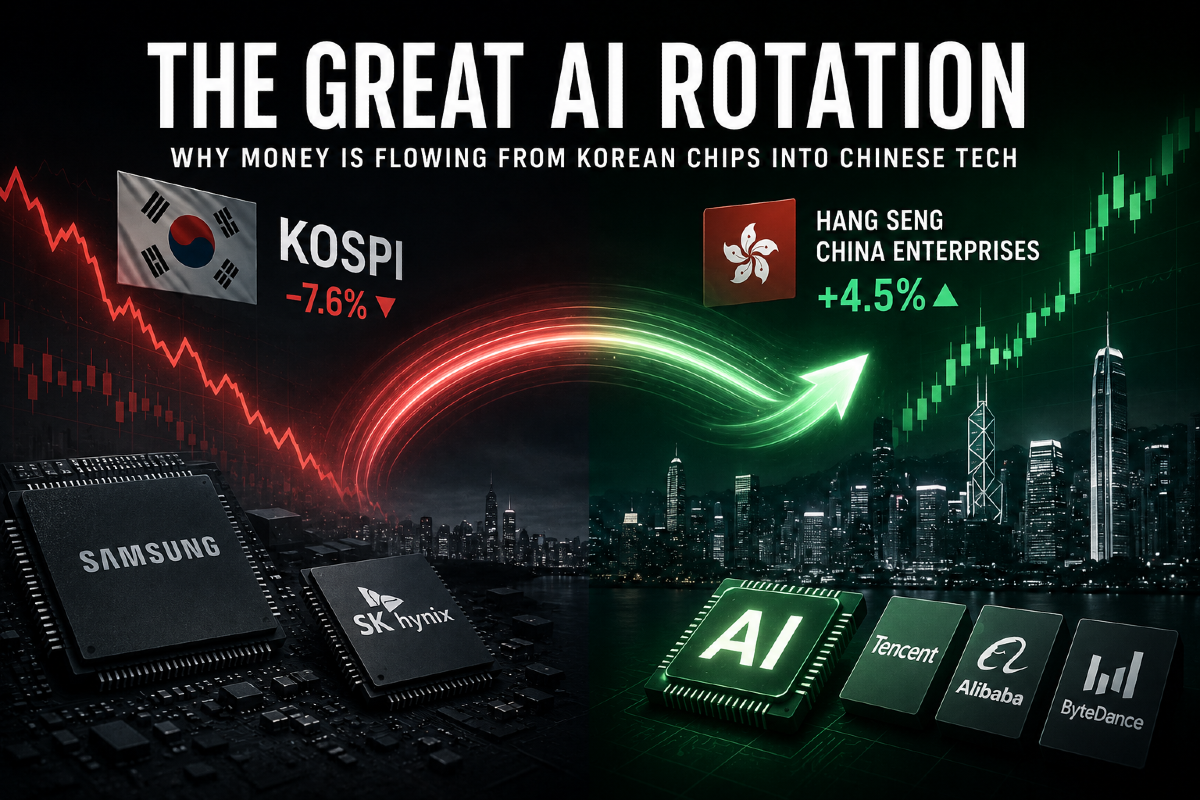
This doesn't mean concentrated positions are always bad — they can also drive outsized gains, as Korean investors saw for most of the year. It means going in with your eyes open, understanding that sharp reversals are the price of that upside, and sizing positions accordingly. The same dynamic is worth watching as capital rotates through the broader AI trade — something we explored in our breakdown of why the Kospi crashed 25% from its peak.
The Bottom Line on Kospi Concentration Risk
Korea's bear market wasn't caused by a collapse in fundamentals — Samsung had actually just guided for strong earnings. It was caused by too much of the index's fate resting on too few stocks. That's a lesson that applies well beyond Seoul, and it's worth a five-minute portfolio check no matter what market you invest in.