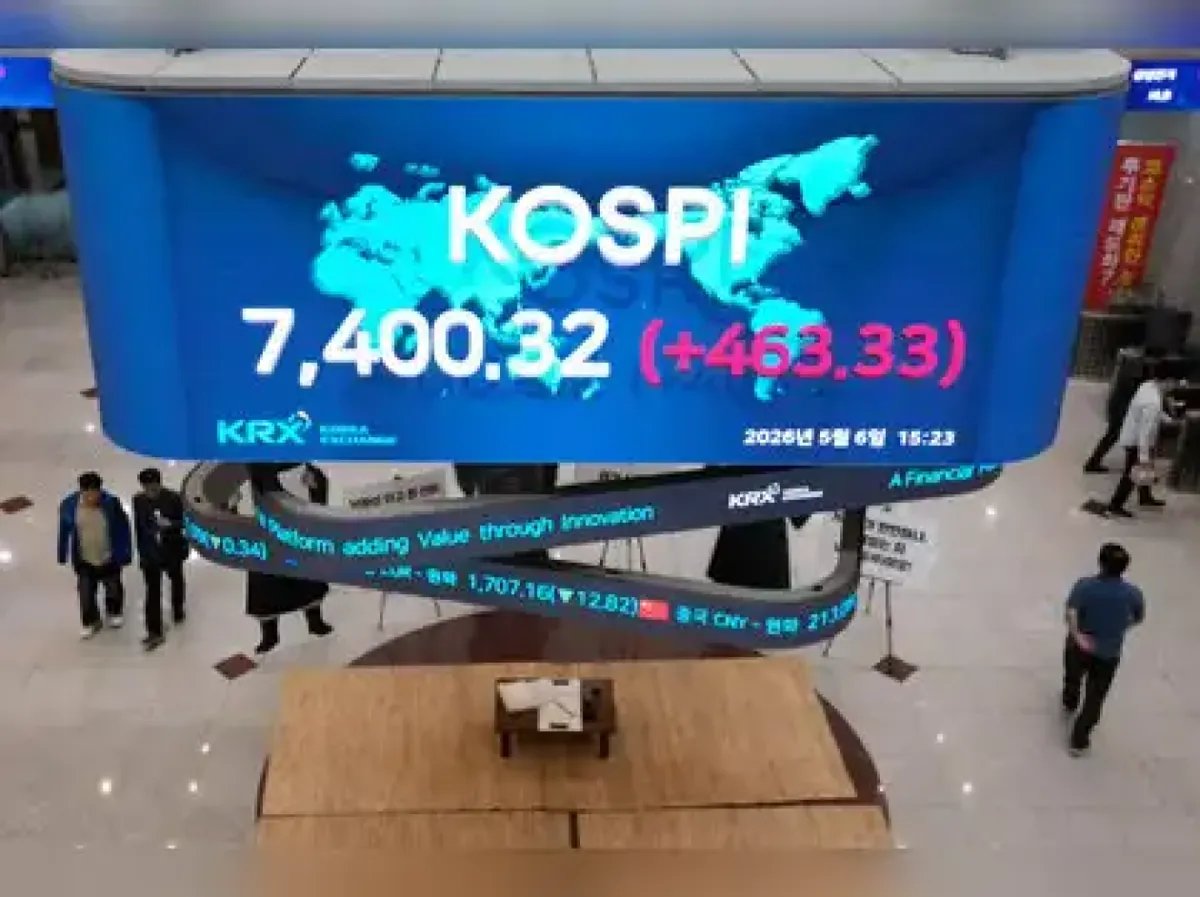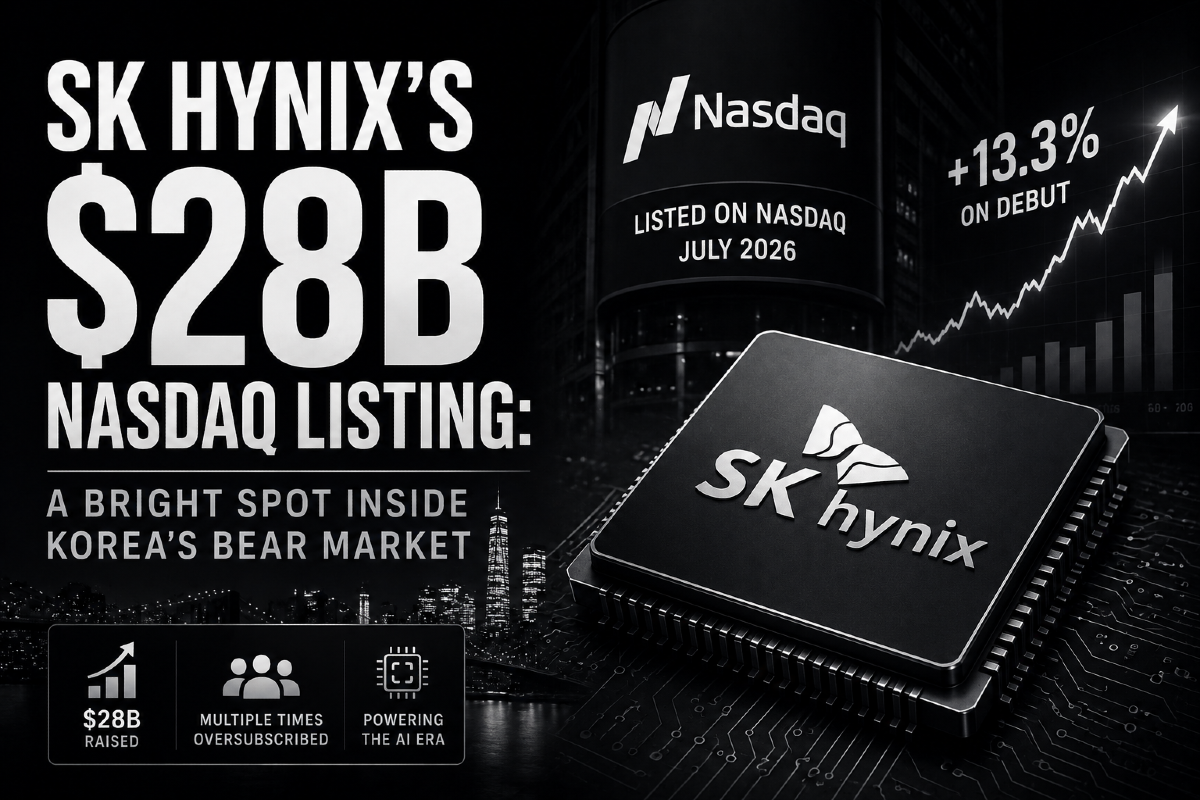
While South Korea's Kospi index was collapsing into a bear market, one of the very stocks dragging it down quietly pulled off one of the biggest share sales in the world. SK Hynix priced a $28 billion American Depositary Receipt offering on the Nasdaq that was covered multiple times over by U.S. investors — and its shares jumped more than 13% on debut. It's a reminder that a falling stock price and a struggling business are not always the same thing.
A Listing That Landed Despite the Storm
The timing could hardly have been more dramatic. SK Hynix's Korean-listed shares were sliding alongside the broader Kospi — down as much as 10% in a single week — even as the company finalized one of the largest new share sales anywhere in the world. Reuters reported that bookbuilding for the ADR offering was already covered multiple times before the deal even priced, with U.S. investors placing large orders. When the stock began trading on Nasdaq, it jumped over 13% at debut, a sharp contrast to the mood back home.
Pricing tells its own story. SK Hynix priced at $149 per ADR and raised roughly $26.5 billion, even as its domestic shares closed slightly lower on the same day. At that valuation, the stock trades at around 5.8 times forecast earnings — noticeably cheaper than U.S. peer Micron Technology, which trades closer to 7 times. For investors hunting AI memory exposure at a discount, that gap looked hard to ignore.
The CEO's Warning: A Shortage, Not a Slowdown
Perhaps the most striking signal came from SK Hynix CEO Kwak Noh-jung, who warned of the worst global memory chip shortage in years heading into 2027 — arguing that demand will outstrip supply for at least another decade, even accounting for planned capacity expansions. That's a notably bullish message from a company whose stock had just been through one of its sharpest drawdowns in years.
SK Hynix is a key supplier of high-bandwidth memory chips used in AI systems built by customers including Nvidia. The company is reportedly still weighing new wafer fabrication sites, including potential U.S. locations, while evaluating land, utilities, labor, and costs — alongside a separate $14 billion U.S. investment already underway. None of that reads like a company bracing for an AI slowdown.
Why the Stock Fell Anyway
So why did SK Hynix's Korean shares fall so hard if the underlying business looks this strong? The answer lies less in SK Hynix's own numbers and more in market structure. Samsung and SK Hynix together account for roughly two-thirds of the MSCI Korea Index, meaning any wobble in U.S. semiconductor sentiment gets amplified through the entire Kospi. Add in newly popular leveraged single-stock ETFs tied to chipmakers — which regulators have flagged as capable of intensifying one-sided trading — and short-term price swings can become disconnected from the underlying fundamentals. We covered this dynamic in detail in our piece on why the Kospi crashed 25% from its peak.
What This Means for AI Memory Investors
The SK Hynix ADR debut suggests a split forming between how global and domestic investors are pricing the same AI memory story. U.S. investors, presented with a fresh entry point and a valuation discount to Micron, piled in. Korean markets, weighed down by concentration and volatility from leveraged products, sold off. Both reactions can be true at once — the stock's short-term price action reflects market structure, while the CEO's shortage warning speaks to genuine multi-year demand.
For anyone tracking the broader AI infrastructure buildout, SK Hynix's listing is a useful data point: capital spending on AI memory hasn't slowed down, even during a week when Korean equities were making headlines for all the wrong reasons. That's consistent with what we found when covering how AI compute demand showed no signs of slowing despite chip stock jitters.