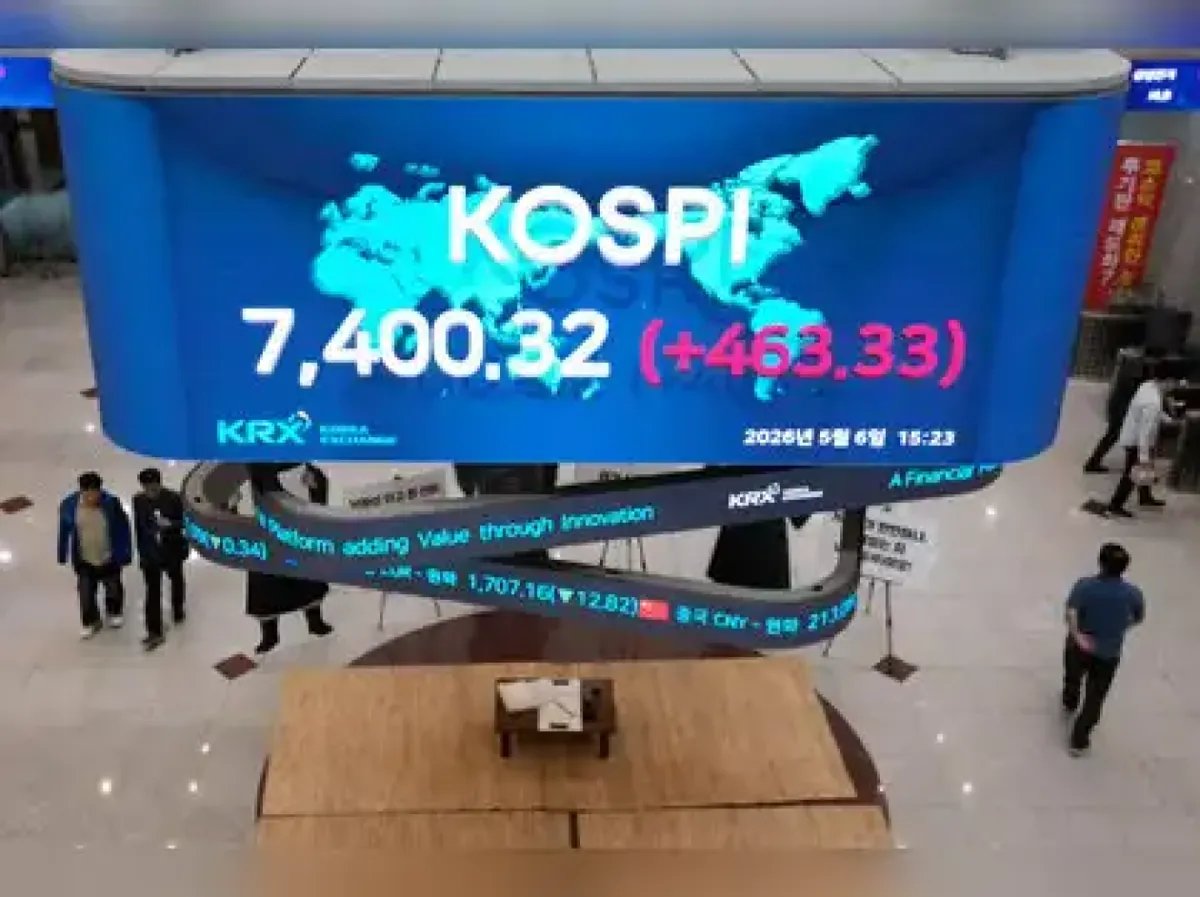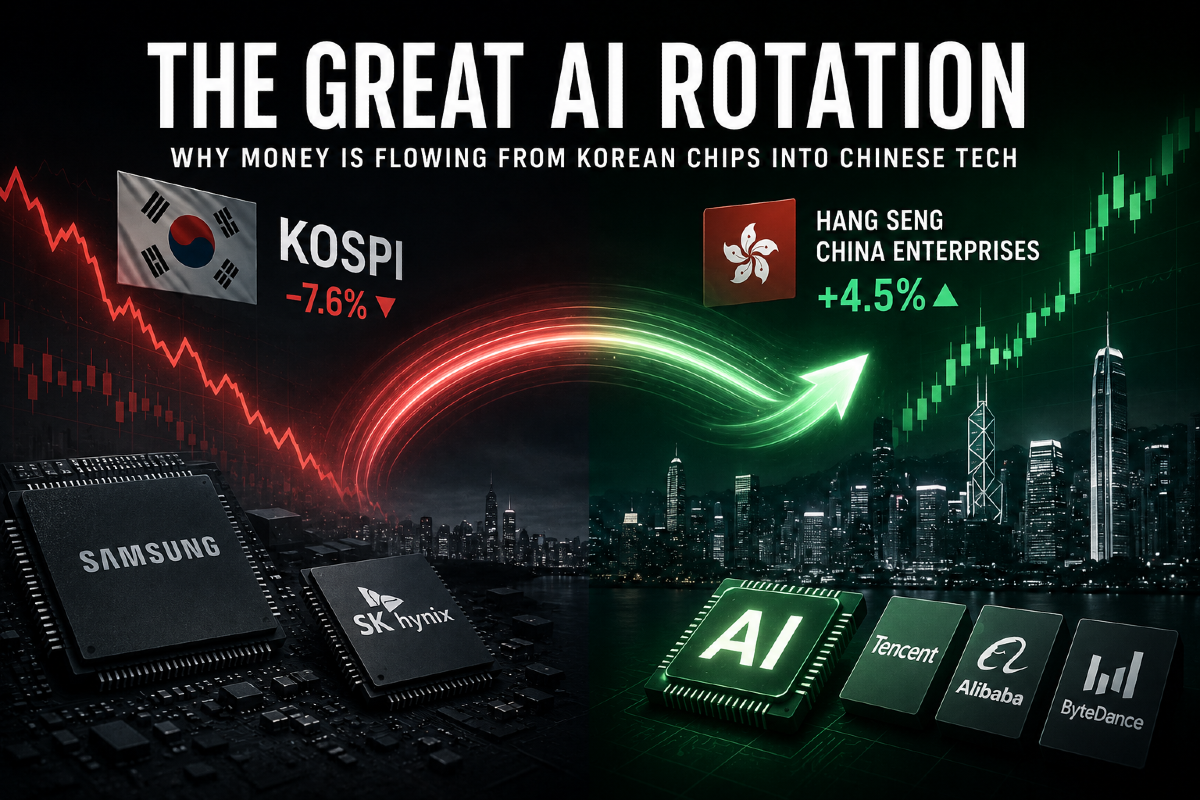
While South Korea's Kospi index was crashing into a bear market in early July 2026, something almost mirror-image was happening a few hundred miles away in Hong Kong. The Hang Seng China Enterprises Index jumped as much as 4.5% in a single session — its biggest advance since April 2025 — while Korean chipmakers bled billions in market value. This wasn't a coincidence. It's what strategists are calling the AI rotation trade, and it's reshaping how global investors play the artificial intelligence boom.
From Korea's Best-of-2026 to the Bottom of the League Table
Korean equities had become one of the most crowded AI trades in the world after an extraordinary run — the Kospi was up over 70% at its June peak, making it the best-performing major stock market globally. Samsung Electronics and SK Hynix, which together represent roughly two-thirds of the index's weighting, rode surging demand for AI memory chips all the way up.
Then the rotation hit. Within a single week, the Kospi lost 7.6% while the Hang Seng gained 3.5% — an 11-percentage-point swing between the two markets. Inside the tech sector, the gap was even starker: Hang Seng Tech climbed nearly 5% while SK Hynix fell over 10% and Samsung dropped almost 8% in the same stretch. By one measure, Korea went from the best performer among major indices to languishing near the bottom of the league table, while Chinese stocks in Hong Kong surged to the top.
Why Investors Are Rotating Into China
The move isn't really a rejection of the AI trade — it's a hunt for cheaper and more diversified ways to play it. A few forces are driving the shift:
- Valuation relief. SK Hynix trades at roughly 5.8 times forecast earnings versus about 7 times for U.S. peer Micron — cheap by some measures, but Korean chip names had still run far ahead of earnings, making investors nervous about further upside. Chinese AI names offered a comparatively less crowded entry point.
- Capital formation momentum. Chinese technology companies have raised roughly $20 billion in Hong Kong this year alone to fund AI, semiconductor, and advanced-manufacturing expansion, giving the rally a financing base beyond pure sentiment.
- Broadening beneficiaries. Rather than concentrating in one or two chipmakers, the rotation has lifted a wider basket — from mainland-listed chipmakers to large language model developers like Zhipu and MiniMax, both of which have posted enormous year-to-date gains.
- A shift into financials. Some of the rebound has come from investors rotating out of AI-linked names entirely and into insurers and lenders, suggesting part of the move is simple portfolio rebalancing rather than a pure AI bet.
Not a Clean Story
It's worth noting this rotation isn't uniformly bullish for China either. Just weeks earlier, Hong Kong's China Enterprises gauge had been sinking as global AI investors favored chipmakers elsewhere, with financial shares dominating an index seen as underexposed to the AI supply chain. That earlier weakness is part of what made the rebound so sharp — money moved into a market that had been comparatively unloved, not one already priced for perfection.
Meanwhile, the underlying Korean AI story hasn't actually broken. Samsung guided for strong quarterly earnings just before the sell-off, and SK Hynix pulled off a $28 billion Nasdaq listing that was oversubscribed multiple times over, with its CEO warning of a looming multi-year memory chip shortage. For more on why the fundamentals look sturdier than the price action suggests, see our full breakdown of why the Kospi crashed 25% from its peak.
What Comes Next
Markets have three near-term tests that could determine whether the rotation sticks or reverses: TSMC's delayed sales figures and Q2 earnings, fresh U.S. inflation data, and the Bank of Korea's next policy meeting. As one Great Hill Capital strategist put it, global semiconductors have become "the most crowded trade in the world right now" — which means capital is likely to keep moving fast between whichever markets look cheapest relative to the AI story, rather than settling anywhere for long.