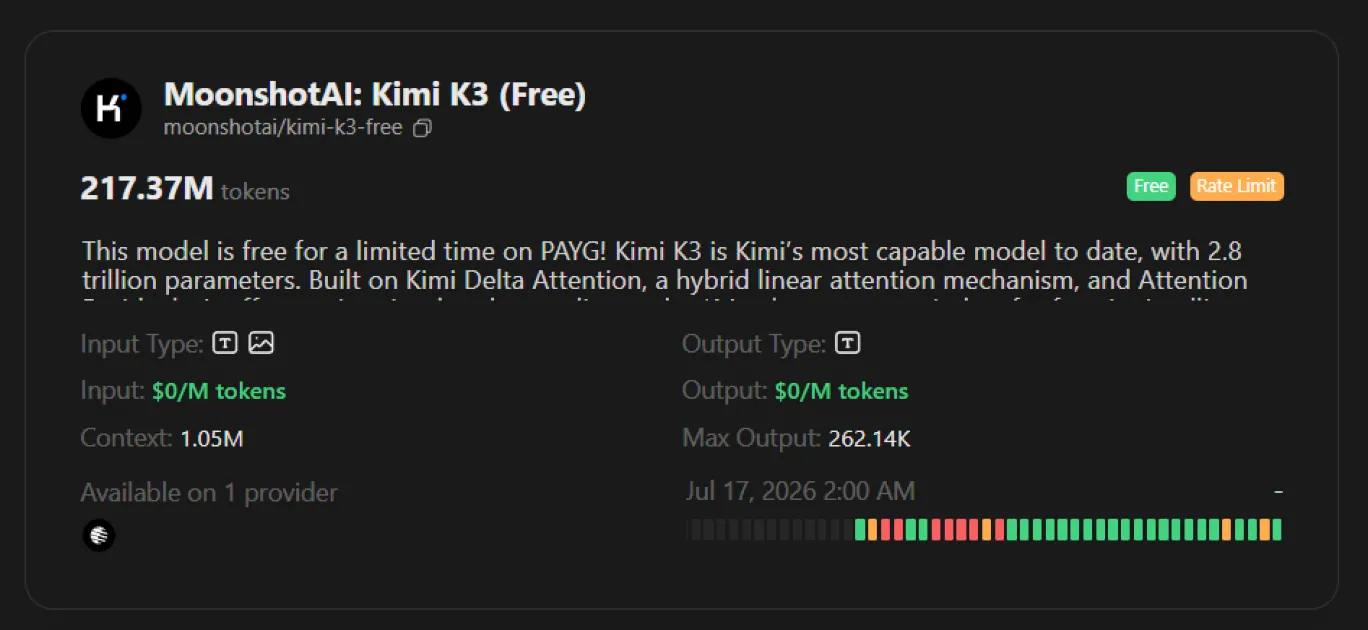
Moonshot AI's Kimi K3 — the 2.8-trillion-parameter open-weight model that topped LMArena's Code Arena and sent Google Trends searches for its creator soaring 500% — has landed on ZenMux, the enterprise LLM gateway built around unified API access and AI model insurance. More importantly: ZenMux is running it free on its pay-as-you-go tier for a limited time.
For developers who want to experiment with Kimi K3's flagship capabilities — 1M-token context, native vision, and the long-horizon coding benchmarks it's already known for — without spinning up API keys from Moonshot AI directly, this is the fastest on-ramp available right now.
What ZenMux Actually Is
ZenMux is a Singapore-based enterprise model aggregation platform that lets developers access 100+ AI models — GPT-5.x, Claude, Gemini, DeepSeek, Grok, Kimi, Qwen, and more — through a single API endpoint. The platform is compatible with OpenAI, Anthropic, and Google Vertex AI protocols, meaning existing integrations don't require rewrites.
Its differentiating feature is AI Model Insurance: a built-in compensation mechanism that covers subpar outputs — hallucinations, excessive latency, or low throughput. That's an unusual proposition in the crowded LLM gateway space, and it's what sets ZenMux apart from alternatives like OpenRouter.
Pricing is pay-per-token outside of the free tier, ranging from $0.05 to $21 per million input tokens depending on the model. Kimi K3 is currently listed at no charge on the PAYG plan — though ZenMux hasn't committed to a specific end date for the promotion.
What You Get With Kimi K3 on ZenMux
Kimi K3's architecture is worth understanding before you start querying it. The model is built on Kimi Delta Attention (KDA), a hybrid linear attention mechanism designed to improve information flow across long sequences, paired with Attention Residuals for deeper model coherence. Its Mixture-of-Experts setup activates 16 out of 896 experts per token — giving it the efficiency of a smaller model with the capacity of a near-3-trillion-parameter system.
In practice, that translates to:
- 1M-token context window — one of the largest of any publicly accessible model
- Native visual understanding — image input without the need for a separate vision pipeline
- Long-horizon coding — sustained multi-step engineering tasks with terminal tool use
- Reasoning and knowledge work — competitive with frontier closed-source models on deep analytical tasks
Full model weights are scheduled for open release on July 27, 2026. Until then, API access — either directly via Moonshot AI or through platforms like ZenMux — is the primary way to run the model at scale.
How to Access It
Create an account on ZenMux. Once signed in, Kimi K3 is available under the MoonshotAI provider section and is currently flagged as free on the PAYG tier.
The free tier is listed as a limited-time offer with no publicly stated deadline, so it's worth testing now rather than waiting. ZenMux's track record with similar promotions — including a previous free window for Kimi K2.7 — suggests these offers tend to run for days to weeks, not months.
Why This Matters Beyond the Free Label
The more interesting dimension here isn't the cost — it's routing. ZenMux's intelligent auto-routing means developers building multi-model pipelines can drop Kimi K3 into an existing workflow without managing a separate Moonshot AI integration. For teams already using ZenMux to call Claude or Gemini, adding K3 to an agent stack is a configuration change, not a migration.
The timing also matters. Kimi K3 currently leads on LMArena's Code Arena above every major Western model — and the model's full weights haven't even been released yet. Getting familiar with its behavior and latency profile now, while it's free, puts developers ahead of whatever workflow shifts follow the July 27 open-weight drop.