Fish Audio Drama 3 Ships at $10 per Million Characters Through November 12, Then $50 List, With Open Weights Under a $500K Revenue Cap
Fish Audio launched Drama 3 on 13 Oct 2026: directed TTS at $10 per million characters through 12 Nov (list $50), open weights under a $500K revenue cap, and Vercel AI Gateway support.
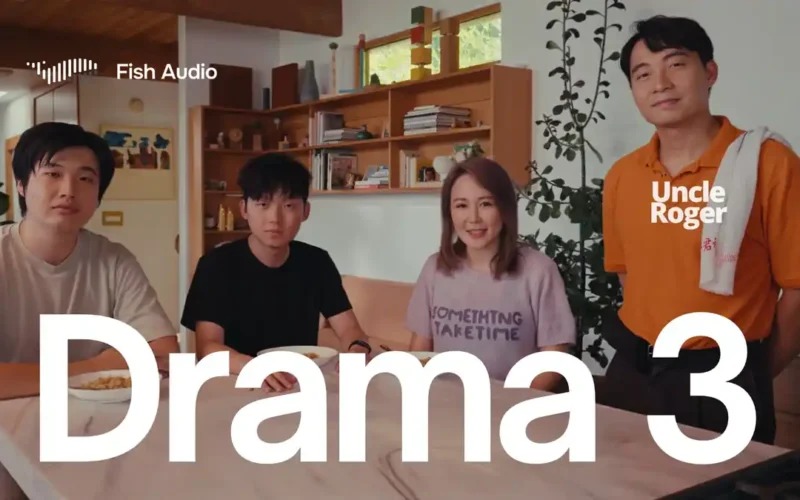
Fish Audio launched Drama 3 on 13 October 2026, pitching it as a text-to-speech model you direct like an actor rather than one you only prompt for a flat read. The company says the same bracket directions that worked on S2.1 Pro now land with more emotion, mid-line mood shifts, and stronger pronunciation on hard words.
Availability is immediate on fish.audio Text to Speech, the iOS and Android apps, the Fish Audio API, and Vercel’s AI Gateway. For the first 30 days, API usage is marked at USD 10 per million characters, which Fish Audio states is 80% off a USD 50 list price, through 12 November 2026. New creator plans get 50% off in the same window.
Drama 3 is also open-weight under the Fish Audio Community License v1.0: free for research and non-commercial use, and free for commercial use if you and your affiliates have less than USD 500,000 in annual revenue. Above that, or if you resell it as a TTS or cloning API, you need a paid license. The model is still labeled preview, and Fish Audio tells creators to render a few takes and keep the best one.
What Drama 3 actually ships
According to the Drama 3 docs, you keep the existing POST /v1/tts endpoint and set the model header to drama-3. Misspell the header and the request does not fail; it falls back to s2.1-pro.
Direction lives in the script. Square brackets set emotion, pacing, and character. Sounds and pauses sit where they should happen. Paired tags such as emphasis or whisper change only the words inside. Directions can be written in a language that does not match the spoken line. Multi-speaker scenes use speaker tags plus an array of voice IDs in reference_id.
Fish Audio claims Drama 3 speaks 83 languages. It also cites Artificial Analysis’ Pronunciation Robustness benchmark at 93.2% overall versus 88.1% for S2.1 Pro, with gains on brand names, context-dependent words, and exact sequences. That is an independent leaderboard Fish Audio points to, not a full production QA suite for every language you care about.
Pricing in USD, and what the launch offer means
The concrete API launch figure is clear in the blog: USD 10 per million characters from 13 October through 12 November 2026, against a stated USD 50 list. Vercel repeats the same 80% off window for AI Gateway. After 12 November, budget against the USD 50 list unless Fish Audio extends the promo.
Creator web plans sit beside the API. Fish Audio’s pricing page lists Free at USD 0 (8,000 credits monthly), Plus at USD 11 per month on annual billing (USD 15 monthly), Pro at USD 75 per month on annual billing (USD 100 monthly), and Max at USD 749 per month on annual billing (USD 999 monthly). The launch post’s 50% off new creator plans is a time-boxed discount on those plans; it is not a permanent rate cut.
| Item | What Fish Audio states |
|---|---|
| Drama 3 API launch price | USD 10 per million characters, 13 Oct to 12 Nov 2026 |
| Stated API list price | USD 50 per million characters after the offer |
| Creator plan promo | 50% off new creator plans in the same window |
| Free web tier | USD 0, 8,000 credits monthly, up to 500 characters per generation |
| Plus / Pro / Max (annual) | USD 11 / 75 / 749 per month billed yearly |
| Open-weight commercial free tier | Under USD 500,000 annual revenue for you and affiliates |
Character billing is not token billing. A million characters is closer to a short novel of plain text than to a million LLM tokens. For indie teams shipping audiobooks, game lines, or short voiceovers, the launch window is the cheap trial. After 12 November, five times the API rate changes the unit economics fast.
Confirmed versus still unconfirmed
| Claim | Status |
|---|---|
| Drama 3 live on web TTS, mobile apps, and API on 13 Oct 2026 | Confirmed in Fish Audio blog and docs |
| USD 10 per million characters API promo through 12 Nov 2026 | Confirmed in blog and Vercel changelog |
Same /v1/tts endpoint with model: drama-3 |
Confirmed in docs |
| Open weights on Hugging Face under Community License v1.0 | Confirmed; revenue and resale caps apply |
| Artificial Analysis Pronunciation Robustness #1 at 93.2% | Vendor-cited independent benchmark; confirm for your language set |
| Interactive editing and audio inpainting for everyone | Invite-only testing; editing API “coming soon” |
| Enterprise three months free when switching voice providers | Stated in PRNewswire release; not detailed as a self-serve SKU on the plan page |
| Stable quality on every language and every cloned voice | Unconfirmed; Fish Audio says takes vary and the model is in preview |
Keep the roadmap separate from the shipping product. Interactive editing that remembers prior takes, and inpainting that regenerates one word inside an approved take, are the interesting next steps. They are not general availability today.
Architecture notes that matter for builders
Fish Audio’s technical write-up describes a 35B-parameter mixture-of-experts backbone with about 3B active per token, initialized from Qwen3.5-35B-A3B’s language model, plus a codebook-MTP audio decoder over ten codebooks at 44.1 kHz. On one H200 it reports 271 frames per second single-stream decode versus 177 for S2, despite more than seven times the parameters.
Weights sit on Hugging Face as fishaudio/drama-3, with serving examples through SGLang-Omni. Hugging Face tables show H200 streaming numbers, including time-to-first-audio under 100 ms on a single stream in their setup. That helps self-hosters with GPU budget. It does not predict hosted API latency from India or Australia on a busy day.
The Community License also bans cloning a real person’s voice without consent. That matches Fish Audio’s Uncle Roger launch demo: a consented clone, used with permission. Dubbing and character libraries should treat consent as a product requirement, not a footnote.
What it means for Indian developers
India is a natural fit for directed multilingual TTS. Drama 3’s pitch of 83 languages, directions in a different language from the spoken line, and experimental mid-line language tags matters for Hindi-English sales scripts, tutor apps, and regional dubbing. That sits next to other October voice moves such as SquadStack’s Arth V2 latency claims on Indian sales calls, but Drama 3 is aimed at scripted content you render and keep, not live agent turn-taking.
For startups under the USD 500,000 revenue cap, open weights can cut hosted spend if you already run GPUs. For everyone else, the USD 10 per million characters window is the on-ramp through 12 November. After that, compare the USD 50 list with creative voice tools and with video-plus-voice stacks such as Synthesia’s Syren beta.
We covered Fish Audio’s USD 52 million seed and claimed USD 21 million ARR earlier in 2026. Drama 3 is the product beat that follows: more creator control, a dated launch discount, and a license that still walls off large redistributors.
Practical takeaways
Drama 3 is a real model launch with docs, a header switch, a dated price, and open weights. The useful part for developers is direction in the script plus a drop-in API change. The useful part for finance is the calendar: USD 10 per million characters ends 12 November 2026 unless extended.
The constraints are equally clear. Preview quality varies take to take. Interactive editing is invite-only. Benchmark leadership on pronunciation does not prove emotional quality for your brand voice. Self-hosting under the Community License stops at the USD 500,000 revenue line and at any plan to offer Drama 3 as your own API.
If you already ship Fish Audio S2.1 Pro, change one header and A/B a chapter of narration before rewriting pipelines. If you are choosing voice vendors for ads and jingles, keep Drama 3 next to suites such as ElevenLabs’ current jingle challenge, and price the full pipeline, not only the promo rate.
FAQ
When did Fish Audio launch Drama 3?
Fish Audio published the Drama 3 launch on 13 October 2026. The model is available in Text to Speech on fish.audio, in the iOS and Android apps, through the Fish Audio API with model header drama-3, and on Vercel AI Gateway as fish-audio/drama-3.
How much does Drama 3 cost in USD?
From 13 October to 12 November 2026, the Drama 3 API is USD 10 per million characters, stated as 80% off a USD 50 list. New creator plans are advertised at 50% off in the same window. Web plans list Free at USD 0, Plus from USD 11 per month on annual billing, Pro from USD 75, and Max from USD 749.
Is Drama 3 open source?
It is open-weight, not a fully open-source stack under a permissive OSI license. Weights are on Hugging Face under the Fish Audio Community License v1.0. Commercial use is free only if you and your affiliates stay under USD 500,000 annual revenue. Reselling Drama 3 as a TTS, cloning, or inference API needs a separate license from Fish Audio.
How do I switch an existing Fish Audio integration?
Call the same POST https://api.fish.audio/v1/tts endpoint and set the model header to drama-3. Put directions and tags inside the text field. If the model header is missing or misspelled, the API falls back to s2.1-pro instead of erroring.
Can Indian teams use Drama 3 for Hindi-English content?
Fish Audio says Drama 3 speaks 83 languages and accepts directions in a different language from the spoken line. Mid-line language tags are experimental. Verify multilingual quality on your own scripts and clones before production.