Google’s Genie 4 Adds Voices and Physics to Real-Time Worlds, but DeepMind Left Out the Resolution, the Frame Rate and the Price
Google DeepMind's Genie 4 makes playable worlds with native audio and real-time steering, but resolution, frame rate and price are unconfirmed.
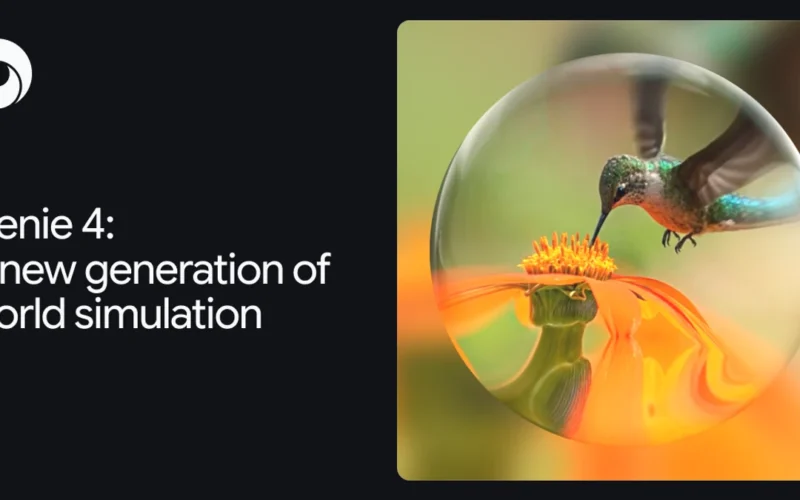
Google DeepMind announced Genie 4 on 27 October 2026, a world model that turns a sentence or a still image into a playable scene and keeps it running in real time while you steer it by typing. The headline upgrade over Genie 3 is sound. Ambient noise, music and characters that speak and answer back are generated with the world itself, not dubbed on afterwards.
DeepMind is calling it a research preview for trusted testers. It is not something you can buy today. Google AI Ultra subscribers will get it “soon” inside Project Genie, and early access partners will see it through the Gemini API and Google AI Studio. There is no date and no price.
The missing detail is the interesting part. When DeepMind launched Genie 3 in August 2025, it led with the numbers: 720p resolution, 24 frames per second, consistency for a few minutes. The Genie 4 announcement gives no resolution, no frame rate and no session length. The demo footage looks sharp. The spec sheet is blank.
Quick answer: Genie 4 is Google DeepMind’s newest real-time world model, announced on 27 October 2026. It generates interactive, photorealistic scenes with native audio and live dialogue, and you reshape the scene with plain text. Access is limited to trusted testers for now, with a waitlist for Project Genie, then Google AI Ultra subscribers and Gemini API early access partners. DeepMind has not published resolution, frame rate, session length or pricing.
What DeepMind actually shipped
Genie 4 is not one model doing everything. DeepMind says Gemini Omni anchors the simulation in real-world appearance and behaviour, while other Gemini models supply the reasoning that keeps a scene coherent as it unfolds. The pitch is that you set an event in motion and the model works out what happens next: how the world responds, how it sounds, and how the people in it move, react and talk.
The company lists four capabilities. Photorealism comes from Gemini Omni. Physics covers aerodynamics, collisions and human movement. Real-time control lets you change weather, camera or characters mid-scene. Native audio adds ambience, music and interactive speech. That last one is the part no previous DeepMind world model had.
There is a second model in the loop. Gemini 3.8 Flash acts as a guiding agent: it watches the generated frames, breaks a goal into steps, checks whether each step succeeded, and replans when the world shifts or the user intervenes. DeepMind frames this as the difference between a pretty video and a simulation with causality.
The audio is the real upgrade
World models have been good at geometry and bad at sound. Genie 4 generates audio natively, which means the soundscape is produced alongside the pixels rather than layered on top. DeepMind says every world carries the ambience of its setting, from wind in trees to waves on a beach, and that characters can hold a conversation in real time.
The demo prompts lean hard on atmosphere: a saxophonist on a floating platform over a lake, a stained-glass landscape, a dragon race shot in first person. It is impressive footage, and it is curated by the team that built the model, which is normal for a preview and not evidence of average performance.
DeepMind says all generated video and audio carries SynthID, its imperceptible watermark. That matters more for audio than video, because a convincing synthetic voice is harder to spot and easier to clip into a scam. The watermark helps platforms detect it, but only if the platform bothers to check.
The robot demo is the one to watch
Buried near the end of the post is the most consequential example. DeepMind paired Genie 4 with Gemini 4 Argon and had the pair simulate Apptronik’s Apollo humanoid playing checkers. Argon breaks the task into steps, the steps are fed to Genie as captions while the scene renders, and the simulation adapts as the task progresses.
That is the actual commercial case for world models: a training environment that can be generated, varied and reset faster than a physical lab. DeepMind says it is also working with enterprise partners on “zero-to-one” scenario generation, which is investor language for pilots that may or may not become contracts.
The long-term plan is a hybrid. Gemini maps structure and narrative, Genie renders the immediate physical world. DeepMind calls this an early step, and it is: the two systems are still stitched together, not fused.
Genie 3 vs Genie 4: what changed and what is still unstated
| Spec | Genie 3 (August 2025) | Genie 4 (October 2026) |
|---|---|---|
| Resolution | 720p, stated by DeepMind | Not published |
| Frame rate | 24 fps, stated by DeepMind | Not published |
| Session length | A few minutes, with visual memory around one minute | Not published |
| Audio | None | Native ambience, music and interactive dialogue |
| Real-time text steering | Promptable world events | Continuous natural-language steering plus Gemini monitoring |
| Reasoning layer | None in the loop | Gemini 3.8 Flash guides and checks steps |
| Access | Limited research preview | Trusted testers, waitlist, Ultra “soon”, API early access |
| Price | Not sold separately | Not announced |
Two rows are empty on purpose. DeepMind has shipped a model that generates sound and dialogue in real time, and it still will not say how many pixels per second you get. For a research preview that is defensible. For anyone planning to build on it, it is the first question.
What DeepMind admits is still broken
The limitations section is honest and specific. Visual details and object permanence can drift, especially in longer sessions, after several complex prompt edits, or while moving through a scene. Complex physical interactions, audio accuracy, legible text and spatial accuracy remain open research problems.
Object permanence is the big one. A world model that forgets the layout of a room after you turn around cannot be trusted as a training environment, because the agent learns from a world that quietly rewrites itself. DeepMind does not claim Genie 4 has solved this. It says the opposite.
There is also no public benchmark. DeepMind published no head-to-head evaluation against Genie 3, no user study numbers and no failure-rate table. The four capabilities are described qualitatively. That is not unusual at preview stage, but it means every claim about quality currently rests on curated clips.
Confirmed vs not confirmed
| Claim | Status |
|---|---|
| Genie 4 was announced on 27 October 2026 | Confirmed by DeepMind |
| It generates native audio, including interactive dialogue | Confirmed by DeepMind |
| It is built on Gemini Omni and guided by Gemini 3.8 Flash | Confirmed by DeepMind |
| It is a research preview for trusted testers | Confirmed by DeepMind |
| All output carries SynthID watermarks | Confirmed by DeepMind |
| Object permanence and long-session consistency still fail | Confirmed by DeepMind |
| Resolution, frame rate and session length | Not disclosed |
| Pricing, usage limits and API rate limits | Not disclosed |
| India availability date for Ultra or the API | Not disclosed |
| Independent quality benchmarks | None published |
What it means for Indian developers
The practical answer is: not much this quarter. There is no self-serve endpoint, no SDK, no pricing page and no regional availability. The only routes in are the Project Genie waitlist and the Gemini API early access programme, both of which DeepMind controls and neither of which comes with a timeline.
For studios in Bengaluru, Pune and Hyderabad that prototype game mechanics, the interesting use case is pre-visualisation: generating a rough playable space before an artist opens an engine. DeepMind’s own tester quotes describe exactly that, and it is the least speculative claim in the post.
Cost is the unknown that will decide adoption. A real-time video model needs serious inference hardware, and every minute of generated world is a minute of GPU time. Until Google publishes a price, any Indian team budgeting for this is guessing. The same applies to latency, which matters more here than for a text model, because a world that responds in two seconds is not interactive.
There is a data question too. DeepMind has not said where inference runs or what retention applies to prompts and generated worlds. For teams handling client footage or unreleased game assets, that gap is a blocker, not a detail.
The comparison worth keeping in mind is with the rest of Google’s stack. DeepMind has spent the year pushing cost per token down on the text side, including work like TorchTPU running PyTorch natively on TPUs at 2.01 cents per million tokens and Harness2 lifting cheaper models with a better harness. World models are the opposite trade: far more compute per second of output, and no public efficiency number at all. Even the infrastructure side of the industry is now priced in tens of billions, as Nvidia’s rack-scale AI factory push shows. Simulation at scale will be judged on the same economics.
Frequently asked questions
Is Genie 4 available to the public?
No. It is a research preview for trusted testers. DeepMind has opened a waitlist for Project Genie and says it is coming soon to Google AI Ultra subscribers and to early access partners of the Gemini API and Google AI Studio.
Can Genie 4 generate sound and speech?
Yes. DeepMind says it is the company’s first real-time world model to generate audio natively, covering ambient sound, music and interactive dialogue that adapts to what happens in the scene.
How long can a Genie 4 world run?
DeepMind has not said. The post notes that details and object permanence can drift in longer sessions, but it publishes no session length, resolution or frame rate, unlike the Genie 3 announcement.
How much does Genie 4 cost?
There is no price. Access will be bundled into Google AI Ultra and the Gemini API, but DeepMind has not published subscription terms, per-minute pricing or usage limits for Genie 4.
Can Indian developers use Genie 4 today?
Only through the waitlist or an early access partnership. DeepMind has not announced an India launch date, regional pricing or data residency terms for Genie 4.
Sources
- Google DeepMind, “Genie 4: A new generation of world simulation”, 27 October 2026. deepmind.google
- Google, “We’re announcing Genie 4, our new world model for real-time interactive simulation”, 27 October 2026. blog.google
- Google DeepMind, “Genie 3: A new frontier for world models”, 5 August 2025. deepmind.google
- Techmeme, front page coverage of the Genie 4 launch, 27 October 2026. techmeme.com