Nvidia DSX POD: 7 Vera Rubin Racks in a Container, 14-Day Setup, No Price
Nvidia packs seven Vera Rubin racks into a factory-built container and claims 14-day setup. Here is the price gap, power demand, water claim, and 2027 timeline.
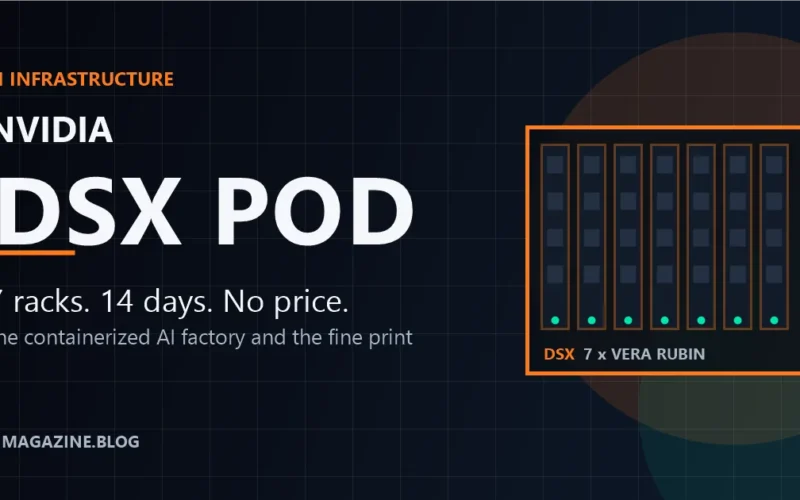
Nvidia wants to sell AI capacity by the container. At GTC Berlin on October 21, the company introduced DSX POD, a factory-built reference design that packs seven Vera Rubin racks into a shipping container, tests the whole unit before it leaves the factory, and drops it onto a prepared site. Nvidia says the setup can take as little as 14 days, down from roughly six months for a conventional build.
The catch is in the phrase “prepared site.” The 14-day clock starts after permits, foundations, power, connectivity and site work are done. DSX POD does not remove the hard parts of building an AI factory. It moves racks, cabling, liquid cooling and validation into a controlled factory, then shrinks the part that happens on site.
Nvidia did not announce a price. Analysts told CNBC that a single Vera Rubin rack can cost more than $7 million, which puts seven racks above $49 million before container integration. Deliveries are scheduled for early 2027 through manufacturing partners.
What Nvidia actually announced
DSX POD is not a new GPU. It is a reference design for a complete AI factory built from standardized container types. The compute container holds seven Vera Rubin racks. The wider design also coordinates networking, storage, power delivery, liquid cooling, cabling and management software, so partners can validate the system as one unit instead of assembling racks piece by piece at the customer site.
The container is roughly the size of a standard shipping container and weighs about 28,000 kilograms, according to CNBC. It is designed to move by truck on normal roads. Nvidia says partners complete rack-to-rack cabling, wiring, piping and functional testing before shipment. At the destination, the unit connects to the site’s power, cooling and network interfaces and goes through final testing.
The design uses an 800 VDC power input, liquid cooling and dry coolers. Nvidia positions it around its Vera Rubin platform, the rack-scale system that follows Blackwell. The reference design does not make containers mandatory. Nvidia says conventional data centers and onsite-integrated builds remain options. DSX POD is for operators who value schedule predictability and repeatable deployment over a custom build.
The 14-day claim needs context
Nvidia’s comparison is six months versus as little as 14 days. That is a real difference if the alternative is months of coordinating electricians, pipefitters, network engineers and validation crews on a live construction site. Factory integration can catch wiring faults, cooling leaks, firmware mismatches and network problems before the container ships.
But the claim is not “a data center in two weeks.” A site still needs utility power, grid interconnection, fiber, water or dry-cooler access, security, permits and a foundation that can carry the container. Those tasks often take longer than rack installation. The 14-day figure covers the final placement, connection and burn-in at a site that is already ready to receive capacity.
That distinction matters for anyone comparing DSX POD with a traditional build. The container removes onsite labor and schedule risk. It does not remove the power plant, the transmission queue or the local planning process. Operators who treat 14 days as a total project timeline will be disappointed. Operators who treat it as the last mile of a long project will see the value.
Why Nvidia is selling containers now
The AI buildout has moved from a chip shortage to a system bottleneck. Customers can order accelerators, but they also need buildings, transformers, cooling loops, networking and trained crews. Those pieces do not scale at the same speed. A factory-built pod gives Nvidia and its partners a way to ship more of the system as one product and to start earning revenue from a site sooner.
It also moves Nvidia further up the stack. The company once sold GPUs. It now sells racks, networking, software and, through partners, complete AI factories. DSX POD is the logical next step: a standardized building block that makes Vera Rubin easier to deploy at scale and harder to replace with a competitor’s rack.
Europe is an obvious target. Nvidia used GTC Berlin to announce the design, and its partner list includes Bull, Dell Technologies, HPE, Lenovo, Schneider Electric and Vertiv, alongside manufacturers such as Foxconn, Gigabyte, Pegatron, QCT and Wistron. The company says the units will be available worldwide in early 2027. For European clouds and sovereign AI projects, the appeal is a shorter path from capital approval to production tokens.
The efficiency claims are platform-level, not just the box
Nvidia’s water and power numbers are broader than one container. The company says its DSX platform can cut facility cooling water consumption by up to 100% using closed-loop liquid cooling and dry coolers. For a 2-gigawatt deployment, that could save up to 54 million liters of water per day, which Nvidia compares to the daily use of 180,000 households.
Those figures depend on the site, the cooling design and the workload. A container that uses dry coolers still needs airflow, maintenance and the right climate. Water savings are not automatic just because the racks arrive in a box.
Nvidia also says its DSX MaxLPS software can produce the same number of tokens with up to 30% less power by managing workload placement and power limits. That is a platform claim, not a property of the container alone. Buyers should ask partners for measured power-per-token data at their own utilization, not just the headline efficiency range.
The price gap is the biggest unknown
Nvidia has not published a price for DSX POD. The only public anchor is the analyst estimate of more than $7 million per Vera Rubin rack. Seven racks at that rate would exceed $49 million for compute alone, before networking, storage, cooling, integration, delivery and support. A real deployment will cost more.
That price point puts DSX POD in neocloud, sovereign AI and large enterprise territory, not the small-team market. It also explains why Nvidia is selling a reference design rather than a single SKU. Partners can configure power, cooling and storage for regional codes and customer requirements, while Nvidia keeps the compute and network architecture consistent.
The missing price also makes ROI hard to judge. The pitch is faster time to revenue, but a 14-day saving is worth different amounts to different buyers. A neocloud racing to fill a contract may pay a premium. An enterprise with a fixed budget may wait for a conventional build. Nvidia needs customer case studies, not just a deployment timetable, to prove the premium is worth it.
Who should care
DSX POD is most relevant to operators who already have a site and a power allocation but cannot get racks installed fast enough. That includes AI clouds adding capacity, governments building sovereign compute, and large enterprises that need dedicated inference capacity before a permanent data center is ready.
It is less relevant to teams running a handful of GPUs or renting capacity from a hyperscaler. Those users already buy AI compute as a service. The container model matters when the buyer wants to own the hardware, control the software stack and scale in repeatable blocks.
It is also a signal for the open-model crowd. Larger open-weight models such as DeepSeek V4.1-Flash and the serving stacks around them, including DeepSeek’s DeepInfer, are designed for dense, power-hungry clusters. Faster ways to stand up those clusters change the economics of self-hosting.
What to watch before 2027
Three things will decide whether DSX POD becomes a standard or a niche product. First, pricing. Nvidia and its partners need to show what a complete pod costs, including networking, storage and support. Second, real deployment data. A 14-day installation at a prepared site is plausible, but buyers should ask how long site preparation took and whether the factory tests survived transport.
Third, power. The container solves the building, not the grid. If a site cannot get a utility connection, a factory-built pod will sit unused. Nvidia’s efficiency software helps, but it cannot create megawatts.
DSX POD is a bet that AI infrastructure will increasingly be bought as a standardized product, not designed project by project. If that bet is right, the data center of 2027 will look less like a construction site and more like a logistics operation. If it is wrong, the container will be remembered as a clever packaging idea that could not fix the power queue.