GPT-6 Sol and Luna Cut OpenAI API Prices in Half — What Developers Actually Get
OpenAI shipped GPT-6 Sol at $2/$10 and GPT-6 Luna at $0.10/$0.50 per million tokens on September 22 — at least 50% below the GPT-5.6 promotional rates. Specs, pricing cliffs, and who each model is for.
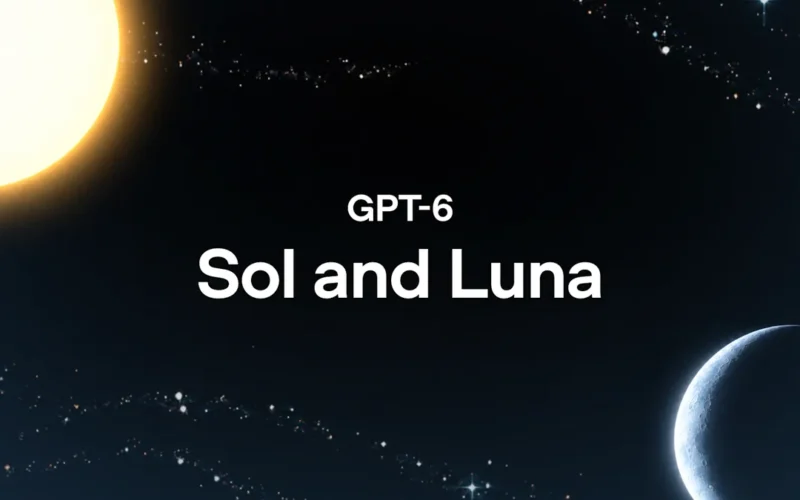
OpenAI filled out the GPT-6 family on September 22. Less than three weeks after GPT-6 Astra landed on September 3 as the $10 / $50 flagship, the lab shipped GPT-6 Sol and GPT-6 Luna — the mid-tier and volume models — at half the GPT-5.6 promotional rates of the models they succeed.
For developers who never needed Astra’s top-end scores, this is the release that changes the bill. Sol is now $2 per million input tokens and $10 output. Luna is $0.10 and $0.50. Both are live in the API, Codex, and ChatGPT Work.
What OpenAI Announced
In its launch post, OpenAI says Sol and Luna were trained with methods similar to Astra, and that caching and inference improvements let it cut API prices by 50% versus GPT-5.6 promotional pricing. The same message went out on the OpenAI Developer Community.
TechCrunch notes the timing: Anthropic released a new version of Opus 5.5 just 90 minutes earlier, a sign of how closely the two labs are competing for everyday coding and agent traffic.
The Rate Card, Straight From OpenAI
These are the short-context standard rates from OpenAI’s API pricing page, in USD per 1 million tokens:
| Model | Input | Cached input | Output |
|---|---|---|---|
GPT-6 Luna (gpt-6-luna) |
$0.10 | $0.01 | $0.50 |
GPT-6 Sol (gpt-6-sol) |
$2.00 | $0.20 | $10.00 |
GPT-6 Astra (gpt-6-astra) |
$10.00 | $1.00 | $50.00 |
| GPT-5.6 Sol (promo) | $4.00 | $0.40 | $20.00 |
| GPT-5.6 Luna | $0.20 | $0.02 | $1.20 |
OpenAI labels both cuts “50% cheaper.” That is exact for Sol and for Luna’s input price. Luna’s output price falls from $1.20 to $0.50, which is actually a 58% cut.
A few multipliers matter in production. The big cliff: prompts over 272K input tokens are billed at 2× input and cache rates and 1.5× output for the full request. Cache writes cost 1.25× the uncached input rate ($2.50 for Sol, $0.125 for Luna). Batch and Flex are half of standard. Fast mode is 2×. Regional processing adds 10% where available, and EU data residency for Sol and Luna is only available with Standard processing.
Astra is now a 5× premium over Sol on both input and output. That is a wider gap than at Astra’s own launch, when the tier below it, GPT-5.6 Sol at $4 / $20, made Astra a 2.5× premium.
Specs That Matter for Builders
From OpenAI’s Sol and Luna model pages:
- Context: 1,050,000 tokens; max output 128,000
- Knowledge cutoff: Sol April 20, 2026; Luna May 18, 2026 (Luna’s cutoff is about a month later than Sol’s)
- Reasoning effort:
none,low,medium(default),high,xhigh,max— unlike Astra, whose lowest setting islow, both keep a truenonemode for latency-sensitive calls - Modalities: text + image in, text out
- Tools (Responses API): web search, file search, code interpreter, hosted shell, computer use, MCP, and more
- Fine-tuning: not supported
OpenAI’s docs say Sol is built for complex coding and agentic workflows. Luna is the efficient model for focused, high-volume tasks — summarization, extraction, routing, and similar work.
What the Benchmarks Claim (Vendor Numbers)
OpenAI’s launch post leans on cost per result, not raw score. The figures below are OpenAI’s own runs, as stated in that post:
- DeepSWE v1.1: Sol (max) 68.8%; Luna (max) 66.6%. OpenAI says Sol lands within 1.1 points of Claude Fable 5’s best score (69.9% at xhigh) at roughly 80% lower cost per task.
- AutomationBench 1.0.6: Sol (xhigh) 33.2% at $0.27 per task — above Astra at low effort (30.3%) and Claude Opus 5 at max (26.9%) in OpenAI’s table, at 9% of Opus 5’s cost per task.
- OSWorld 2.0 offline: Sol (xhigh) 60.5%, roughly level with Claude Opus 5 at medium (60.3%) at ~80% lower cost per task. Astra remains ahead for computer use.
- Factuality: OpenAI says Sol makes about half as many mistakes as GPT-5.6 Sol on an internal eval built from de-identified ChatGPT conversations where users flagged mistakes.
Treat these as vendor-reported until independent benchmarks land. OpenAI notes that its own evaluations ran in its research environment or via its API, and that competitor scores were taken from publicly available reports.
Where You Can Use Them
Per OpenAI’s launch post, community announcement, and model docs:
- API:
gpt-6-solandgpt-6-lunaon Responses, Chat Completions, and Batch - ChatGPT Work + Codex: Plus, Pro, Business, Enterprise, and Edu, rolled out gradually through launch day
- Free and Go: Luna in the desktop app
- Regular ChatGPT chat: at launch, OpenAI said the models were “not yet available in Chat”
OpenAI also said, in a post shared on the community announcement thread, that it was “loading a banked reset into all accounts of our Plus, Pro and Business users.” It is a banked reset, so you choose when to apply it.
What It Means for Indian Developers and Startups
Half-price Sol and $0.10 Luna change the default stack for cost-sensitive teams. A routing pattern that already makes sense elsewhere works even better here: Luna for extraction and summarization, Sol for coding agents and analysis, Astra only when a task fails or needs top-end computer use.
That sits next to the India-priced coding tools we have covered — including Cursor Start at ₹649/month and our roundup of AI IDEs from ₹96 to ₹958 a month. API token cost is the other half of the same budget.
Open models still matter on output price and self-hosting. We tracked that side of the market in Qwen 3.8-27B’s SWE-Bench Pro run and DeepSeek’s V4 Pro pricing schedule. Compare those list prices against Sol and Luna carefully: output tokens and cache behavior still decide the real bill.
How to Choose: Luna, Sol, or Astra
- Pick Luna for high-volume classification, extraction, summarization, and routing. Use
reasoning.effort: "none"when you need speed. - Pick Sol as the default for coding agents, debugging, data analysis, and repeated agent loops. It is the upgrade path from GPT-5.6 Sol at half the promo price.
- Pick Astra for hard multi-step work, computer use, and cases where a failure costs more than tokens. It remains 5× Sol.
One migration gotcha from OpenAI’s docs: on Chat Completions, function calling with Sol or Luna only works when reasoning_effort is none. For tool-using agents at higher effort, use the Responses API.
What’s Confirmed vs. Still Open
| Claim | Status |
|---|---|
| Sol $2/$10 and Luna $0.10/$0.50 short-context API rates | Confirmed on OpenAI’s pricing page |
| 50% cut vs GPT-5.6 promotional pricing | Confirmed by OpenAI’s launch post and community announcement (exact for Sol; Luna’s output cut is ~58%) |
| Availability in API, Codex, ChatGPT Work; Luna for Free/Go desktop | Confirmed by OpenAI |
| Sol makes ~half as many factual mistakes as GPT-5.6 Sol | OpenAI’s internal eval — not an independent bench |
| DeepSWE / AutomationBench / OSWorld scores above | Vendor-reported from OpenAI’s launch post |
| GPT-5.6 Sol promo rate end date | Open: OpenAI’s pricing page says the promo is available at least through November 21, 2026 |
If you are still on the older family, our earlier guide to GPT-5.6 Sol, Terra, and Luna covers the models Sol and Luna succeed. The naming overlap is confusing — always check the model ID (gpt-6-sol vs gpt-5.6-sol) before you trust a price table.
Frequently Asked Questions
How much does GPT-6 Sol cost?
On OpenAI’s API, $2.00 per million input tokens and $10.00 per million output tokens for short context, with cached input at $0.20. That is half of GPT-5.6 Sol’s current promotional rate of $4 / $20.
How much does GPT-6 Luna cost?
$0.10 per million input and $0.50 per million output, with cached input at $0.01. GPT-5.6 Luna is listed at $0.20 / $1.20, so Luna’s input price is halved and its output price is 58% lower.
What’s the difference between GPT-6 Sol, Luna, and Astra?
Price and target work. Luna is for high-volume routine tasks. Sol is for coding, agent loops, and analysis. Astra ($10 / $50) is for the hardest multi-step and computer-use jobs and costs 5× Sol.
Can free ChatGPT users access GPT-6 Sol or Luna?
Free and Go users can try GPT-6 Luna in the ChatGPT desktop app. Sol is for paid plans (Plus, Pro, Business, Enterprise, Edu) via ChatGPT Work and Codex, per OpenAI’s announcement.
Is GPT-6 Sol the same as GPT-5.6 Sol?
No. They are different model IDs with different prices and knowledge cutoffs. GPT-6 Sol (gpt-6-sol) launched September 22, 2026 at $2 / $10. GPT-5.6 Sol (gpt-5.6-sol) remains in the API at the $4 / $20 promotional rate.
4 comments