DeepSeek V4-Pro Just Permanently Repriced Enterprise AI — Here’s What That Actually Means
DeepSeek V4-Pro just permanently repriced enterprise AI with output tokens at $0.87 per million. Learn what this means for budgets, benchmarks, and risks.
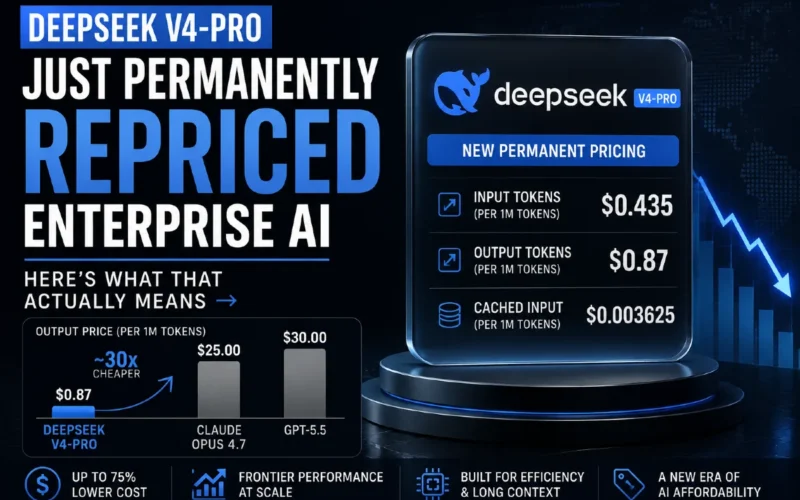
DeepSeek V4-Pro just permanently repriced enterprise AI by making its 75% discount permanent in May 2026. Output tokens now cost $0.87 per million, which is roughly 34.5 times cheaper than GPT-5.5. This shift fundamentally alters budget planning for teams running large-scale workloads.
However, lower prices do not eliminate all risks. Teams must understand where the model excels and where it falls short before migrating critical systems.
How DeepSeek V4-Pro Just Permanently Repriced Enterprise AI
On May 22, 2026, DeepSeek confirmed that promotional pricing would become the new standard. Input tokens now cost $0.435 per million, while cached input hits $0.003625 per million. Therefore, this represents the lowest first-party frontier-model cache price currently available.
Promotional pricing is typically a temporary marketing event, but permanent pricing establishes a market floor. Every competing lab must now answer to these numbers. Additionally, cache hit prices across the entire API suite dropped to one-tenth of original levels on April 26.
This efficiency stems from engineering rather than subsidies. The model runs at roughly a quarter of the compute and a tenth of the memory footprint of its predecessor. Consequently, heavy retrieval workloads can now run well under $50 monthly at meaningful scale.
Benchmark Performance Against Western Models
The pricing argument only holds if performance remains competitive. On SWE-bench Pro, V4-Pro scores 55.4% compared to Claude Opus 4.7 at 64.3%. Meanwhile, GPT-5.5 leads Terminal-Bench 2.0 at 82.7%, leaving V4-Pro at 67.9%.
First, this gap matters significantly for complex command-line agentic workflows. However, V4-Pro actually beats Claude Opus 4.7 by four points on the BrowseComp web research benchmark. A NIST evaluation also found it performs similarly to GPT-5 for most production applications.
Ultimately, V4-Pro trails the absolute frontier by roughly one generation. For tasks demanding state-of-the-art reasoning, this difference is notable. Yet, for typical production workloads, the model remains within striking distance at a fraction of the cost.
Budget Implications for Enterprise Teams
A workload consuming 1 billion tokens monthly costs around $522 on V4-Pro. The same task runs roughly $9,000 on Claude Opus 4.7 and $10,000 on GPT-5.5. Therefore, this gap determines whether certain products are financially viable.
Even organizations that never deploy DeepSeek can use this pricing as leverage. Procurement teams now have a concrete reference price for contract negotiations with Western vendors. Furthermore, multi-model routing strategies are becoming mandatory rather than optional.
Premium models can handle high-stakes compliance work while V4-Pro manages high-volume tasks. An orchestration layer should route traffic based on complexity and risk. As a result, previously borderline workloads like large-scale batch analysis become straightforwardly viable.
Critical Risks and Compliance Considerations
Data sovereignty remains a primary concern because user data is stored on servers in China. Under local laws, organizations may be required to support intelligence work without notifying users. Thus, the hosted API is unsuitable for PII or proprietary IP without strict controls.
Regulatory uncertainty also persists as US lawmakers consider adding DeepSeek to the Entity List. Security track records include past database exposures and hidden code transmitting data. Finally, ecosystem maturity lags behind native integrations offered by AWS, Microsoft, and Google.
Fortunately, open weights under the MIT license offer an alternative path. Teams can self-host to eliminate data sovereignty concerns, though this requires significant GPU infrastructure investment.
Practical Steps for Migration
First, always benchmark your actual workloads rather than relying solely on public scores. Classify data sensitivity before selecting models to ensure regulatory compliance. Additionally, update legacy model IDs to deepseek-v4-pro before July 24, 2026.
You should also plan a tested rollback path since geopolitical conditions change rapidly. Finally, avoid over-assigning tasks to V4-Pro when V4-Flash suffices. Routing simpler subtasks to cheaper models can reduce costs substantially compared to single-model approaches.