Google’s TPU 8tx Keeps a Model Encrypted While It Runs, but You Cannot Buy It Until 2027
Google announced TPU 8tx for confidential inference and TPU 8i Max for long-context agents on 9 November 2026. Neither has a published price, a confirmed ship date or an independent benchmark, and Bloomberg reports a 2027 launch.
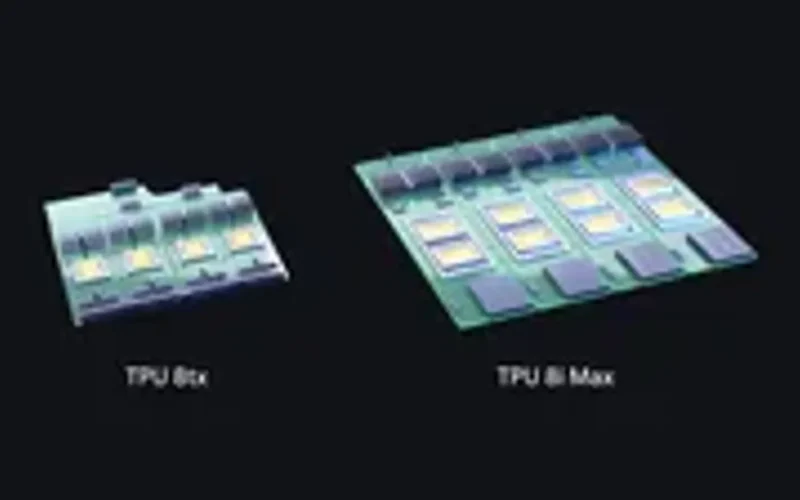
Google announced two new eighth-generation TPUs on 9 November 2026. TPU 8tx is built for confidential inference, keeping data and model weights protected while they are being used. TPU 8i Max puts two TPU 8i chips on one package to double compute, SRAM and HBM bandwidth for long-context agent workloads.
The announcement brings Google’s eighth-generation family to four systems in one year: 8t for training, 8i for low-latency reasoning, 8tx for secure inference and 8i Max for massive context windows. Google says it now has nearly 100 TPU customers.
The catch is that neither system is a product you can price, rent or benchmark today. Google published no launch date, no price and no independent performance data. Bloomberg reported that both systems launch in 2027, a date Google’s post does not confirm.
Quick answer: TPU 8tx is a confidential-computing version of Google’s eighth-generation TPU, built on the same silicon as TPU 8t and paired with 5th Gen AMD EPYC CPU hosts. Google claims up to 2x lower latency than TPU 8t with a near-zero performance penalty. TPU 8i Max combines two TPU 8i chips in one package, doubling compute, SRAM and HBM bandwidth. Neither has a published price, a confirmed ship date or an independent benchmark. Bloomberg reports a 2027 launch.
What Google actually announced
TPU 8tx is aimed at regulated enterprises and governments running proprietary models and autonomous agents next to sensitive data. Google says the system builds security into the hardware layer rather than relying only on encryption at rest or in transit.
“Normally, data is encrypted when stored or sent over a network, but has to be unlocked in memory while a computer processes it,” Google’s Amin Vahdat wrote. TPU 8tx is designed to keep “sensitive data and model weights protected and isolated even while in active use.”
The system uses the same silicon as TPU 8t and pairs it with 5th Gen AMD EPYC hosts. It also adopts the low-latency Boardfly network Google built for real-time reasoning. Google claims up to 2x lower latency than TPU 8t with a near-zero penalty, and says customers can fine-tune, distill and run reinforcement learning on private data without moving it between clusters.
TPU 8i Max attacks a different bottleneck. Google took two TPU 8i chips and combined them onto one package, doubling compute, SRAM and HBM bandwidth. Because the package fits twice the silicon into the existing rack footprint, Google says data centers can deploy more compute per square foot and per watt.
Why confidential inference is the harder claim
Confidential computing is not new. CPUs and GPUs have offered encrypted memory enclaves for years. The hard part is doing it without destroying throughput, because every memory access inside a protected enclave carries overhead.
Google’s claim is that TPU 8tx delivers hardware-level isolation with a near-zero performance penalty and lower latency than TPU 8t. If that holds up, it matters more than the encryption label. Banks, hospitals and government departments do not buy security features that cut model throughput in half.
The claim is also unverified. Google published no benchmark, no threat model and no third-party audit. It did not name a customer running TPU 8tx in production. The security of a hardware enclave depends on side-channel resistance, attestation and the software stack, and none of those details are public yet.
Hardware-level confidential computing can support a compliance program, but it is not a compliance certificate. India’s Digital Personal Data Protection Act, RBI outsourcing rules and SEBI cloud guidance all require contracts, audits and governance. An encrypted inference chip does not replace any of that.
Google’s four eighth-generation TPUs compared
| System | Main job | Key published spec | Host CPU | Price and availability |
|---|---|---|---|---|
| TPU 8t | Large-scale training | 9,600-chip superpod, 121 ExaFlops, 2 PB shared HBM | Google Axion | No public price. Google said in April it would be generally available in 2026 |
| TPU 8i | Low-latency reasoning | 288 GB HBM, 384 MB SRAM, 19.2 Tb/s interconnect | Google Axion | No public price. Google said in April it would be generally available in 2026 |
| TPU 8tx | Confidential inference and small-scale training | Same silicon as 8t, up to 2x lower latency than 8t | 5th Gen AMD EPYC | No public price. Bloomberg reports a 2027 launch |
| TPU 8i Max | Million-token contexts and high-density inference | Two 8i chips per package, 2x compute, SRAM and HBM bandwidth | Inherits the 8i platform | No public price. Bloomberg reports a 2027 launch |
Google published no absolute memory figure for TPU 8tx, no per-rack power number for 8i Max and no rental price for any of the four systems.
Confirmed vs not confirmed
| Claim | Status |
|---|---|
| Google announced TPU 8tx and TPU 8i Max on 9 November 2026 | Confirmed by Google’s official blog |
| TPU 8tx uses 8t silicon and 5th Gen AMD EPYC hosts | Confirmed by Google |
| TPU 8tx keeps data and model weights protected during active use | Google product claim. No independent audit published |
| TPU 8tx delivers up to 2x lower latency than TPU 8t | Vendor claim. No benchmark published |
| TPU 8i Max doubles compute, SRAM and HBM bandwidth over 8i | Confirmed by Google’s published specification |
| Both systems launch in 2027 | Reported by Bloomberg. Google has not confirmed a date |
| Pricing, India region availability and side-channel resistance | Not announced or unverified |
What it means for Indian developers
For most Indian teams, the practical question is not which TPU is faster. It is which one they can rent, in which region, at what price. Google has cloud regions in Mumbai and Delhi NCR, but it has not said whether TPU 8tx or 8i Max will be available there at launch.
TPU 8i Max matters for products that feed long documents, codebases or video into an agent. More memory bandwidth per rack can lower the cost of long-context inference, but only if Google passes that saving into on-demand or committed-use pricing. It has not published either.
TPU 8tx matters for fintech, health, insurance and government work where data cannot be exposed in memory. The pitch is relevant to India’s DPDP regime, but the buying decision will depend on attestation, audit rights and data residency, not on the phrase “hardware-level confidential compute.”
The catch: a roadmap is not a product
Google’s announcement is a systems roadmap. It explains how the company plans to serve agent workloads that are too large, too sensitive or too latency-bound for a general-purpose accelerator. It does not give a customer a date, a price or a number they can test.
The AMD EPYC detail is worth watching. Google’s 8t and 8i use its own Axion Arm CPUs, while 8tx uses 5th Gen AMD EPYC hosts. Google did not explain the switch, so any reason for it is speculation until a technical brief appears.
The bigger competitive problem is software, not silicon. Nvidia’s advantage is CUDA and the optimized libraries around it. Google is trying to lower that wall with TorchTPU, native PyTorch support and open inference backends. Those moves may matter more to developers than a dual-chip package.
Until Google publishes pricing, independent benchmarks and a named production customer, TPU 8tx and 8i Max are claims about the next infrastructure cycle. The specs are specific enough to take seriously, but not enough to plan a 2027 budget around.
FAQ
What is Google TPU 8tx?
TPU 8tx is a Google tensor processing unit optimized for secure and confidential inference. It is built on the same silicon as TPU 8t, uses 5th Gen AMD EPYC CPU hosts, and is designed to keep data and model weights protected while they are processed.
How is TPU 8i Max different from TPU 8i?
TPU 8i Max combines two TPU 8i chips on a single package. Google says that doubles compute, SRAM and HBM bandwidth while fitting twice the silicon into the existing rack footprint.
When will Google’s new TPUs be available?
Google has not published a launch date. Bloomberg reported that both TPU 8tx and TPU 8i Max launch in 2027. Google’s announcement says only that the systems are part of its eighth-generation portfolio.
How much do TPU 8tx and TPU 8i Max cost?
Google has not announced pricing for either system. It has also not published a per-token or per-hour rate for TPU 8i Max, so any cost comparison with Nvidia GPUs or other TPUs is incomplete.
Can Indian developers use TPU 8tx at launch?
That is not confirmed. Google has not said whether TPU 8tx or TPU 8i Max will be offered in its Mumbai or Delhi NCR cloud regions.
Sources
Google: Our newest TPUs, 8tx and 8i Max, built for the agentic era, 9 November 2026.
Google: Our eighth generation TPUs, two chips for the agentic era, April 2026.
Bloomberg: Google escalates Nvidia rivalry with new versions of its TPU systems, 9 November 2026.
AImagazine: Google’s TorchTPU runs PyTorch natively on TPUs, 21 October 2026.
AImagazine: Google’s orbital data center and the cost of space, 2 November 2026.
AImagazine: AMD Helion packs 32,768 Zen 6 cores into one rack, 13 October 2026.