How to Become an Agentic AI Engineer: A 6-Month Roadmap for Developers
Follow this practical guide on how to become an agentic AI engineer. This 6-month roadmap covers async Python, tool calling, memory, security, and production deployment.
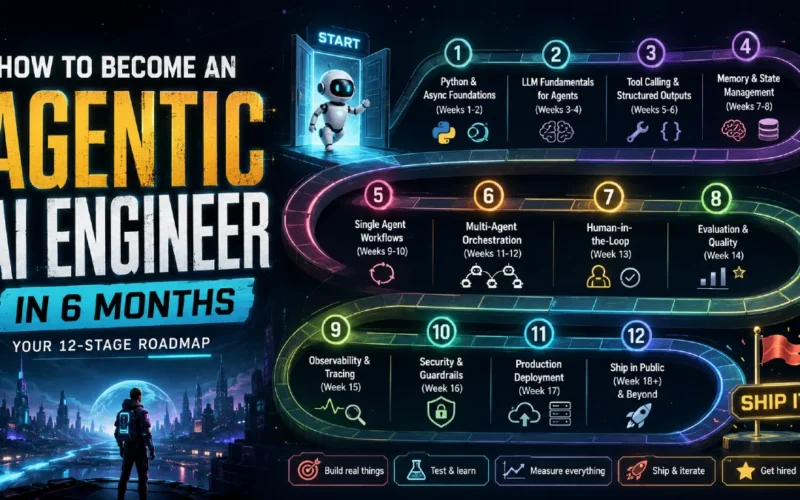
Job postings for AI agents have exploded recently. However, few working agents exist outside of demos. Many developers watch tutorials instead of shipping real systems. Therefore, learning how to become an agentic AI engineer is a massive opportunity. This article provides a structured path to bridge that gap.
This guide outlines a 12-stage plan spanning six months. You will move from basic ChatGPT usage to deploying production agents. The order is deliberate, so do not skip early stages. Each step builds directly on the previous one to ensure stability.
What an Agentic Engineer Actually Builds
Backend developers write code that follows exact instructions. In contrast, an agentic engineer builds systems that decide their own next steps. Understanding this distinction is vital when learning how to become an agentic AI engineer.
The agent loop functions as follows:
- The agent reads a goal rather than a function call
- It breaks that goal into actionable steps
- It selects the right tool for each step
- It executes, checks results, and adjusts if needed
- It repeats until the job is complete
You are no longer writing the steps yourself. Instead, you design the system that figures them out. This shift from programming logic to designing reasoning defines the role.
Stage 1: Python and Async Foundations
First, master Python asynchronous programming before touching agent frameworks. Agents spend most of their time waiting for models or APIs. If your code blocks on every call, performance suffers greatly.
The solution is asyncio. Concurrent calls can make your agent ten times faster. Build a FastAPI server that handles ten concurrent LLM calls without blocking. Also, implement retry logic that survives API failures gracefully.
This stage may seem boring, but it is essential. Blocking code under load causes many production failures. If your framework cannot run tool calls concurrently, you lose significant speed advantages.
Stage 2: LLM Fundamentals for Agents
Next, learn how models actually behave. Context limits are real, even with larger windows. Models still lose track of details buried in huge prompts. Therefore, plan for compression from day one.
Additionally, model routing saves money. Not every task requires an expensive model. Route simple tasks to cheaper options like Haiku, and reserve Opus for complex reasoning. Always track spend per agent run immediately.
Finally, know where models fail. Hallucinations look confident but are wrong. Details in the middle of long contexts get forgotten. Instruction drift occurs after many turns. Read the model card before building around it.
Understanding Model Efficiency and Updates
Efficiency matters significantly for production costs. For instance, GPT-5.6 Arrives: OpenAI’s New Model Family Bets Big on Efficiency and Agentic Power. Staying updated on these efficiency gains helps optimize your roadmap budget.
Stage 3: Tool Calling and Structured Outputs
A model that only talks is a chatbot. However, a model that calls tools is an agent. This is where the real shift happens in your journey. Use Pydantic for structured outputs to ensure reliability.
Never trust raw strings when you need reliable data downstream. Models will sometimes call tools incorrectly with wrong arguments. Therefore, build recovery logic into every tool handler. Treat tool definitions as part of your API contract.
Stage 4: Memory and State Management
An agent without memory repeats itself forever. Give it memory, and it becomes useful. You should implement four specific types of memory for robust agents.
Short-term memory handles current task context. Long-term memory uses vector databases for persistent knowledge. Working memory tracks state for the current job. Episodic memory records what happened in past sessions.
Compress conversation buffers early and cheaply. Use your fastest model for summarization. Save your best model for reasoning that truly needs it. This approach prevents context overflow while maintaining coherence.
Stage 5: Single Agent Workflows
Now, build one agent that works end-to-end. The core pattern is ReAct: reason, act, observe, and repeat. Always set a maximum step limit to prevent infinite loops.
Furthermore, handle cases where the agent cannot finish cleanly. Log every step because you will need trails for debugging later. Validate tool outputs before feeding them back into the conversation.
One reliable single agent beats ten agents that mostly work. Get this stage solid before adding complexity. For inspiration on open-source implementations, check out 10 Open-Source GitHub Repos Every Founder & Vibe Coder Should Bookmark.
Stage 6: Multi-Agent Orchestration
Sometimes you genuinely need a team of agents. However, more agents are not automatically better. Add agents only when a single one cannot do the job alone.
The supervisor pattern is the most useful design to learn first. Multi-agent systems fail at the seams, not inside individual agents. Plan every handoff as carefully as an API contract. Validate output at every transfer point to prevent silent failures.
Stage 7: Human-in-the-Loop Implementation
Full autonomy sounds great until an agent makes expensive mistakes. Keep a human in the loop wherever risk is high. Teach the agent to notice uncertainty and ask for help.
Add approval gates before every irreversible action. Maintain an audit trail of what the agent did and why. Make it possible to pause, let a person intervene, and resume cleanly. The best agents know when to ask for assistance.
Stage 8: Evaluation and Quality Assurance
You cannot improve what you do not measure. Unfortunately, most people skip evaluation. Track task completion rate, accuracy, hallucination rate, and cost per task before every deploy.
If your pass rate is below 90%, do not ship yet. Fix the failures first. An eval suite turns subjective feelings into defensible numbers. Use your strongest model to judge outputs strictly against defined criteria.
Stage 9: Observability and Tracing
When an agent misbehaves in production, you need visibility. Without tracing, debugging is just guessing. Set up alerts and check dashboards daily.
Costs often spike under real load compared to development. Tool calls may take seconds instead of milliseconds. Failure rates in production often exceed testing environments. You cannot fix what you cannot see.
Stage 10: Security and Guardrails
People will try to break your agent once it touches the real world. Prompt injection is the biggest threat. Always separate system instructions from untrusted external content.
Never run untrusted code outside a sandbox. Redact personal data before it enters the context window. Filter output before it leaves your system. Know your industry compliance rules before deploying to avoid costly breaches.
Stage 11: Production Deployment Strategies
Working locally is not a product. Build an async API so slow runs do not block requests. Use background jobs that return IDs immediately for client polling.
Implement rate limiting to protect your budget. Use canary deploys to roll out changes gradually. Have a rollback plan ready for immediate execution. This stage separates hobby projects from professional engineering.
Stage 12: Ship in Public
Finally, shipping public work gets you hired. Proof beats a polished resume every time. Ship one real, working agent on GitHub with clear documentation.
Explain your architecture decisions and trade-offs. Include a screen recording showing the agent completing a real task. Write about what broke and how you fixed it. People who point to working agents get interviews.
Roadmap Summary for Aspiring Engineers
| Month | Focus Area | Weeks |
|---|---|---|
| 1 | Foundation: Python async, FastAPI, LLM mechanics | 1–4 |
| 2 | Agent core: tool calling, structured outputs, memory | 5–8 |
| 3 | Building agents: ReAct loop, multi-agent supervisor | 9–12 |
| 4 | Production skills: human-in-the-loop, eval suites | 13–14 |
| 5 | Ship it: observability, tracing, security defense | 15–16 |
| 6 | Real world: deployment, canary releases, portfolio | 17–18+ |
Critical Advice for Success
Everyone wants to jump to multi-agent systems immediately. However, almost nobody wants to spend weeks on async foundations. Most production failures trace back to blocking code, missing evals, or poor tracing.
The boring stages matter most. Do them first and do them properly. Following this advice on how to become an agentic AI engineer ensures long-term success. Remember to add proper error handling before running any code against real traffic.