India’s First Codex Metro Hackathon Happened on a Moving Train in Kochi
100 curated builders. One moving metro train. Two hours to ship something real with OpenAI Codex. The Codex Nightline just redefined what a hackathon can look like.
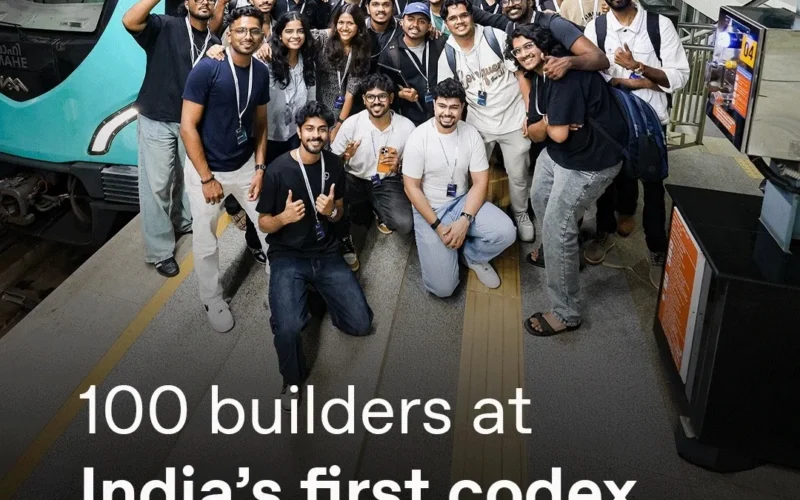
The Kochi metro Codex hackathon did not happen in a conference room or a university auditorium. It happened on a moving train — at night, with 100 builders racing a two-hour clock and nowhere to go until the metro completed its loop.
The event, called Codex Nightline, is the world’s first AI build sprint conducted inside a live metro system. Organised by Codex Community Kochi under OpenAI’s Codex Ambassador programme, it ran in partnership with Kochi Metro Rail Limited (KMRL) on a specially chartered after-hours train. Participants boarded at 11:00 PM and built until 1:00 AM as the metro completed its round trip from Vyttila to Aluva to Thrippunithura and back.

What Made the Kochi Metro Codex Hackathon Different
Most hackathons give participants 24 to 48 hours and a room full of amenities. Codex Nightline stripped all of that away. Participants got two hours, a moving vehicle, and a solo build constraint — no teams allowed. Every submission was an individual effort, completed entirely within the sprint window after the train departed.
Furthermore, ideas could be prepared in advance, but implementation started only after the official sprint began on board. That constraint forced participants to think in terms of what Codex could actually execute under pressure, not what looked impressive on a slide deck.
The track options reflected genuine urban and societal priorities: Urban Mobility, Community Strengthening, and Productivity tools. Building on a metro train for metro-related problems was, by design, not accidental.
The Format: Four Stations, One Submission Window
The schedule ran with military precision. Check-in and the opening ceremony began at 9:30 PM. Boarding followed, and the build sprint commenced at 11:00 PM sharp as the train pulled out of Vyttila. At 1:00 AM participants deboarded, transitioned to the showcase area, and submission checks began.
By 2:45 AM, the top ten finalists were shortlisted. Lightning demos and judge Q&A followed until 4:15 AM, when winner announcements closed the night. The entire event, from boarding to wrap-up, ran through to 5:00 AM — making it as much an endurance test as a coding competition.
This structure eliminated the common hackathon failure mode where participants pad time rather than ship. When the train stops, the sprint ends. Consequently, participants arrived with sharper scope and tighter execution plans than a typical 48-hour event tends to produce.
Supported by OpenAI, Built by the Community
Codex Nightline is a community-driven initiative rather than a direct OpenAI-organized event. However, it operates under the OpenAI Codex Ambassador programme, which provides the community scaffolding and platform access that makes events like this viable.
This is not the first Codex community event in India. An earlier OpenAI Build Week ran nationally and drew tens of thousands of participants. A separate Codex Community Hackathon in Kochi — held at Jain University — brought together teams building agentic coding tools, UX for AI-native applications, and domain-specific agents. Codex Nightline represents the more experimental edge of that same community momentum.
Separately, OpenAI’s first official Codex Hackathon in India ran in Bengaluru in April 2026 with over 100 builders and $100,000 in prizes. That event, co-organised with GrowthX, targeted developers already shipping production-grade code with AI tools daily. Kochi’s metro sprint followed that energy — but compressed it into something far more cinematic.
Why This Format Works for Codex Specifically
Codex is an agentic coding platform designed for high-velocity, parallel task execution. Its value proposition — spinning up subagents, running worktrees, leveraging plugins — is most legible under the kind of time pressure that the metro sprint manufactured deliberately. A 48-hour hackathon lets participants explore Codex gradually. A two-hour solo sprint on a moving train forces participants to orchestrate it immediately.
Therefore, Codex Nightline functions as a live stress test of what Codex actually enables when the conditions are compressed and the stakes are real. The format does not forgive procrastination, over-scoping, or dependency on teammates. It rewards builders who already operate at the edge of what the platform can do.
For OpenAI, community events like this generate something that marketing cannot: credible, high-pressure proof that Codex performs when developers need it most. In that sense, the Kochi metro was not just a venue. It was a deliberate constraint that made the demos more honest.
India’s Developer Community Is Building Its Own Codex Culture
What the Kochi event signals is broader than one hackathon. India’s developer ecosystem is now producing its own Codex community formats — events that go beyond reproducing Western hackathon templates and instead build context-specific challenges that reflect local infrastructure, local ambitions, and local constraints.
Running an AI build sprint on the Kochi Metro, partnered with KMRL, is a distinctly Indian AI moment. It says something about the maturity of the community that the event required a metro rail operator as a logistics partner rather than a tech campus as a venue.
As OpenAI’s Build Week showed globally, the developers willing to build under the tightest constraints tend to produce the most interesting results. Kochi’s builders proved that point on a train at 1:00 AM — and the 100 names on that platform at the end of the sprint are now part of the first chapter of a format that will almost certainly be copied elsewhere.
Frequently Asked Questions
What is Codex Nightline?
Codex Nightline is the world’s first AI build sprint conducted inside a moving metro system. It ran on a specially chartered Kochi Metro train, with 100 curated builders completing solo projects using OpenAI Codex during a two-hour window overnight.
Who organised the Kochi metro Codex hackathon?
The event was organised by Codex Community Kochi, a community-driven initiative operating under OpenAI’s Codex Ambassador programme. Kochi Metro Rail Limited (KMRL) served as the venue and mobility partner.
Was this India’s first Codex hackathon?
No — OpenAI’s first official Codex Hackathon in India ran in Bengaluru in April 2026. However, Codex Nightline is the first AI hackathon conducted inside a moving metro train anywhere in the world.
What could participants build?
Participants could build across three tracks: Urban Mobility (transport and commute tools), Community Strengthening (social and public life applications), and Productivity (tools that help people work smarter). Implementation had to begin only after the official sprint started on the train.
