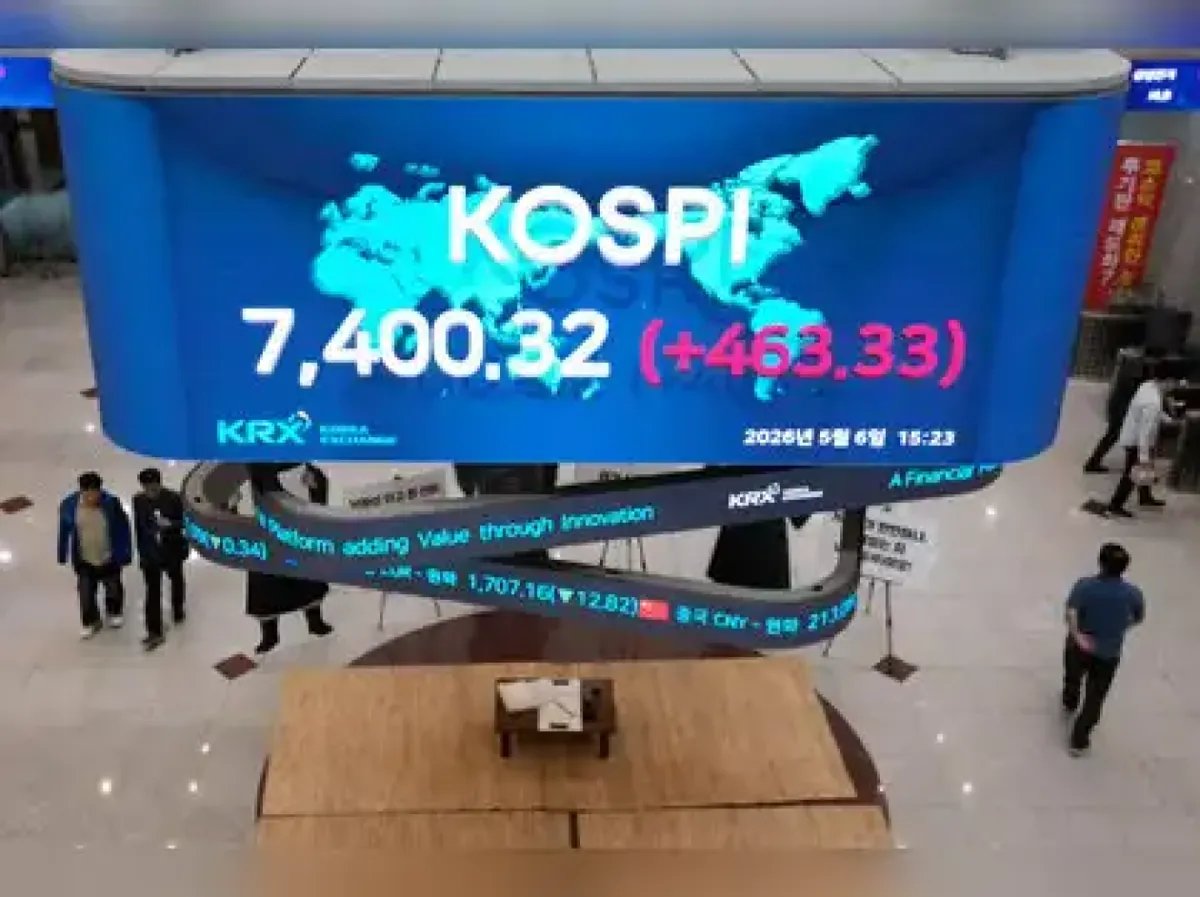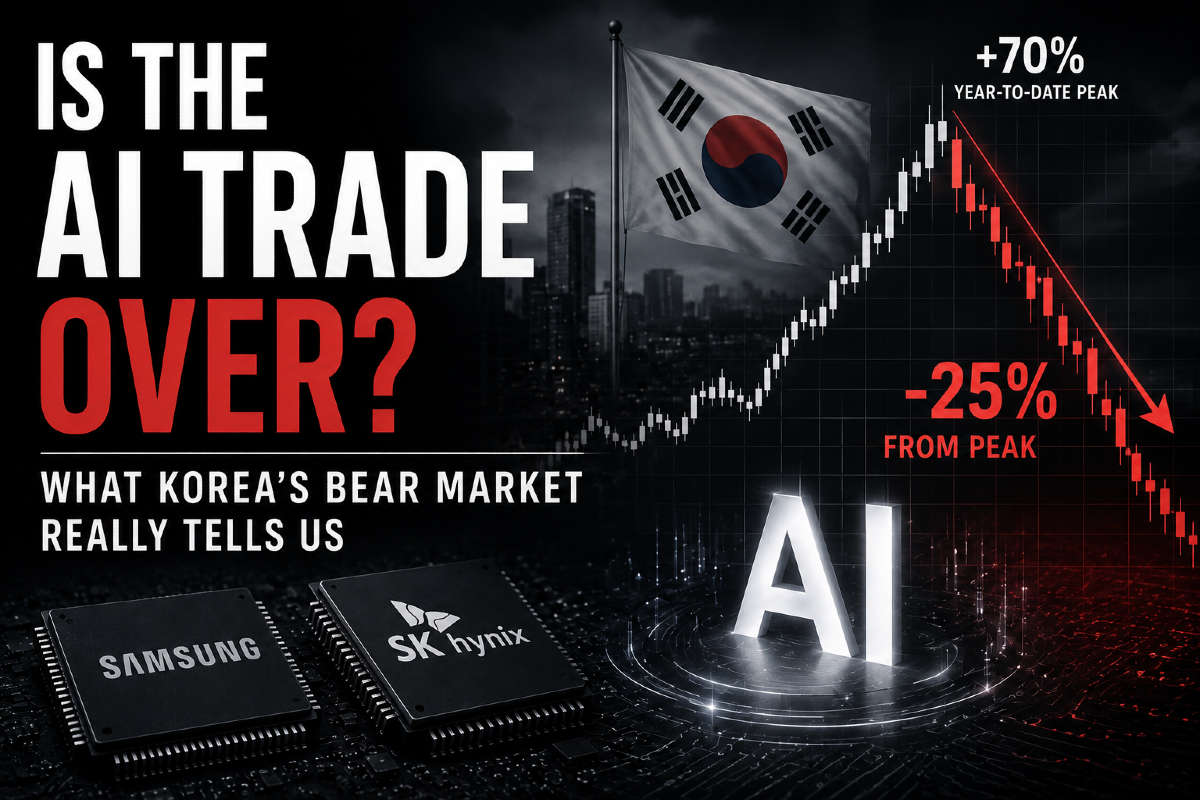
When a stock market that was up 70% for the year suddenly falls 25% from its peak in a matter of weeks, it's natural to ask: is the AI trade over? That's exactly the question hanging over markets after South Korea's Kospi index — driven almost entirely by AI-linked chipmakers Samsung Electronics and SK Hynix — tumbled into a technical bear market in July 2026. So: is the AI trade actually cracking, or is something narrower going on?
The Case That Something Real Broke
The bear case starts with valuation. Korean chip stocks had rallied so aggressively on AI optimism that, in the words of one strategist, they became one of the most crowded AI trades globally — meaning it didn't take much to trigger profit-taking once conditions turned. Analysts at Kiwoom Securities pointed to genuine concerns underneath the surface: a possible slowdown in memory-chip price growth and uncertainty about whether earnings had already peaked, even after Samsung's strong guidance. Rising global rate uncertainty and worries that earnings upgrades could moderate added to the caution.
There's also a structural argument. The Kospi's collapse was amplified by newly popular leveraged single-stock ETFs tied to chipmakers, which South Korea's Financial Supervisory Service and the Bank of Korea both flagged as capable of intensifying one-directional trading. When a market is this mechanically wired for concentrated momentum, sharp reversals become almost inevitable once sentiment shifts even slightly.
The Case That the AI Trade Is Just Rotating, Not Ending
The counter-evidence is hard to ignore. Samsung guided for strong second-quarter results — about 171 trillion won in sales and 89.4 trillion won in operating profit — in the days immediately before the sell-off accelerated. SK Hynix, meanwhile, pulled off a $28 billion Nasdaq listing that was oversubscribed multiple times over, with shares jumping more than 13% on debut and its CEO warning of the worst memory chip shortage in years heading into 2027.
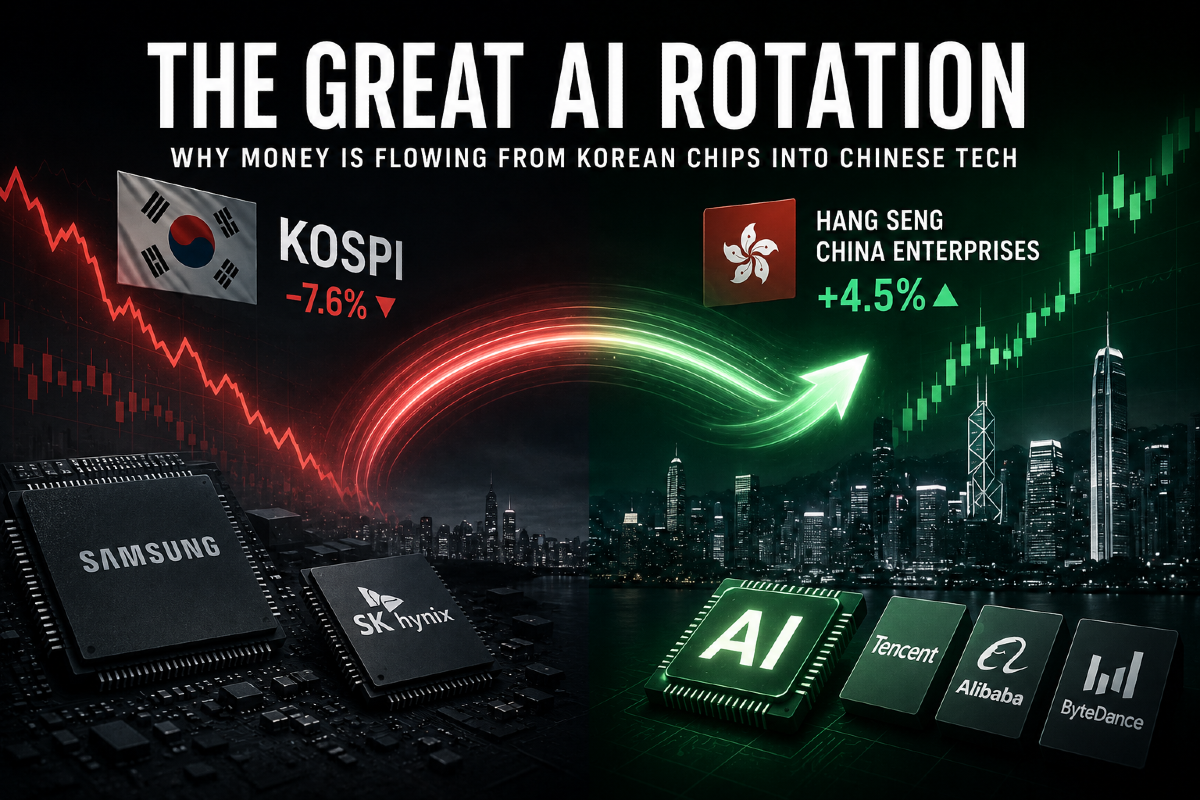
Just as tellingly, the capital that left Korean chip stocks didn't leave the AI trade altogether — it rotated. Hong Kong's Hang Seng China Enterprises Index posted its biggest single-day gain since April 2025 during the same stretch, lifted by AI-linked names, mainland chipmakers, and language model developers. That's the signature of a rotation trade, not a broad retreat from artificial intelligence as an investment theme. We break this dynamic down further in our look at the great AI rotation from Korean chips into Chinese tech.
What the Experts Are Actually Saying
The read from market strategists leans toward "reset," not "reversal." Jung In Yun of Fibonacci Asset Management Global called the correction more about positioning than fundamentals, describing it as a healthy reset rather than a fundamental change in outlook, and noted that foreign investors are likely to revisit Korea once global risk sentiment stabilizes given its central role in the AI supply chain. Manishi Raychaudhuri of Emmer Capital pointed to the same combination of AI skepticism and extreme market concentration as the real drivers, rather than any collapse in earnings.
Perhaps the most useful framing came from KB Financial Group's Peter Kim, who argued this is partly about how modern markets behave more broadly: retail flows, leveraged ETFs, and AI-driven concentration have made 5-10% swings increasingly common, driven as much by news flow and fads as by fundamentals. That's less a verdict on AI and more a warning about market structure.
So, Is the AI Trade Over?
The evidence points toward no — at least not in the way the "AI bubble bursting" narrative implies. What changed is investor tolerance, not investor belief. Markets are no longer rewarding every AI-linked stock automatically; they're asking whether earnings can keep climbing, whether memory-chip prices can hold, and whether valuations ran too far ahead of reality. That's a maturing trade, not a dying one. For a closer look at the mechanics behind Korea's specific sell-off, see our full breakdown of why the Kospi crashed 25% from its peak.
The next few weeks — TSMC's delayed earnings, U.S. inflation data, and the Bank of Korea's policy meeting — should offer a clearer read on whether this settles into a genuine reset or extends further. Until then, the safest conclusion is the least dramatic one: the AI trade isn't over, but it's no longer a one-way bet.
Related Reading
- Why the Kospi Crashed 25% From Its Peak — And What It Means for the Global AI Trade
- The Great AI Rotation: Why Money Is Flowing From Korean Chips Into Chinese Tech
- SK Hynix's $28B Nasdaq Listing: A Bright Spot Inside Korea's Bear Market
- AI Compute Demand Shows No Signs of Slowing, Despite Chip Stock Jitters