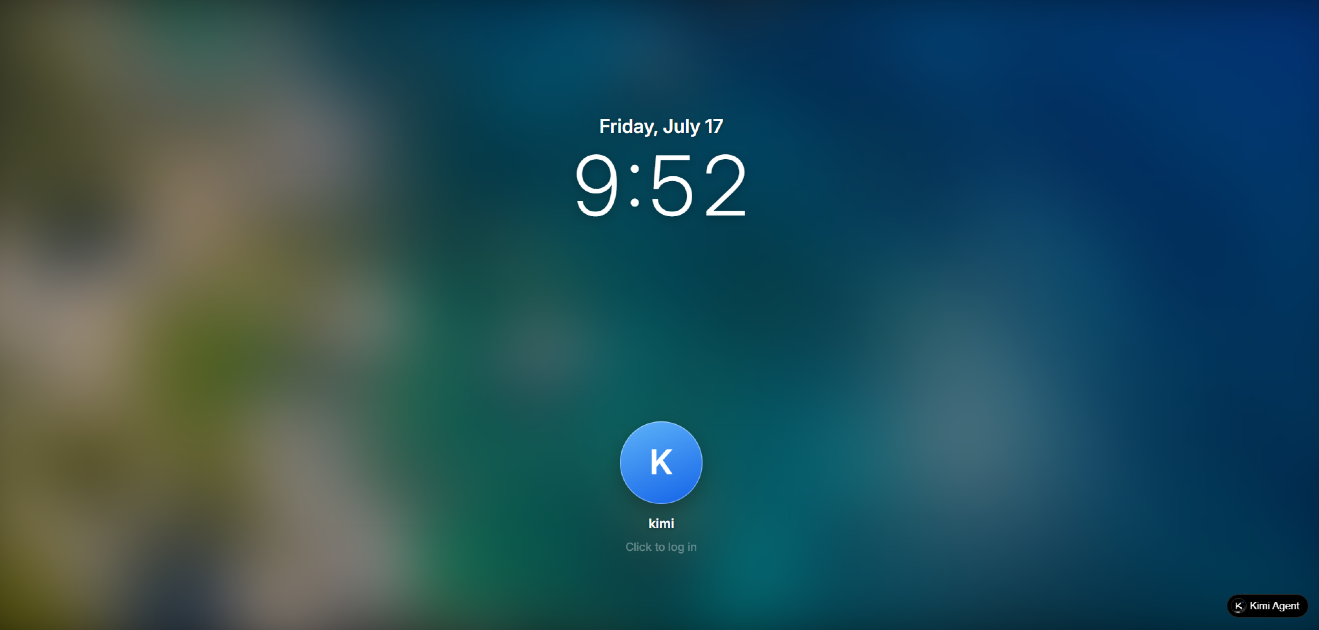
When Max Weinbach handed Kimi K3 a single prompt and walked away, what came back wasn't a mockup. It was a fully interactive macOS 27 simulator — complete with Liquid Glass effects, a functional Dock, a playable Chess game, editable Notes, and animated wallpapers — running live in a browser. The whole thing took hours, not days. And it may be one of the clearest signals yet of what Moonshot AI's 2.8-trillion-parameter model is actually capable of when pointed at frontend tasks.
The demo, which launched on July 16, 2026, is live at macos27.kimi.page and has since attracted attention far beyond the usual AI enthusiast circles. Users have reported playing full chess games, resizing floating widgets, and switching between scenic wallpapers — all with fluid animations that feel deliberately designed rather than procedurally assembled.
How Weinbach Used Kimi K3's Agent Swarm
Weinbach didn't use a single model call to produce the simulator. He leveraged Kimi K3 Swarm Max, the model's parallel batch-processing variant, which coordinates multiple agent threads simultaneously. This agentic architecture is what allowed the build to happen at the speed it did — K3 could run UI generation, logic scaffolding, and animation handling concurrently rather than sequentially.
The result is a showcase that highlights one of Kimi K3's most distinctive traits: its apparent superiority in frontend and UI generation tasks. In blind testing on LMArena's Code Arena leaderboard, developers ranked K3 above every leading U.S. model for front-end coding — a finding that carries more weight when you see it expressed as something like a macOS desktop running in your browser tab.
Weinbach was also notably candid about his prompting approach:
People over think prompts
— Max Weinbach (@mweinbach) July 17, 2026
They just need to trust the models and give it less details when you need a more creative response and more details when you need a specific response
Typos don't help but they don't matter for large enough models https://t.co/Ofqx8y2mSX
The point cuts against the prompting-as-engineering mindset that has dominated developer discourse. For a model at K3's scale, creative latitude often yields better results than over-specified instructions — a principle that applies as much to UI generation as it does to reasoning tasks.
What's Inside the Simulator
The macOS 27 demo isn't a static screenshot or a CSS mockup. It includes:
- Liquid Glass effects — Apple's new design language rendered faithfully in the browser
- A dynamic Dock — interactive and animated, with app icons responding to hover
- Playable Chess — a full game with move validation, not just a visual board
- Editable Notes — a functioning text editor within the simulated environment
- Floating widgets over scenic wallpapers — layered UI elements that scroll and resize
To be precise: this is a simulator, not an operating system. There's no kernel, no memory management, no actual process scheduling. But that distinction matters less than it sounds for what it demonstrates. Weinbach's build shows that a sufficiently capable model can autonomously construct a complex, visually coherent, interactive application with production-quality aesthetics — from a high-level prompt, without a human designer in the loop.
Why Kimi K3 Excels at This
Kimi K3 is a 2.8-trillion-parameter Mixture-of-Experts model, activating 16 of 896 experts per forward pass. It ships with a one-million-token context window and supports native visual input. But raw scale isn't the whole story here.
Independent benchmark data, including leaderboard rankings on LMArena's Code Arena, places K3 at the top of UI and frontend generation evaluations — outperforming models from OpenAI and others in side-by-side developer preference tests. Moonshot's own numbers show competitive performance against frontier-tier proprietary models on coding and agentic tasks, with full weights scheduled for public release on July 27, 2026.
The Swarm Max variant that Weinbach used is specifically tuned for parallel agentic workloads — making it well-suited to tasks like building a multi-component UI where many sub-tasks (layout, logic, styling, interaction) can be dispatched concurrently. That architectural fit is likely a significant part of why the macOS 27 build came together at the speed it did.
For the broader context on what Kimi K3 is and how it benchmarks against the field, see our earlier coverage: Kimi K3 Is Official: The 2.8T Open Model That Built Its Own Compiler and Designed Its Own Chip.
What This Means for Developers
The macOS 27 demo is a proof of concept for something with practical implications. Rapid UI prototyping has historically required design tools, front-end engineers, and iteration cycles measured in days. What Weinbach demonstrated compresses that timeline dramatically — from hours of human effort to hours of model runtime, with a result that's immediately interactive.
This doesn't mean AI replaces UI/UX designers. But it does mean the threshold for a working prototype — something you can put in front of stakeholders and click through — has dropped significantly. The question for developers is no longer whether models can do this, but how to structure prompts and agent workflows to get consistent, production-quality results at will.
Kimi K3's rise to the top of LMArena's Code Arena is directly relevant here. As we covered in Kimi K3 Just Dethroned Every Western Model on LMArena's Code Arena, the model's preference lead in frontend tasks isn't marginal — it's a clean sweep against the current Western field. The macOS 27 simulator is, among other things, a real-world stress test of that ranking.
For teams already exploring agentic coding pipelines, this is also a useful data point on Swarm Max. The parallel agent architecture isn't just a performance optimization — it's what makes complex, multi-component builds tractable at all. Earlier this week, we looked at a different angle on this pattern with Gemini's Managed Agents and how budget controls are reshaping how developers think about agentic workflows.
What's Next
The macOS 27 simulator is likely to inspire a wave of similar demos as more developers get hands-on time with K3 Swarm Max. The full model weights — including the technical report covering architecture, training, and evaluations — are scheduled for public release on July 27. Once they're available for local deployment, the range of possible applications expands considerably.
More broadly, this demo arrives at a moment when the question of which model frontier developers should build on is genuinely open. With Kimi K3's coding strengths now demonstrated in a highly visible, shareable format, Moonshot AI has made a strong bid for mindshare among the frontend and prototyping community — a group that has historically coalesced around tools and models that just work for visual, interactive output. Time will tell whether K3 holds that position once the full weights ship and independent evaluation catches up.
Related Reading
- Kimi K3 Is Official: The 2.8T Open Model That Built Its Own Compiler and Designed Its Own Chip
- Kimi K3 Just Dethroned Every Western Model on LMArena's Code Arena
- Kimi K3 Deep Dive: What 2.5T Parameters and a 1M-Token Window Actually Change
- Gemini's Managed Agents Now Run on Free Tier — But the Budget Controls Are Why Devs Should Care