A Single Prompt. A Working OS. What Just Happened?
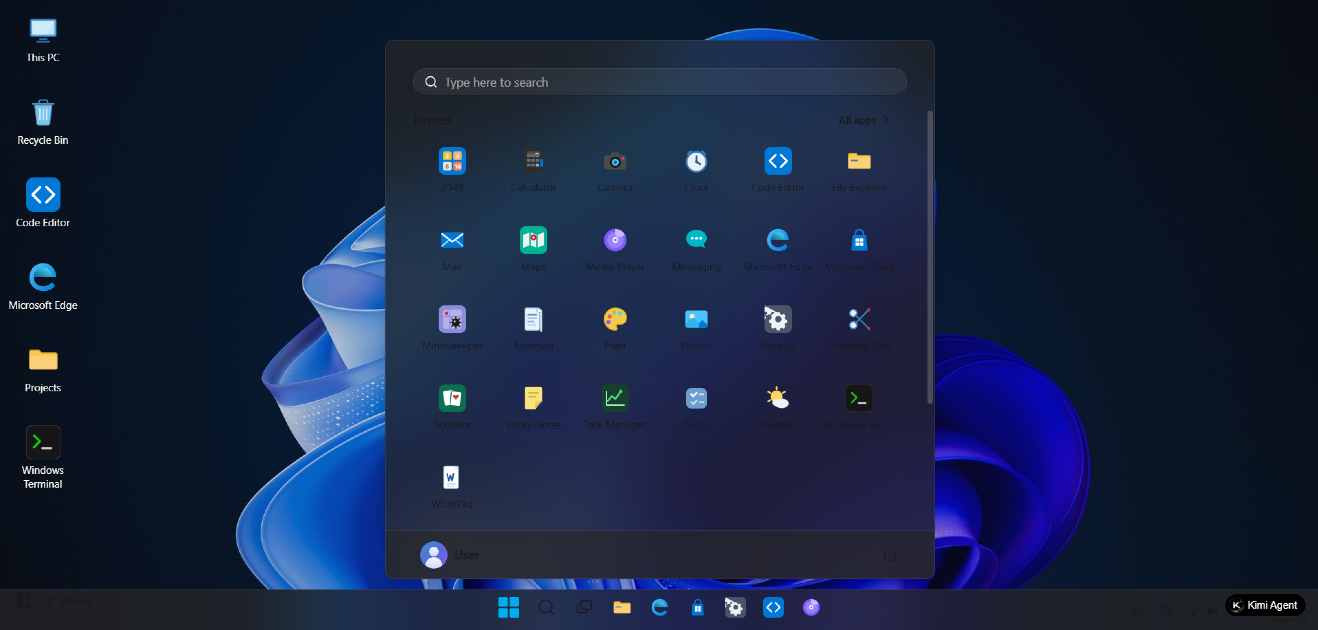
The demo that's been circulating on X since July 17 looks, at first glance, like a magic trick. Developer Chetaslua posted a video of a fully interactive Window Browser OS — complete with windowed apps, a taskbar, and navigable UI elements — generated by Kimi K3 from a single prompt. The original comment with the prompt is right there in the thread. No multi-turn refinement, no scaffolding, no agent loop — just one shot.
Window Browser OS made by Kimi K3Holy SHit one shot prompt is comment and here is the link so that you can see how cool it is https://t.co/C4b9grceW7 https://t.co/VIWm0pEi6a pic.twitter.com/lVvYzmXkpQ
— Chetaslua (@chetaslua) July 17, 2026
It's an arresting piece of generative UI — but the more interesting question isn't what was built. It's why Kimi K3 is the model pulling off demos like this right now, and what the one-shot constraint actually tells us about where frontier AI coding is headed.
Why Kimi K3 Is the Model Doing This
Kimi K3 is Moonshot AI's flagship model, launched on July 16, 2026 as the world's first open model in the 3-trillion-parameter class. Its architecture — Stable LatentMoE with 896 experts, activating just 16 per token — gives it the reasoning depth of a 2.8T model while keeping inference latency manageable. It also ships with native vision and a 1-million-token context window, meaning it can hold an entire complex UI spec in working memory without losing track of component relationships.
But the capability that makes the Browser OS demo possible isn't raw scale. It's K3's specific training emphasis on frontend code generation and visual reasoning. According to Moonshot's official platform documentation, K3 was explicitly designed to excel at tasks combining software engineering with visual understanding — using screenshots and visual feedback to improve workflows in frontend engineering, game development, and related scenarios.
That's not just marketing language. It reflects in the benchmarks. Kimi K3 currently sits at #1 on Arena's Frontend Code leaderboard with a score of 1,679 — a 17-place jump from where its predecessor K2.6 ranked, and a margin that puts it meaningfully ahead of Claude Fable 5 (1,631) and GPT-5.6 Sol (1,618). It topped six of seven frontend domains in the evaluation, losing only in Gaming.
What "One-Shot" Actually Means Here
The one-shot framing deserves careful unpacking. Generating a functional windowed OS interface — with draggable windows, layered UI elements, a working browser pane, and consistent visual language — from a single natural language prompt requires the model to:
- Decompose a high-level concept into a coherent component hierarchy
- Generate all the HTML, CSS, and JavaScript without intermediate feedback
- Maintain internal consistency across elements it hasn't "seen" yet as it writes
- Produce interactive behavior (event listeners, window management) that actually works on first render
This is qualitatively different from producing a landing page or a form. An OS-style UI involves stateful behavior — window focus, z-indexing, resize handles — that requires the model to plan the full system before committing to any single component. That kind of forward planning under a one-shot constraint is exactly where long-context models with strong internal coherence tend to outperform shorter-context alternatives.
Pre-release arena testing had already flagged K3's one-shot frontend capabilities. Developers noted "striking frontend generation demos: interactive product pages, single-file HTML experiments, visual polish closer to top closed coding models' 'taste' demos than to dry algorithm problems." The Browser OS is a more ambitious version of that same pattern.
The Architecture Behind the Demo
Several architectural details make K3 particularly suited to this class of task:
Kimi Delta Attention (KDA)
K3's hybrid linear attention mechanism dramatically reduces the KV cache cost of processing long inputs. Moonshot reports a 75% reduction in KV cache requirements and a 6x throughput improvement for 1M-context tasks compared to standard attention. For a complex one-shot prompt describing an entire OS UI, this means K3 can hold the full specification in active context without the quality degradation that typically appears when models hit their effective context ceiling.
Stable LatentMoE
The mixture-of-experts design — 896 total experts, 16 activated per token — means K3 routes different parts of the generation task to specialized sub-networks. Frontend CSS layout decisions, JavaScript event logic, and high-level structural planning likely activate meaningfully different expert combinations, giving the model something closer to genuine specialization rather than averaging across all tasks simultaneously.
Vision-in-the-Loop Training
K3 was trained with visual feedback as part of the development loop. Moonshot demonstrated "vision in the loop" capabilities at launch — the model iterating between code and live screenshots to self-correct visual output. While the Browser OS demo was one-shot (no iteration), the underlying training objective that produced this behavior is one where visual correctness and code correctness are jointly optimized. The model has internalized what working UI is supposed to look like, not just what valid HTML looks like.
How This Fits the Broader Kimi K3 Story
The Browser OS demo is one data point in a larger pattern of K3 producing striking generative outputs across different domains. Earlier coverage documented how K3's agent swarm built a working macOS 27 simulator — a different task (multi-agent, longer time horizon) but the same underlying capability: turning a high-level concept into a functional interactive artifact with minimal human scaffolding.
The common thread is K3's ability to bridge the gap between intent and implementation. Most current AI coding workflows still require significant human iteration — prompt, review, refine, re-prompt. What these demos suggest is that K3 can close more of that loop in a single pass, at least for UI-heavy tasks where visual coherence and functional correctness are the primary success criteria.
That has real implications for prototyping workflows. If a developer can describe a product concept and receive a functional, interactive prototype in one pass, the economics of early-stage product development change. The Browser OS demo isn't a production-ready deliverable — but it's the kind of thing that would have taken a skilled developer several hours to build from scratch.
The Caveats Worth Keeping in Mind
Viral one-shot demos are, as the pre-release coverage correctly noted, easy to cherry-pick. A model that generates an impressive Browser OS in one attempt may fail the same task with a slightly different prompt, or produce subtly broken behavior that only surfaces under real interaction. The demo video shows the output; it doesn't show the 20 attempts that didn't work.
K3's frontier coding credentials are real — the Arena leaderboard numbers are independently confirmed — but the model also carries the same caveat that applies to all vendor-showcased demos: the best results tend to be curated. Independent developers running systematic evaluations have noted that K3 can be slow and prone to overthinking on complex tasks, a pattern Moonshot addressed with its K2.7 Code's "HighSpeed" mode and may address in subsequent K3 variants.
Additionally, K3's open weights aren't available until July 27. Until then, all interaction is via API, meaning developers can't inspect the model's internals, fine-tune it, or run it locally. The full picture of where K3's one-shot capabilities are reliable versus where they break down will become clearer once the community has direct access to the weights.
What's Next for AI-Generated UI
The Browser OS demo lands at an interesting moment for AI-assisted frontend development. K3's #1 Arena ranking for frontend code means the community already has strong signal that this model punches above its weight on visual coding tasks. The one-shot OS demo adds a qualitative dimension to that quantitative ranking: it's not just that K3 scores higher on structured benchmarks, it's that it can operate at a level of abstraction — "build me an OS interface" — that most models still struggle to translate into functional output.
The broader implication is about where the frontier of AI-generated UI is moving. A year ago, impressive AI coding demos typically involved single components or simple pages. The current generation of frontier models — K3 among them — is pushing into full systems. That progression suggests the one-shot ceiling for UI complexity is still rising, and demos like the Browser OS may look modest compared to what models can generate by the end of 2026.
For developers watching the space, the practical takeaway is simple: if you're building anything that lives in a browser, Kimi K3 is now a model worth testing as a first-pass prototyping tool. The one-shot Browser OS is a signal, not a guarantee — but it's a signal from a model that the leaderboards and the community are both taking seriously.
Related Reading
- Kimi K3 Is Official: The 2.8T Open Model That Built Its Own Compiler and Designed Its Own Chip
- Kimi K3 Just Dethroned Every Western Model on LMArena's Code Arena
- Kimi K3 Built a Working macOS 27 Simulator in Hours — and Devs Are Rethinking Prototyping
- Kimi K3 Deep Dive: What 2.5T Parameters and a 1M-Token Window Actually Change