Qwen-Image-3.0 Makes Text-Accurate, Knowledge-Dense Image Generation Actually Useful
Alibaba’s Qwen-Image-3.0 accepts 4,500-token prompts to generate legible 10px text and complex layouts, shifting AI art toward deployable professional utility.
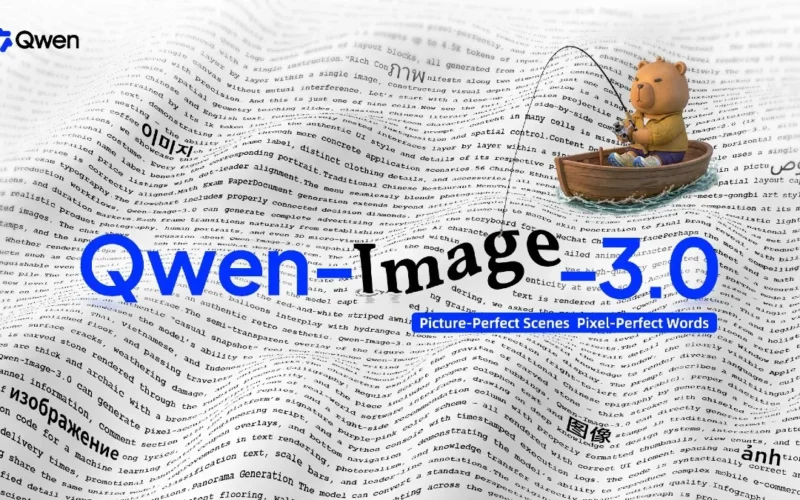
Alibaba recently released Qwen-Image-3.0, marking a significant shift in AI image generation. This model prioritizes functional accuracy over pure aesthetics. Therefore, Qwen-Image-3.0 makes text-accurate, knowledge-dense image generation actually useful for professionals.
Previous versions focused on visual variety. However, this new release targets real-world utility. It generates images that are functionally accurate enough for academic and professional contexts.
Processing 4,500 Tokens in One Pass
The input ceiling demonstrates this massive capability leap. Qwen-Image-3.0 accepts instructions up to 4,500 tokens long. This equals a detailed technical brief. Furthermore, it renders the resulting image in a single pass.
The team illustrated this with a complex 3×3 grid. A 3,700-token prompt fully specified the layout. Each cell contains distinct infographics with accurate bilingual text and formulas. Crucially, the model generated the entire grid simultaneously without interference.
This capability transforms complex information design workflows. Exam papers and technical decks previously required dedicated software. Now, a single prompt can often replace that manual assembly process.
How Qwen-Image-3.0 Makes Text-Accurate, Knowledge-Dense Image Generation Actually Useful
Precision extends beyond layout complexity to small text rendering. The model correctly generates text as small as 10 pixels. This includes LaTeX formulas with superscripts and multi-line alignment.
For example, it rendered a dense algebraic geometry paper page accurately. Every symbol remained readable at small sizes. Additionally, a whale shark infographic showed precise labeled diagrams.
Legible small-text generation separates decorative tools from usable document creators. A newspaper layout example confirms this professional focus. Dense columns and authentic textures suggest genuine utility for publishers.
Nested Interfaces and Deep World Knowledge
The “Deep Knowledge” pillar covers native multilingual rendering and UI simulation. First, the model accurately generates Japanese, Korean, Spanish, and Chinese together. Each language preserves correct typographic conventions.
Second, it simulates realistic nested user interfaces. A single prompt can generate a VSCode editor containing a chat window and a poster. Each layer maintains its authentic visual style. Consequently, developers save significant time creating documentation mockups.
The model also grounds content in real-world data. For instance, it generated a Hangzhou weather forecast using live data. It also created entomological figures by adding taxonomic annotations to insect photographs.
Positioning Within the Broader Ecosystem
This release does not exist in isolation. Alibaba is aggressively expanding the Qwen ecosystem. Qwen3.8, its 2.4-trillion-parameter text model, is already live in preview with open weights coming soon.
Meanwhile, Qwen3.8 Max was positioned against Anthropic’s Fable 5 in recent benchmarks. The image generation arm follows this parallel track of practical deployment.
Highlighted applications include newspaper PDFs and academic figures. This differs from typical artistic showcases. Finally, Qwen-Image-3.0 is available via Qwen Studio and the API platform.