Shanghai AI Lab’s 397B Open Model Tops MMLU-Pro — and Beats GPT-5.5 on Code
Shanghai AI Lab’s 397B open model tops MMLU-Pro at 89.75, beating GPT-5.5. Discover how InternS2 leads scientific reasoning while trailing on some coding tasks.
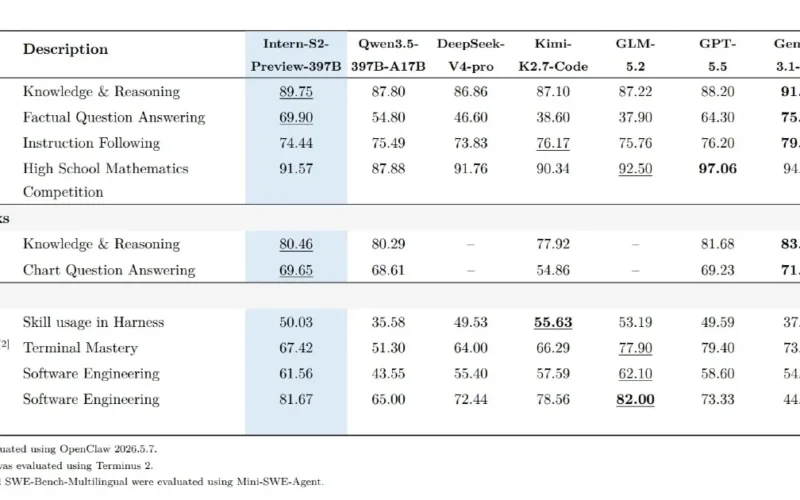
Shanghai AI Lab’s 397B open model tops MMLU-Pro and beats GPT-5.5 on code benchmarks. This new multimodal system, InternS2-Preview-397B, leads open-source general reasoning with a score of 89.75. It also outperforms GPT-5.5 on SWE-Bench Pro. However, its true strength lies in specialized scientific intelligence rather than general coding.
How Shanghai AI Lab’s 397B Open Model Tops MMLU-Pro
The architecture behind this performance is unique. InternS2 uses a Qwen3.5-MoE text backbone with 403B total tensors. Despite the size, it activates only 17 billion parameters per token. First, it routes inputs through 10 of 512 available experts. This efficiency allows for a native 256K context window.
Additionally, the model features separate encoders for vision and scientific time-series data. Most models treat all non-text input identically. In contrast, InternS2 treats experimental data as a distinct modality. Therefore, it maps more accurately to actual research workflows. Native multimodal support covers images, video, and scientific series without bolted-on adapters.
Training on Raw Scientific Documents
Training methodology matters as much as architecture. The team used raw scientific documents instead of plain text. Diagrams, equations, and tables remained structurally intact. Stripping formatting often destroys spatial context. Consequently, the model retains crucial relational information from papers and datasets.
Furthermore, reinforcement learning scaled across 20 scientific domains simultaneously. Biology, chemistry, and physics were trained jointly. This approach prevents catastrophic forgetting common in sequential fine-tuning. Finally, black-box agentic reinforcement learning connects the model to sandboxed environments. It learns from execution outcomes rather than step-by-step supervision.
Benchmark Reality: Where It Wins and Loses
Vendor-reported benchmarks require verification. Nevertheless, the MMLU-Pro score of 89.75 currently leads open-source models. This surpasses GPT-5.5’s 88.20. On SWE-Bench Pro, it scores 61.56 against GPT-5.5’s 58.60. However, it still trails Claude’s 69.20 by nearly eight points.
This gap matters for developers evaluating coding agents. InternS2 is not a general-purpose frontier killer. Mixed results outside its scientific sweet spot suggest specialization. Therefore, it generalizes well because of deep science training, not despite it. Users should weigh this distinction carefully before deployment.
Availability and Hardware Requirements
InternS2-Preview-397B is available under Apache 2.0. You can use, modify, and redistribute the weights commercially. An official chat interface is live online. However, self-hosting requires significant hardware. Running full precision demands at least eight H100-class GPUs. This puts local deployment firmly in the institutional category.
For most users, the InternS2-Preview-35B variant is more practical. Released in May, it runs on single high-end consumer GPUs. While smaller, it remains capable for many research workflows. Third-party inference platforms like OpenRouter do not yet host the 397B version. Wider availability will signal broader adoption intentions.
Competitive Landscape and Future Outlook
InternS2 occupies a specific niche among large open-weight models. Kimi K3 remains larger at 2.8 trillion parameters. DeepSeek V4 runs on non-Nvidia silicon. In comparison, InternS2 focuses on scientific reasoning depth. Its competitive advantage targets biology and materials design specifically.
The “Preview” label indicates this release is unfinished. Future versions will likely improve benchmark numbers. Expanded API availability may follow. For now, the official chat and 35B variant are the primary entry points. Whether this model reaches Western developer platforms soon remains a key metric to watch.
