Soofi S 30B: Germany’s Open-Source LLM That Beats OLMo 3 and Apertus 70B in Both English and German
Germany’s KI Bundesverband released Soofi S 30B, a sovereign open-source model outperforming OLMo 3 and Apertus 70B on English and German benchmarks.
Introducing Soofi S 30B: A Sovereign AI Breakthrough
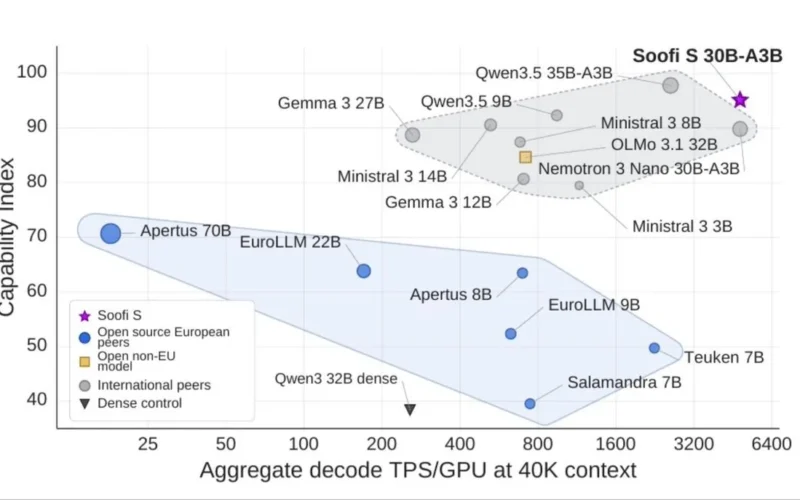
The KI Bundesverband has officially released Soofi S 30B, a powerful new open-source language model. This sovereign AI system currently leads fully open models on both English and German benchmarks. Consequently, it outperforms previous leaders like OLMo 3 32B and Apertus 70B.
Notably, the team trained this model entirely on Deutsche Telekom’s Industrial AI Cloud in Munich. This achievement marks a major milestone for European infrastructure. For the community, Soofi S 30B represents significant progress in regional AI ambitions.
Efficient Hybrid Architecture for Lower Compute Costs
Soofi S 30B uses a mixture-of-experts architecture with 31.6 billion total parameters. However, it activates only 3.2 billion parameters per generated token. Therefore, compute costs resemble a smaller 3B model rather than a standard 30B one.
The consortium adopted Nvidia’s Nemotron 3 Nano architecture without modification. This hybrid design combines Mamba-2 layers with standard attention layers. Unlike typical transformers, only six of its 52 layers maintain a KV cache.
This efficiency yields impressive throughput results. At 40,000 tokens context length, it generates eight times more tokens per second than comparable dense models. Furthermore, performance remains flat across contexts up to 256,000 tokens. Developers interested in similar efficient architectures can explore how to run a flagship MoE model on a single GPU for local deployment insights.
Training Data Weighted Toward German Proficiency
The training process covered roughly 27 trillion tokens across three distinct phases. First, the team established broad language fundamentals using web, code, and math texts. German comprised 7.2% of this initial mix.
Next, phase two utilized higher-quality sources to sharpen learned patterns. Here, the German share rose to 15.3%. Finally, phase three extended long-context capabilities using documents up to one million tokens.
This deliberate over-representation of German differs significantly from standard recipes. Sources included HPLT, FineWiki, and the commercially licensed Genios corpus. As a result, benchmark scores clearly reflect this strategic focus.
Benchmark Performance: Soofi S 30B vs Competitors
Soofi S 30B leads all fully open models on aggregate English and German scores. It finishes first on all German benchmarks against European sovereign baselines. Often, it wins by double-digit margins.
Standout scores include 73.8% on HumanEval and 84.2% on MBPP-DE. Additionally, it achieved 92.3% on ARC-Challenge-DE and 88.8% on GLP-DE. Compared to the Nemotron baseline, German proficiency improved by 15.1 points without sacrificing English performance.
Current Model Limitations
Despite these wins, the model struggles with German competition mathematics. It also lags on open-domain factual retrieval due to fewer active parameters. Dense models simply store more world knowledge.
Moreover, long-context extraction shows weakness beyond 32,000 tokens. The hit rate drops to around 3% on frequent-word tasks. The team attributes this to missing synthetic extraction data during training.
Sovereign Infrastructure and Sustainability Standards
Training occurred between March and May 2026 on 512 Nvidia B200 GPUs. The facility runs entirely on renewable energy. Additionally, it uses canal water for cooling and feeds waste heat to nearby neighborhoods.
A broad consortium supports this project, including Fraunhofer Institutes and DFKI. Funding comes from the German Federal Ministry for Economic Affairs and Energy. This backing ensures robust development within the European IPCEI-CIS program.
Open Source Licensing and Availability
The team is releasing weights, checkpoints, code, and a detailed data inventory. This satisfies the Open Source AI Definition 1.0 according to the consortium. Even excluded sources are fully documented.
However, a stricter European proposal requiring freely distributable tokens is not met. The Genios corpus carries a commercial license, affecting about 1.3% of data. Still, developers can independently reconstruct 99% of the training mix.
Implications for European AI Development
This release arrives during fierce global competition in open-source LLMs. Models from East and West continue raising performance bars. Yet, Soofi S 30B offers dominant German capability alongside sovereign training infrastructure.
The consortium now seeks industry partners for technical document processing and code generation. For teams targeting German-speaking markets, this is a premier open-source starting point.
Frequently Asked Questions
What makes Soofi S 30B different from other open-source models?
Soofi S 30B distinguishes itself through sovereign European training infrastructure and superior German language benchmarks. Unlike many global models, it was trained entirely in Munich using renewable energy. Additionally, its hybrid Mamba-2 architecture delivers high throughput at lower compute costs.
Is Soofi S 30B truly open source?
Yes, the model satisfies the Open Source AI Definition 1.0 by releasing weights, code, and data inventories. However, about 1.3% of training data comes from the commercially licensed Genios corpus. Despite this, developers can independently reconstruct 99% of the training mix.
How does Soofi S 30B handle long-context tasks?
Performance remains flat across contexts up to 256,000 tokens for general generation. However, specific extraction tasks show weakness beyond 32,000 tokens. The team plans to address this limitation with additional synthetic extraction data in future updates.
