The Great AI Rotation: Why Money Is Flowing From Korean Chips Into Chinese Tech
Korean chip stocks crashed while Chinese tech surged. This shift highlights the great AI rotation and what it means for global investors.
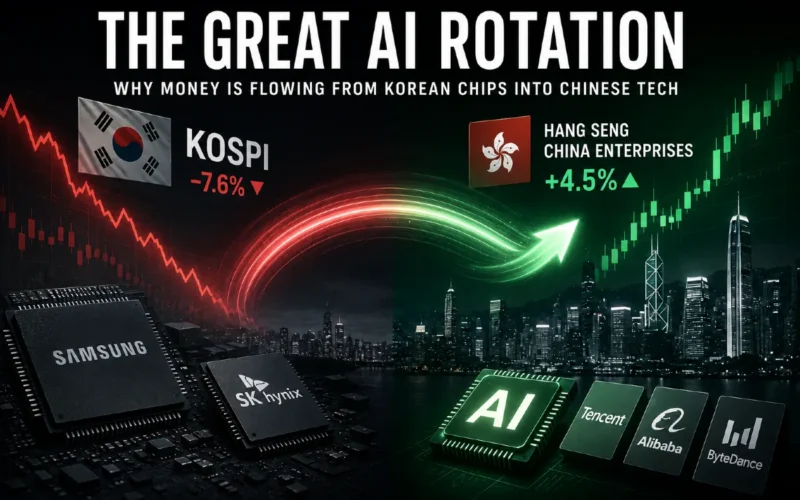
South Korea’s Kospi index recently entered a bear market. However, Hong Kong’s Hang Seng China Enterprises Index surged simultaneously. Strategists call this shift the great AI rotation: why money is flowing from Korean chips into Chinese tech. This trend is reshaping how global investors approach the artificial intelligence boom.
Korea Falls as China Rises
Korean equities were previously a crowded trade. The Kospi rose over 70% by its June peak. Samsung Electronics and SK Hynix drove this growth through AI memory demand. Then, the rotation hit hard.
The Kospi lost 7.6% in one week. Meanwhile, the Hang Seng gained 3.5%. Hang Seng Tech climbed nearly 5% during this period. Conversely, SK Hynix fell over 10%. Therefore, Korea dropped to the bottom of major indices while Chinese stocks surged.
Drivers Behind the Great AI Rotation: Why Money Is Flowing From Korean Chips Into Chinese Tech
Investors are not rejecting AI entirely. Instead, they seek cheaper entry points. Several forces drive this capital shift.
First, valuation relief matters. Korean chip stocks ran far ahead of earnings. Chinese AI names offered a less crowded alternative. Second, capital formation supports the rally. Chinese tech firms raised $20 billion in Hong Kong this year. This funding backs AI and semiconductor expansion.
Additionally, beneficiaries are broadening. The rotation lifts mainland chipmakers and model developers like Zhipu. Finally, some investors rotated into financials. This suggests portfolio rebalancing rather than a pure AI bet.
Nuance in the Market Shift
This rotation is not uniformly bullish for China. Hong Kong markets had sunk just weeks earlier. Financial shares previously dominated the index. Consequently, money moved into an unloved market rather than one priced for perfection.
Meanwhile, Korean fundamentals remain intact. Samsung guided for strong earnings before the sell-off. SK Hynix also completed a massive Nasdaq listing. Its CEO warned of a looming memory chip shortage. For deeper analysis, read Why the Kospi Crashed 25% From Its Peak — And What It Means for the Global AI Trade.
Future Market Tests
Three near-term tests will determine if this rotation sticks. These include TSMC earnings, U.S. inflation data, and Bank of Korea policy. Global semiconductors remain the most crowded trade. Therefore, capital will likely keep moving between markets based on relative value.
Related Reading
