What Is AI-Powered Phishing and Why It’s So Dangerous in 2026
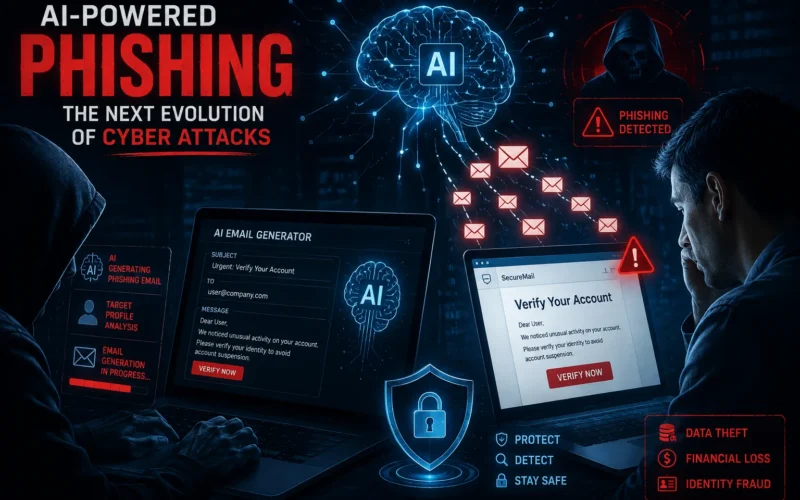
Phishing is not new. For decades, cybercriminals have used fake emails, suspicious links, and cloned login pages to steal passwords and sensitive data. However, in 2026, something has fundamentally shifted — and most people have no idea how dangerous AI-powered phishing has become.
Artificial intelligence has handed attackers a genuinely terrifying upgrade. Today’s phishing emails carry no spelling mistakes, no generic greetings, and no obvious red flags. They are personalized, professionally written, and eerily accurate. Furthermore, they arrive at a scale the industry has never seen before.
This article breaks down exactly what AI-powered phishing is, how the attack chain works, why traditional defenses are failing, and what you can actually do to stay protected.
What Is AI-Powered Phishing?
AI-powered phishing is a cyberattack where criminals use generative AI tools — including large language models, voice cloning software, and deepfake video generation — to craft highly convincing scam messages. The goal is to trick you into handing over credentials, money, or sensitive corporate data.
Traditional phishing was relatively easy to spot: poor grammar, generic sender addresses, and obvious urgency. AI phishing removes almost every one of those warning signs. With generative AI, attackers can now write flawless professional emails that mimic real colleagues and executives. They personalize each message using data scraped from LinkedIn, company websites, and social media. They clone voices to make fake phone calls that sound exactly like your boss, generate deepfake videos impersonating real decision-makers in real time, and produce thousands of customized messages per hour.
The result is attacks that look and feel completely legitimate — even to trained, security-aware employees.
How Does AI-Powered Phishing Work?
Understanding the attack chain helps you recognize and interrupt it. Here is how a modern AI phishing campaign typically unfolds.
Step 1: Target Profiling
The attacker feeds an AI tool your publicly available information — your LinkedIn profile, company website, GitHub activity, social media posts, and any leaked database records. Within minutes, the system builds a detailed profile: your role, your manager’s name, recent projects, communication tone, and key relationships.
Step 2: Message Crafting
Next, a large language model generates a highly personalized phishing email. It might reference a real project you’re currently working on, match the writing style of your CFO, and request an urgent payment approval or password reset. The grammar is flawless, the tone matches, and there are no obvious red flags.
Step 3: Multi-Channel Delivery
Modern AI phishing campaigns are not limited to email. Attackers combine messages with fake phone calls using AI voice cloning, follow-up SMS messages, and deepfake video calls. This multi-channel pressure makes the scam feel overwhelmingly real. According to recent threat analysis, phishing is now involved in 57% of all social engineering incidents, and QR-code phishing (“quishing”) has surged as an additional delivery vector since most email gateways scan URLs but cannot decode QR images for analysis.
Step 4: Credential Harvesting
Finally, the victim clicks a link, enters credentials on a convincing fake login page, or installs what appears to be a legitimate software update — handing attackers full access to accounts, systems, or corporate networks.
Watch: AI Phishing in 2026 Explained
This video breaks down how AI-powered scams, including phishing, are spreading fast — and what you need to know to protect yourself:
The Numbers That Should Alarm You
This is not a theoretical threat. The data from 2025 and 2026 is striking across every metric that matters to security teams and individuals alike.
The FBI recorded $16.6 billion in cybercrime losses in 2024 alone — a 33% year-over-year increase. The World Economic Forum found that 73% of organizations were directly affected by cyber-enabled fraud in 2025. A single deepfake video call cost UK engineering firm Arup $25.6 million after attackers impersonated executives in a fake Zoom meeting.
AI-generated phishing emails now achieve 54% click-through rates, compared to just 12% for generic phishing attempts. Phishing attacks linked to generative AI surged 1,265% in a short measurement window, while vishing attacks increased 442% between 2023 and 2024. Deepfake incidents grew 680% year-over-year, with Q1 2025 alone recording more cases than all of 2024 combined. The FBI’s 2025 IC3 report confirmed a 37% rise in AI-assisted Business Email Compromise. Projected fraud losses from AI-enabled attacks are expected to reach $40 billion by 2027.
Types of AI-Powered Phishing Attacks
Spear Phishing at Scale
Traditional spear phishing required hours of manual research per target. AI makes it scalable. One documented 2026 campaign targeted over 800 accounting firms with personalized emails referencing specific state registration details — achieving a 27% click rate. What used to require a team of researchers now runs automatically at machine speed.
Vishing — AI Voice Cloning
Attackers clone a person’s voice using as few as a few seconds of publicly available audio — from a podcast, YouTube clip, or LinkedIn video. The cloned voice then calls targets, impersonating executives, bank representatives, or IT support staff to extract passwords or authorize fraudulent wire transfers. Several documented 2025 cases involved employees receiving calls from apparent C-suite executives whose voices had been cloned from public earnings calls.
Deepfake Video Attacks
The most sophisticated form involves real-time video deepfakes impersonating a known person — a CEO, a colleague, or a government official — to conduct fake meetings or issue fraudulent instructions. YouTube warned in 2025 that AI-generated video of its own CEO was being used in campaigns targeting content creators. To understand how modern deepfake detection tools are beginning to catch up, read our earlier analysis: A Fake Photo of a Hospitalized Senator Just Proved Deepfake Detection Actually Works.
AI-Enhanced Malware Delivery
Phishing emails now carry AI-generated malicious code that adapts dynamically to evade antivirus tools. The VENOMOUS#HELPER campaign of May 2026 used AI-generated emails to trick victims at more than 80 US companies into installing modified remote access tools — giving attackers persistent access to corporate networks while bypassing every traditional defense layer.
Adversary-in-the-Middle (AiTM) Attacks
Even multi-factor authentication is no longer a reliable backstop. AiTM toolkits like Tycoon 2FA and EvilProxy sit between the victim and a real login page, stealing the session token after a successful MFA login. Attackers gain full account access without ever needing the password or MFA code directly. Standard SMS-based MFA offers no protection against this technique.
Watch: Why Traditional Phishing Detection Is Failing
This video takes a closer technical look at why legacy email security fails against AI-driven attacks — and what next-generation defenses actually look like:
Why AI Phishing Is Fundamentally Different
The old advice — check for spelling mistakes, look for a generic greeting, avoid clicking suspicious links — simply does not work against AI-generated attacks. Here is why the threat is categorically different from what came before.
AI phishing is indistinguishable from legitimate communication. Perfect grammar, accurate personal details, and correctly matched tone leave no obvious signals to act on. Moreover, it bypasses traditional security tools. Email filters trained to catch generic phishing patterns consistently fail against personalized, LLM-generated messages. It also scales infinitely — generative AI lets attackers send thousands of tailored messages in the time it once took to write one. Finally, it crosses every channel simultaneously: email, phone, SMS, and video call, with AI capable of impersonating anyone on any platform.
Researchers at Sakana AI have identified that current cybersecurity benchmarks struggle to account for this kind of adaptive, multi-vector threat — a conclusion echoed in their Fugu-Cyber model analysis, which argues that matching frontier models on benchmarks is not enough without proper real-world integration.
How to Protect Yourself from AI-Powered Phishing
The threat is real, but it is not unstoppable. The following defenses are effective against AI-driven attacks in 2026.
1. Verify Through a Separate Channel
If you receive an urgent request — from your boss, your bank, or IT support — always verify it through a completely independent channel. Call the person directly using a known number. Do not reply to the message or click any links it contains.
2. Switch to Phishing-Resistant MFA
Standard SMS-based MFA is vulnerable to AiTM session token theft. Switch to passkeys or hardware security keys, such as a YubiKey, wherever possible. These resist the session interception techniques that bypass conventional MFA entirely.
3. Slow Down on Urgency
Urgency remains the attacker’s most powerful psychological lever. Therefore, any message creating pressure to act immediately — approve a payment, reset a password, click before something expires — deserves immediate skepticism, regardless of how legitimate it looks.
4. Establish a Team or Family Verification Code
For families and small teams, agree in advance on a verification word or phrase for any sensitive request made by phone or video call. Use it every time — even when the voice sounds exactly right.
5. Upgrade to AI-Native Email Security
Next-generation email security platforms now use AI themselves to detect AI-generated phishing by analyzing intent rather than pattern-matching on keywords. Make sure your organization uses modern, intent-aware filtering rather than legacy rule-based systems that attackers already know how to defeat.
6. Train Consistently, Not Annually
The FBI recommends combining technology with a well-trained workforce. Regular phishing simulation training — including vishing and video deepfake scenarios — significantly reduces real click rates. Annual awareness sessions are no longer sufficient. Employees need practiced, rehearsed responses to AI-powered calls and messages before a real attacker reaches them.
The Bigger Picture
AI-powered phishing represents a genuine inflection point in cybersecurity. The attacks are smarter, faster, more convincing, and more accessible to low-skill criminals than anything the industry has faced before. The $40 billion in projected losses by 2027 reflects financial damage that is already accumulating.
The most important mindset shift for 2026 is this: stop judging messages by how they look, and start judging them by what they are asking you to do. Urgency, requests for credentials, unusual payment instructions — these remain the real red flags, regardless of how polished the delivery appears. For a broader view of how AI capabilities are evolving across both offensive and defensive security use cases, see the Huntress 2026 AI Phishing analysis for additional technical context.
Stay informed, stay skeptical, and always verify before you act.
Frequently Asked Questions
What makes AI-powered phishing different from regular phishing?
AI-powered phishing uses large language models to generate flawless, personalized messages at scale — removing the spelling errors and generic phrasing that made traditional phishing detectable. It also combines email with voice cloning and deepfake video to create multi-channel attacks that are far harder to dismiss.
Can multi-factor authentication stop AI phishing attacks?
Standard SMS-based MFA cannot stop Adversary-in-the-Middle attacks like Tycoon 2FA, which steal your session token after you successfully authenticate. Phishing-resistant MFA using hardware keys or passkeys provides significantly stronger protection against these techniques.
How do I know if a voice call is using AI voice cloning?
You often cannot tell by listening alone — that is the point. Instead of trying to detect cloned voices in real time, establish a pre-agreed verification word or phrase with colleagues and family members. Use it for any sensitive request made by phone, regardless of how familiar the caller sounds.
What should organizations prioritize to defend against AI phishing in 2026?
Organizations should combine phishing-resistant MFA, AI-native email security platforms, procedural verification for high-value transactions, and regular multi-channel simulation training — covering email, vishing, and deepfake video scenarios — rather than relying on legacy rule-based defenses alone.
