Walmart Opens Checkout to AI Agents With a $50 Cap, but Its MCP Beta Has No Docs, No Date and No Fees
Walmart is opening its checkout to AI agents with spending caps and separate profiles, but the MCP gateway is still a beta without public documentation or a launch date.
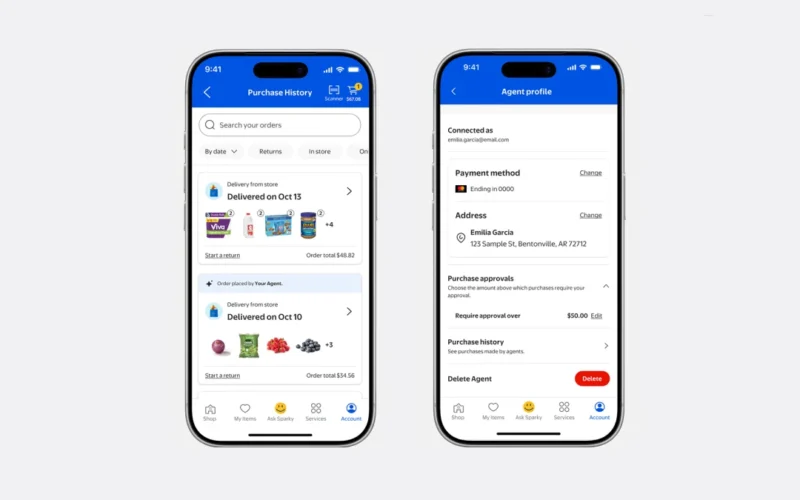
Walmart wants AI agents to shop for you. On October 21, it announced Agent Profiles, an MCP-based Agent Gateway and terms for agents that buy on a customer’s behalf. An agent gets its own profile, a spending limit you choose, and a separate receipt.
The details are thinner than the pitch. Profiles arrive “in the next month.” The gateway is a developer beta. Walmart has not published documentation, a launch date, an approved-agent list or commercial terms.
A shopping agent is not a chatbot with a checkout button. It needs identity, permissions, idempotent orders, tax and substitution rules, returns and a paper trail. Walmart described the policy layer. The engineering layer is still a promise.
What Walmart actually announced
Agent Profiles are the consumer piece. An agent currently signs in with the customer’s account, so its orders look like the customer’s. Now Walmart creates a profile the first time an agent shops through the gateway. The customer links it by signing in, sets a limit and can delete it later. Walmart says only Walmart sees the link.
Approval is the default. Customers can approve every purchase, or let the agent buy within a limit. Walmart gives $50, $100 and $200 as examples, and may still ask for extra approval below the cap.
The Agent Gateway is the developer piece. It is an MCP server, so approved agents can search inventory and place orders through tools rather than click through a human site. Walmart says it starts as a developer beta and can find a customer’s usual items without exposing their purchase history.
The terms cover Walmart and Sam’s Club. Returns apply, including when an agent does not act as intended. Agents cannot go beyond the shopper’s request, see card numbers or change payment methods. They can access only the data a task needs. Walmart can block agents that break the rules.
The developer beta is missing the developer part
Walmart has not published the MCP tool schema, authentication flow, sandbox, rate limits, error model, webhook events or certification process. It has not said whether it will charge for orders, leads or API calls, or named the first agents.
The release also calls MCP “model text protocol.” MCP is the Model Context Protocol, the open standard Anthropic introduced. A naming slip is a signal: this reads like a corporate announcement, not a developer launch.
A correct MCP server still does not solve commerce. The hard parts are order idempotency, price parity, tax, delivery promises, substitutions, age-restricted items, cancellations, returns and dispute evidence. A tool that adds an item to a cart is easy. A tool that completes a $200 grocery order without duplicate charges is not.
The data-minimisation promise needs a precise contract. If the gateway returns usual items without sharing history, what does the agent receive? SKU IDs, a ranked list, a token or an explanation? Developers cannot build a reliable interface from a blog paragraph.
Walmart vs Amazon vs Shopify
Amazon keeps outside shopping agents off its store. It blocked Meta’s Muse in September, saying Meta did not disclose the access, the agent did not identify itself and it appeared to capture customer credentials, GeekWire reported. Amazon says third-party agents should operate openly and respect a merchant’s decision to participate. It is also building its own shopping agent.
Shopify went the other way. It already offers a hosted MCP server, and on September 28 added WebMCP tools for checkout. Browser agents can read and update checkout, then submit after buyer confirmation, handing control back for 3D Secure. Shopify says they work without a new API or merchant configuration. Its agentic storefronts are active by default for eligible stores, while direct checkout settings vary by plan and channel.
Walmart sits between them: more open than Amazon because it wants approved agents to transact, more controlled than Shopify because every agent needs a Walmart profile and a customer budget. The question is who owns the customer record, payment authority and dispute.
| Platform | Agent access | Protocol | Buyer controls | Status |
|---|---|---|---|---|
| Walmart | Approved agents through Agent Gateway | MCP | Separate profile, approval or spending cap | Developer beta; profiles due within a month |
| Amazon | Blocks unapproved third-party agents | No open shopping-agent gateway announced | Customer account only | Meta’s Muse blocked in September |
| Shopify | Eligible stores, including browser agents | MCP, WebMCP and Universal Commerce Protocol | Buyer confirmation and 3D Secure handoff | WebMCP checkout live since September 28 |
The $50 cap is a product decision, not a security proof
A cap limits damage after an agent goes wrong. It does not stop the agent choosing the wrong product, shipping to the wrong address or ordering 12 cases of milk within the cap. Returns are the backstop, but they create work and cost.
The separate profile matters more. It gives customers a per-agent audit trail and a kill switch. That beats letting an agent borrow the login and disappear into order history. It also lets Walmart block an agent without closing the customer’s account.
Are limits per order, day or month? Can a subscription exceed the cap? What happens when an agent splits a basket into three orders? Does the cap include tax, tips and delivery fees? Walmart does not say. These are normal grocery cases, not edge cases.
Prompt injection is the other gap. A product page, review or seller message can try to steer an agent. A cap does not stop that. Neither does a returns policy. The gateway needs server-side rules that ignore model instructions, validate every line item and require fresh approval when the basket changes materially. Walmart’s terms hint at this. They do not show the implementation.
Agent identity is unresolved too. A profile works only if Walmart can verify which agent is acting, which version is running and which permissions it holds. That is the problem the Poppy agent protocol work is trying to solve. Walmart’s profile is merchant-specific, not portable.
What is confirmed and what is not
| Claim | Status |
|---|---|
| Announced October 21, 2026 | Confirmed by Walmart |
| Agent Profiles launch “in the next month” | Target, not a date |
| Limits of $50, $100 or $200 | Examples, not fixed tiers |
| Agent Gateway is an MCP beta for companies and developers | Confirmed |
| Approval by default, with extra checks possible inside a limit | Confirmed |
| Returns apply; agents cannot see card details or change payment methods | Confirmed |
| Exact date, public docs, SDK, sandbox and fees | Not confirmed |
| First approved agents and enforcement method | Not confirmed |
| Whether limits are per order, day or month, and whether tax and fees count | Not confirmed |
| Search ranking and sponsored products in agent results | Not confirmed |
| India or other international availability | Not announced |
What it means for Indian developers
For Indian teams building agents for US commerce, the model call is not the moat. The integration is: merchant-specific authentication, consent, order state, returns and audit logs. MCP makes the transport standard. It does not make the business logic portable.
Watch three things: a real sandbox and schema, Agent Profiles becoming an API other merchants copy, and support for server-to-server agents. Those decide whether this is a developer platform or a partnership programme.
Indian ecommerce teams are good at operations-heavy software: reconciliation, fraud checks, returns and support tooling. Agentic checkout needs all four. Adding a product to a cart is easy. Explaining why an order was placed, who approved it and how to reverse it is the product.
Do not copy the cap-only model. A budget is necessary, not sufficient. Build per-merchant rules, item allowlists, velocity limits and a human handoff for risky baskets. A merchant will ask for that before giving an agent access to inventory. The same lesson appears in broad browser permissions and the OpenAI model spending test ETH. Broad permission is easy to grant and hard to audit.
The bottom line
Walmart has the right direction. Browser automation is brittle, and a merchant-owned gateway is cleaner than letting a model click through a human checkout. Approval, separate profiles and returns are the right first controls.
But this is a framework, not a shipped platform. There are no public docs, sandbox, pricing or named partners. Until those appear, the $50 cap is the most concrete thing Walmart has given buyers. The real test is whether the gateway can complete an order without duplicates, leaks or a support ticket.
FAQ
What is the Walmart Agent Gateway?
It is an MCP server that lets approved agents search Walmart’s inventory and place orders. Walmart says it starts as a developer beta. It has not published the tool schema or a start date.
When will Agent Profiles launch?
Walmart says “in the next month” from October 21, 2026. It has not given an exact day. The profile is created the first time an agent shops through the gateway, then linked to the customer’s account.
Can an agent spend without asking me?
Only if you allow it. Purchases need approval by default. Customers can set a limit instead, with $50, $100 and $200 as examples. Walmart may still require extra approval within that limit.
Does Walmart give the agent my purchase history?
Walmart says the gateway can find a customer’s usual items without sharing their broader history. It has not published what the agent technically receives. The agent provider’s privacy policy covers what the customer shares.
Is this available in India?
Walmart has not announced an India launch or international timeline. The announcement covers Walmart and Sam’s Club and a developer beta. Indian teams can build for the protocol, but cannot assume access yet.