SK Hynix’s $28B Nasdaq Listing: A Bright Spot Inside Korea’s Bear Market
SK Hynix’s $28B Nasdaq listing surged 13% on debut despite a Korean bear market. Discover what this split reveals about global AI memory demand.
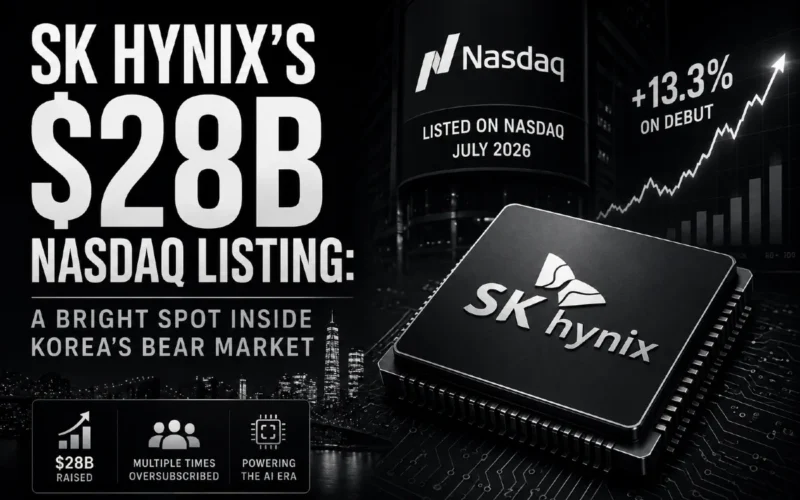
SK Hynix’s $28B Nasdaq listing emerged as a bright spot inside Korea’s bear market recently. The company raised massive capital while its domestic shares struggled alongside the broader Kospi index. However, U.S. investors responded enthusiastically to the American Depositary Receipt offering. Shares jumped over 13% on debut after strong bookbuilding demand. This event proves that falling stock prices do not always signal business failure.
Details of SK Hynix’s $28B Nasdaq Listing
The timing was dramatic for SK Hynix’s $28B Nasdaq listing. Korean shares dropped 10% in one week during the sale process. Yet, U.S. orders covered the offering multiple times before pricing. The stock debuted at $149 per ADR and raised roughly $26.5 billion. Therefore, it trades at about 5.8 times forecast earnings. This valuation is cheaper than U.S. peer Micron Technology. Investors seeking discounted AI memory exposure found this gap attractive.
CEO Warns of Memory Chip Shortage
CEO Kwak Noh-jung issued a striking warning alongside the listing. He predicts the worst global memory chip shortage in years by 2027. Demand will likely outstrip supply for another decade despite planned expansions. This bullish message contrasts with recent stock drawdowns. SK Hynix supplies high-bandwidth memory for Nvidia AI systems. Furthermore, the company is evaluating new U.S. fabrication sites. These actions show confidence in long-term AI growth rather than a slowdown.
Why Korean Shares Fell Despite Strong Fundamentals
Why did domestic shares fall if the business remains strong? The answer lies in market structure rather than company performance. Samsung and SK Hynix dominate the MSCI Korea Index. Consequently, U.S. semiconductor sentiment heavily impacts the entire Kospi. Leveraged single-stock ETFs also intensify one-sided trading volatility. Regulators have flagged these products as risks for short-term swings. We explained this dynamic in our analysis of why the Kospi crashed 25% from its peak.
Implications for AI Memory Investors
A pricing split now exists between global and domestic investors. U.S. buyers saw value in the fresh entry point and discount. Meanwhile, Korean markets sold off due to concentration and leverage. Both reactions can be true simultaneously. Short-term price action reflects market structure issues. However, the CEO’s warning highlights genuine multi-year demand. Capital spending on AI memory has not slowed down. This aligns with our findings that AI compute demand shows no signs of slowing despite chip stock jitters.
Related Reading
