India Ordered GitHub to Kill BitChat. It Didn’t Work.
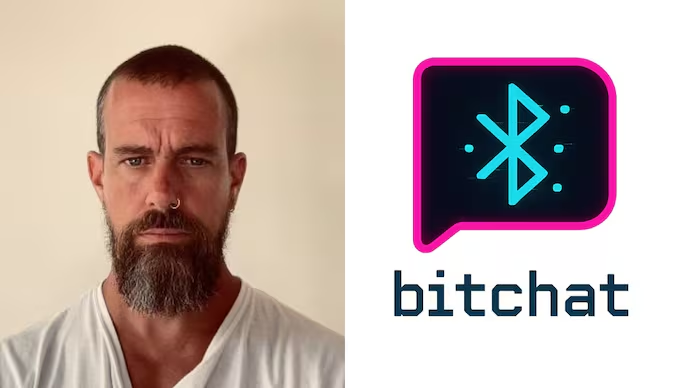
India’s government issued a BitChat GitHub takedown notice on the night of July 23, 2026 — and by the following morning, the app was still running on every major app store. That gap between intent and outcome is the real story here.
The Indian Cyber Crime Coordination Centre (I4C), operating under the Ministry of Home Affairs, sent Notice No. 11072601011432 to GitHub at 11:16 PM, demanding the platform disable three repositories under the permissionlesstech account within three hours. The repositories included BitChat’s main source code, its Android build, and the Android releases page. Authorities cited Section 79(3)(b) of the IT Act, 2000 and Rule 3(1)(d) of the IT Intermediary Guidelines, 2021.
The next morning, Jack Dorsey posted the notice on X. His caption was blunt: “The Government of India does not like technologies like Bitchat and wants it taken down.”
What Is BitChat and Why Did Delhi Protesters Use It
BitChat is a fully open-source messaging application that Dorsey first released in July 2025 as a weekend experiment in low-level networking. Unlike WhatsApp, Signal, or Telegram, it requires no internet connection, no phone number, and no central server. Instead, it uses Bluetooth Low Energy (BLE) to link nearby phones directly, forming a mesh network that relays encrypted messages from device to device across multiple hops.
The design also has a Bitcoin dimension: BitChat can relay BTC transactions offline through the same mesh, passing them between phones until one device with connectivity broadcasts them to the network. However, in the context of the Delhi protests, it was the censorship-resistance — not the payments layer — that drove adoption.
Since July 20, 2026, student protesters under the banner of the “Cockroach Janta Party” have staged some of India’s largest demonstrations in years, primarily at Delhi’s Jantar Mantar. Authorities responded by intermittently suspending mobile internet services around protest sites. Consequently, protesters downloaded BitChat and similar Bluetooth mesh apps to keep coordinating after the mobile data cut. The takedown notice followed directly from that sequence of events.
Why I4C Chose the Wrong Legal Instrument
India’s Internet Freedom Foundation condemned the move as “unconstitutional and authoritarian.” Their concern is not merely political — it is procedural. Before 2021, the government typically relied on Section 69A of the IT Act and the 2009 Blocking Rules when it wanted content removed nationwide. Those rules carry explicit procedural safeguards, including reasoned written orders and an opportunity for the affected party to respond.
Section 79(3)(b), by contrast, is an intermediary liability provision. It governs when platforms lose their legal safe harbor from prosecution — it was not designed as a content-removal tool. Mishi Choudhary, founder of digital rights group SFLC.in, told TechCrunch that the legal provisions cited do not clearly authorize authorities to seek the removal of an entire software project based on how it works architecturally, rather than any specific illegal content within it.
Furthermore, the notice does not identify any specific posts, messages, or illegal material hosted in the repositories. It targets the technology itself, on the grounds that its design — decentralized, log-free, account-free — impedes lawful interception and criminal investigation. That argument sets a troubling precedent: any encryption or anonymization architecture could, by the same logic, be framed as an obstruction of justice.
GitHub Did Not Confirm Compliance. The App Stayed Up.
As of July 24, GitHub had not publicly confirmed whether it complied with the three-hour deadline. The repositories remained accessible from India, and BitChat stayed available on both the Apple App Store and Google Play through the following day. GitHub pointed reporters to its public repository of government takedown requests, which did not include any recent entries related to BitChat.
This outcome exposes a structural problem with the government’s approach. Deleting a repository removes one copy. Open-source code, almost by definition, exists in many copies simultaneously — forked across thousands of personal accounts, mirrored on independent hosts, archived by automated tools. The BitChat codebase was already forked widely before the notice was issued. Removing the canonical repository does not remove the software.
Namrata Maheshwari, Asia Pacific policy manager at Access Now, made an equally important point: blocking an offline messaging platform during an internet shutdown risks converting a connectivity restriction into a complete communication blackout. Protesters in any democracy retain the right to communicate privately and to coordinate peacefully — rights that do not disappear when mobile data does.
The Pattern Goes Beyond India
This episode fits a broader pattern. BitChat download spikes have followed protest events in Indonesia and Nepal over the past several months, each time as a direct response to internet restrictions or social media bans. The app has, essentially, become a bellwether for state-internet tensions: wherever governments cut connectivity, BitChat downloads surge.
That dynamic is precisely why the I4C notice will not achieve its objective. The more aggressively governments attempt to suppress decentralized mesh tools, the more politically salient those tools become — and the faster adoption spreads. India’s notice, shared by Dorsey to a global audience, functioned as free advertising for the very technology it sought to eliminate.
India’s handling of this case also sits uncomfortably beside its broader digital governance ambitions. The government has invested heavily in positioning India as a global technology hub, with policies supporting domestic chip manufacturing, AI investment, and satellite internet rollout. Ordering the removal of an open-source communication tool — via a legally questionable notice, with a three-hour deadline, in the middle of the night — undercuts that narrative in a single stroke.
As the global debate over AI regulation and digital rights intensifies, the BitChat episode is a case study in what happens when governments try to shut down technology they do not control. The answer, it turns out, is that the technology keeps running — and governments are left explaining why they tried.
Frequently Asked Questions
What is BitChat?
BitChat is an open-source, decentralized messaging app created by Jack Dorsey. It uses Bluetooth Low Energy (BLE) mesh networking to relay encrypted messages between nearby phones without requiring any internet connection, mobile data, phone number, or central server.
Why did India order BitChat’s GitHub repositories removed?
India’s I4C cited the app’s decentralized, log-free architecture as an impediment to lawful interception and criminal investigation. The order came after protesters in Delhi used the app to communicate during mobile internet shutdowns at protest sites.
Did GitHub comply with the Indian government’s BitChat takedown notice?
As of July 25, 2026, GitHub had not publicly confirmed compliance. The repositories remained accessible from India, and the BitChat app continued to be available on both the Apple App Store and Google Play Store.
Is the Indian government’s notice legally valid?
Digital rights groups including the Internet Freedom Foundation and SFLC.in argue it is not. They contend that Section 79(3)(b) of the IT Act, the provision cited, is an intermediary liability tool — not a content-removal authority — and that the proper legal channel would have been Section 69A and the 2009 Blocking Rules, which carry procedural safeguards.
