McDonald’s Is Sued for Allegedly Using an AI Pricing Engine to Fix Menu Prices Across 14,000 US Restaurants
Michael Thomas's proposed class action, filed Oct 2 in Chicago, says McDonald's pricing engine and a 30% rule turned rival franchisees into price-fixers. McDonald's says franchisees set prices.
McDonald’s is facing a proposed nationwide class action in federal court in Chicago that says its AI pricing engine quietly turned thousands of competing restaurants into one price-setting club. The 31-page complaint, filed on October 2 by Illinois customer Michael Thomas, calls it “algorithmic price-fixing aimed at customers who are already stretched thin.”
McDonald’s rejects that. A day before the suit landed, the company posted a page titled “Separating Fact from Fiction: AI Does Not Set Prices at McDonald’s”, saying its tool only makes recommendations and franchisees decide what to charge.
The story was trending on Google in Australia on Thursday, and it matters well beyond burgers. This is one of the clearest tests yet of whether a shared pricing algorithm can count as an illegal agreement between businesses that are supposed to compete. Here is what the filing actually says, what McDonald’s says, and what is still only an allegation.
What the lawsuit claims
The case is Thomas v. McDonald’s USA, LLC, case 1:26-cv-12149 in the US District Court for the Northern District of Illinois. The defendants are McDonald’s USA, LLC and McDonald’s Corporation. Thomas is represented by Clarkson Law Firm.
One correction to some early coverage: this is a private lawsuit. No prosecutor or government agency has brought a case.
The core argument is simple. About 95% of the roughly 14,000 US McDonald’s restaurants are owned by independent franchisees, and McDonald’s own franchise documents say those restaurants compete with each other and with company-run stores. Competitors must set prices independently.
The complaint says that since at least 2019, McDonald’s has run a centralized machine-learning “pricing engine” that takes in data from millions of daily transactions, including franchisees’ confidential sales data, and produces recommended prices for individual items at individual restaurants. It argues that when rivals all feed private data into one engine and follow its output, that is price-fixing under Section 1 of the Sherman Act.
Thomas, who lives in DeKalb, Illinois, says he usually orders a Quarter Pounder with cheese, fries and a Coke, and has paid different prices for the same items at stores close to each other. He wants to represent everyone in the US who bought from a McDonald’s restaurant, plus an Illinois subclass, and is asking for treble damages and an injunction.
The 30% rule at the center of the case
The most specific allegation is what the complaint calls the “30% rule.” Citing a September 29 Reuters investigation, it says the engine recommends raising prices on items that have already gone up in at least 30% of stores.
The complaint’s own one-line summary: “whether a franchisee is told to raise a price depends on whether its competitors already did.” That is the part that turns a generic analytics tool into an antitrust problem, at least in the plaintiff’s telling.
The filing also says the tool flags how price sensitive a store’s customers are, with warnings such as “Your restaurant is showing MEDIUM SENSITIVITY to Price,” and that the pricing portal’s own terms warn users they “may be competitors of each other” and must follow antitrust law. Reuters quoted former FTC Commissioner William Kovacic calling that disclaimer “an acknowledgment there’s a potential problem.”
On whether franchisees really have a choice, Reuters reported that five store owners said McDonald’s pressured them to use the AI tools. Since January, McDonald’s business standards have required franchisees to be “constructively engaging with McDonald’s approved Pricing Consultant and Tools.” The complaint also says Reuters’ sources named Tiger Analytics as the firm that runs the tool, and Deloitte as one of the companies that helped design it. Neither is a defendant.
What McDonald’s says
McDonald’s response is blunt. Its October 1 page says: “AI does not set the price of a Big Mac or any other menu item. It does not change prices. And it does not determine what an individual customer pays.”
The company says it does not use dynamic pricing, that the tool does not change prices in real time or by hour, and that it looks at restaurant-level market conditions, not individual customers. “A recommendation is exactly that: a recommendation, not a mandate,” the page says. “Franchisees are not required to accept a pricing recommendation.”
After the suit was filed, a McDonald’s spokesperson told The Guardian the “complaint is filled with inaccuracies and we will vigorously defend against this lawsuit,” adding that its optional tools “do not automate, coordinate or fix pricing in any way.”
Confirmed, alleged and disputed
| Claim | Status | Source |
|---|---|---|
| A proposed class action was filed on Oct 2, 2026 in N.D. Illinois | Confirmed | Court docket |
| McDonald’s offers franchisees a pricing recommendation tool | Confirmed | McDonald’s Oct 1 statement |
| The tool pools franchisees’ nonpublic sales data | Alleged | Complaint, citing the franchise disclosure document and Reuters |
| A “30% rule” ties price rises to rival stores | Alleged | Complaint, citing Reuters |
| Franchisees are pressured to follow the tool | Disputed | Reuters sources say yes; McDonald’s says it is not a mandate |
| AI sets menu prices | Denied | McDonald’s says people make final pricing decisions |
| The arrangement broke antitrust law | Unproven | No ruling yet |
Why “it is only a recommendation” may not end the argument
McDonald’s main defense is that franchisees keep the final say. The plaintiff saw that coming. The complaint quotes a 2025 US Department of Justice statement of interest in a separate Chicago case saying that “any formula used to fix benchmark, component, recommended, or ‘starting point’ prices” can violate the Sherman Act “even if end prices ultimately vary.”
It also leans on executives’ own words. According to the complaint, CEO Chris Kempczinski told investors on August 4 that franchisees who were “not complying” with the pricing program saw softer results. At the September 23 Investor Day, an executive described the engine as giving “pricing recommendations down to the restaurant and item level.”
The weak spot for the plaintiff is the “rim” of the conspiracy. Shared software alone is not illegal. To win a per se price-fixing claim, Thomas likely has to show the franchisees agreed with each other, not just that each one signed up with McDonald’s. A judge has not weighed in on any of this yet.
The price numbers both sides point to
Expect a fight over what the pricing data actually shows. The two sides are not even using the same yardstick.
| Figure | Value | Who says it |
|---|---|---|
| Average US Big Mac price, 2019 | $4.39 | McDonald’s USA president Joe Erlinger, May 2024 |
| Average US Big Mac price, 2024 | $5.29 (up 21%) | Erlinger, May 2024 |
| Average menu price rise, 2019 to 2024 | About 40% | Complaint, citing a May 2024 McDonald’s fact sheet |
| Viral Darien, Connecticut Big Mac meal (2023) | $18 | Complaint; Erlinger called it an exception |
In his 2024 open letter, Erlinger blamed inflation and wrote that franchisees “set menu prices for their restaurants.” The complaint argues the same years line up with when the pricing engine was in use. A price rise on its own proves nothing about collusion, so this will come down to how the tool worked and how closely stores followed it.
What it means for Indian developers
The lawsuit only covers purchases in the US, so it does not touch McDonald’s restaurants in India. The engineering lesson travels much further.
Tiger Analytics, the firm Reuters’ sources linked to running the tool, is headquartered in Santa Clara, California, but its leadership has said a large part of its workforce is in India, with Chennai as a major hub, and that India supports its global clients “in a significant way.” The company also lists offices in Bengaluru and Hyderabad.
If you build pricing or revenue management models for clients, the design questions in this complaint are worth taking seriously:
- Does the model train on confidential data pooled from businesses that compete with each other?
- Does any rule make one customer’s price change depend on what rival customers already did?
- Are users tracked or penalised for ignoring the recommendation?
The complaint itself suggests the safer path: tools that “do not pool franchisees’ confidential data, do not condition price increases on other stores’ increases, and do not tie compliance to franchise standing.” That is a useful checklist for any AI pricing product. Our earlier piece on Meta employees suing over an AI-driven layoff algorithm shows the same pattern: once an algorithm shapes money decisions, the people affected go to court.
What happens next
The docket so far shows only the complaint, a civil cover sheet and a lawyer’s appearance filed on October 3. McDonald’s has not filed a formal response in court, and no class has been certified. A motion to dismiss would be the usual next step.
The case also lands while big companies are under pressure to explain their AI choices in public, a theme we covered in Microsoft AI chief Mustafa Suleyman’s shifting jobs forecast, and while lawsuits like the publishers’ case against Google over Gemini test other AI business models. Whatever happens here, McDonald’s has already done something unusual for a fast food chain: it published a public explainer on how its AI does not work.
FAQ
Is McDonald’s using AI to set menu prices?
McDonald’s says no. It says its tool gives restaurant-specific recommendations and franchisees decide prices. The lawsuit says the tool, pooled data and pressure to comply add up to coordinated pricing.
Who filed the McDonald’s AI pricing lawsuit?
Michael Thomas, a McDonald’s customer from DeKalb, Illinois, represented by Clarkson Law Firm. He filed it on October 2, 2026 as a proposed class action.
What is the 30% rule?
According to the complaint, which cites Reuters, the engine recommends raising an item’s price once it has already gone up in at least 30% of stores. McDonald’s has not confirmed that rule.
Does McDonald’s use dynamic pricing?
McDonald’s says it does not. Its October 1 statement says the tool does not change prices in real time or by time of day and does not price individual customers.
Does the lawsuit affect McDonald’s customers outside the US?
No. The proposed class covers people who bought from McDonald’s restaurants in the United States, with a separate Illinois subclass.
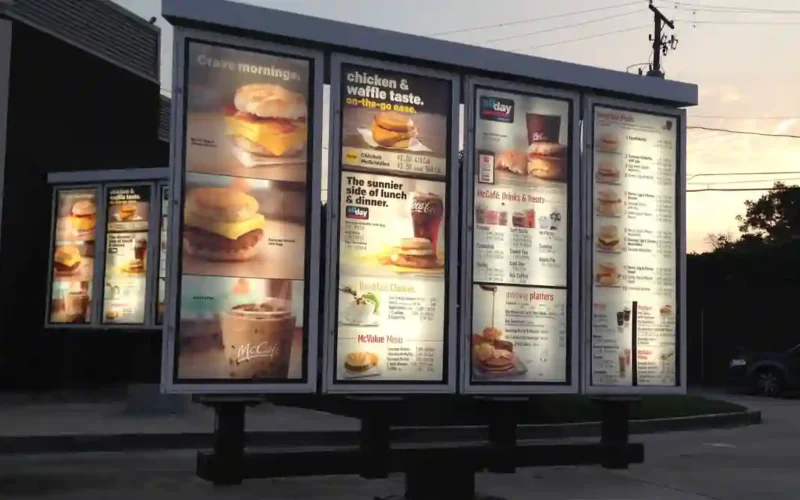
Featured image: McDonald’s drive-thru menu board in Logan, Ohio, by dankeck via Wikimedia Commons, CC0.